


Gin Rummy is a two-player card game created in the early 20th century that has a simple goal: improve your hand by forming combinations and, at the end, tally up how many points you've earned. You can play it live with another person, and all you need is a 52-card deck, a notepad and a pen to keep score.
Below, you’ll find a simple guide for the game of Gin Rummy. We’ll break down the rules and scoring, topping it off with the key terms so you never get lost while playing.
What Is Gin Rummy?
Gin Rummy – the game of choice of poker legend Stu Ungar before he made the switch – is a two-player card game created in 1909 by Elwood T. Baker and his son C. Graham Baker. It's a variant of Rummy that became hugely popular in the mid-20th century.
The game uses all 52 cards in the deck, ranked from King at the top down to Ace at the bottom. You play over multiple rounds, scoring as you go. The first player to hit the points target wins. Most people play to 100.
Melds, Deadwood & How Gin Rummy Works
The whole game comes down to improving your hand by putting together melds. A meld is either three or four cards of the same rank, like 8-8-8 or K-K-K-K, or a run of three or more consecutive cards of the same suit (like 3-4-5 of hearts). On top of that, players try to get rid of low-value cards that don't easily contribute to any combination – this is known as deadwood.
For instance, an Ace of spades is only worth one point and can only form a run starting from A-2-3. Unlike in poker, the Ace is always low in Gin Rummy, so runs don't wrap around from King to Ace.
It’s also worth noting that the same card cannot be used in two different melds. For example, if a player is holding 8-8-8-9-10 with the 8, 9 and 10 of diamonds, that 8 must either go into the set of three 8s or the diamond run from 8 to 10, not both.
How to Play Gin Rummy
Each player gets ten cards. Once the deal is done, the top card from what's left of the deck gets flipped face up next to the stockpile. That's your discard pile.
First turn of the round, the non-dealer looks at that face-up card and decides whether to take it or pass. If they pass, the dealer gets the same choice. If nobody wants it, the non-dealer has to pick it up anyway and swap it for something from their hand, tossing that card onto the discard pile. After that first turn, both players take turns, and each can choose to draw a card from the stockpile (face down) or from the discard pile (face up).
You keep going until someone calls 'knock' or 'gin', or the stockpile gets down to two cards. If it's that last one, the round is a draw, and nobody scores.
Key Gin Rummy Terms: Knock, Gin & Undercut
There are a few words in this game's vocabulary we need to go over. Knowing these terms is essential, since they come up without exception in every game of Gin Rummy you'll ever play.
Knock
If a player's deadwood cards (cards that don't form any meld) have a combined value between 0 and 10, they can announce "knock" and reveal their hand, putting an end to that round. When this happens, the other player can choose to lay off deadwood cards from their own hand onto the knocker's melds, if any of them fit. A player is never required to knock just because their deadwood is below 10 – it's always optional.
Gin
If all 10 cards in a player's hand form melds, meaning they have zero deadwood, that player can announce "Gin", ending the round immediately. That player receives a 20-point bonus straight away.
Undercut
Though rarer, there's a third situation worth knowing about: the undercut. If the player who knocked has deadwood of greater value than their opponent's deadwood, an undercut occurs. When this happens, the opponent of the player who knocked receives 10 points plus the difference between their deadwood values.
Gin Rummy Scoring
Cards | Value |
Face Cards (K/Q/J) | 10 Points |
2-10 | Face Value (E.G - an 8 is worth eight points) |
Ace | 1 Point |
Once a round ends, whether through knock or gin, it's time to work out how many points are awarded. Remember: only one of the two players scores in each round.
If these values look familiar, it's because they work in a similar way to blackjack card values, though the Ace plays a slightly different role there.
Scoring After a Knock
When a player knocks, their score is calculated by taking the value of the opponent's deadwood and subtracting the knocker's own deadwood value.
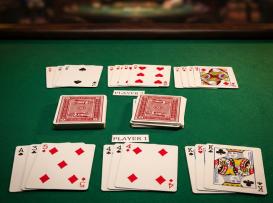
Example: Player 2 announces "knock". Their hand has three unmatched cards (A♦ 2♣ 2♠), worth 1 + 2 + 2 = 5 points. Player 1 also has three deadwood cards (A♠ 3♣ 5♦), worth 1 + 3 + 5 = 9 points. Player 2 scores 9 − 5 = 4 points.
Scoring After Gin
When a player announces Gin, their opponent's deadwood value is added to their score on top of the 20-point bonus that making gin guarantees.
Example: Player 2 announces "Gin" and the opponent’s deadwood cards are 5♣ 3♦ 3♣ A♠. They receive 12 points from the opponent's deadwood (5 + 3 + 3 + 1) plus the 20-point gin bonus, totalling 32 points for that round.
Scoring After an Undercut
When an undercut occurs, the opponent of the player who knocked receives 10 bonus points plus the difference between the two deadwood values.
The game ends as soon as either player reaches the predetermined point total (usually 100).
Gin Rummy Variants
There are plenty of variants of this game that branch off a bit from the original. Straight Gin, Oklahoma Gin and Hollywood Gin are the main ones.
- Straight Gin – There's no knock. You have to play until someone makes Gin, which means you'll play longer and more intense rounds.
- Oklahoma Gin – The value of the card flipped to start the discard pile defines the maximum deadwood value allowed when knocking on that round. If you flip a 4, you can only knock if you have 4 or fewer deadwood points. It makes each round different.
- Hollywood Gin – Same rules, different scoring. Players register three games simultaneously, and the first gin or knock counts towards game 1, the second towards games 1 and 2, and the third onward towards all three. It's a quicker game.
Looking for card games with a casino twist? Check our guide on how to play blackjack!
Gin Rummy FAQs
How many cards do you deal in Gin Rummy?
Ten cards to each player.
What's the difference between Knock and Gin?
When you knock, you still have some deadwood (up to 10 points' worth), and your opponent gets to lay off cards onto your melds. Gin means all 10 cards form melds, so your opponent can't lay off anything, and you get a 20-point bonus.
Can you use the same card in two melds?
No. Each card can only belong to one meld.
What happens if neither player knocks or calls gin?
If the stockpile gets down to just two cards without anyone knocking or declaring gin, the round ends in a draw and no points are scored.
How do you win at Gin Rummy?
Be the first player to reach the agreed-upon score, usually 100 points.
