



Video slots use a random number generator (RNG) to determine every spin. They pay out winners at less than true odds, and that's where the house edge lives. Paylines, bonus rounds, symbol distribution – there's a lot going on under the hood that most players never look at.
That’s the kind of stuff that actually changes how you pick a game.
How Video Slots Work: The Random Number Generator
At their cores, modern slot machines with mechanical reels and video slots work the same way. Numbers selected by a random number generator are translated into the symbols you see on the reels. What you see on video screens is a user-friendly representation of the game being played on the RNG.
Random number generators are close enough to truly random that players can't discern any repeating patterns, and the long-term percentages are those you would expect from randomly occurring outcomes.
Because the reels and symbols don't exist in a physical sense, there is no need to keep reel strips small enough to fit inside a machine casing. If the programmer needs the reel strip to be 100, 500 or 1,000 symbols long to yield the optimal number of combinations, that can be done. With five reels and large numbers, the number of potential combinations gets very large, very fast. For example, if each of five reel strips has 100 symbols, that's 10 billion possible combinations per payline. That gives designers plenty to work with while accounting for multiple wins per play, scatter pays, bonuses, expanding wilds, and everything else a modern video slot offers.
Paylines and Betting
Slot machine payoffs are built around paylines. In classic three-reel games, the most common configuration is a single line down the centre. When five-reel video slots rose to popularity, the breakthrough games had five paylines. Today, 20-, 25-, 30-, and 40-payline games are all common.
On five-reel video slots, you don't need the winning symbol on every reel. You'll get some return for lining up a symbol on reels 1, 2 and 3, with bigger payoffs if that symbol also appears on the same payline on reels 4 and 5. On some games, top-paying symbols even bring a small return with only two matching symbols starting from the left.
Multiple paylines also mean you can win on more than one line on a single spin. This opens up possibilities for game designers: very frequent small wins can yield a low-volatility game that keeps you playing longer, while putting more of the return into bigger pays can yield higher volatility with a better shot at larger wins – but also a faster drain on your bankroll.
In many modern games, particularly penny slots, you're required to cover all paylines. These "forced bet" machines mean you can't bet just one coin. You bet one coin per payline, so a 40-line game requires a minimum 40-coin wager.
One thing worth knowing is that on pretty much every video slot out there, payouts scale with the number of coins you bet per line. A winning combo is just as likely to appear on any payline as on any other. So betting more by covering all lines means spending more, but you're also hitting wins more often. It balances out.
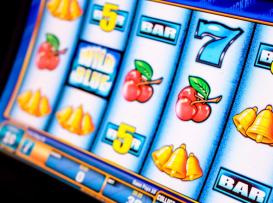
Key Features: Wilds, Scatters and Bonuses
Wild symbols work as matches for any symbol, usually excluding scatter or bonus symbols. When a wild lands in a winning combo, it steps in as whatever symbol gets you the best pay. Some games take it further with expanding wilds, where one wild symbol grows to fill every position in its column. That can set off wins across several paylines from a single spin.
Scatters work differently. They don't need to sit on any specific payline. Land three or more of them anywhere on the reels and you either get a payout or kick off a bonus event. Doesn't matter where they show up.
Bonus events are a prime attraction on nearly all video slots. They can take the form of free spins, pick-a-prize events, wheel spins and more. Their impact on the game is significant – on many games, roughly a third of the total payback comes from bonuses. A game that returns 90 per cent overall might return only 60 per cent on the base game, adding 30 per cent through bonus rounds. That can differ from game to game and manufacturer to manufacturer, but it must be accounted for by game designers and programmers.
Beyond Traditional Paylines
Not every video slot sticks with traditional paylines. Aristocrat Technologies came up with something called Reel Power, where you're buying reels instead of paylines. As long as winning symbols show up on adjacent reels from left to right, it counts. Top, middle, bottom, doesn't matter. That opens up 243 ways to win, or 1,024 on versions with four symbols per reel. These tend to be more volatile games.
The idea kept evolving from there. Big Time Gaming built on it with Megaways, in which reel sizes shift with every spin and can create up to 117,649 ways to win. It took off massively and dozens of providers now license the format. Then you've got cluster pays, which throw out paylines altogether. You win when matching symbols land next to each other anywhere on the grid.
Cascading reels brought another twist. After a winning combo pays out, those symbols disappear and new ones drop in from above. One spin can chain into several wins that way. And hold-and-spin games like Lightning Link lock special symbols in place while the rest of the positions respin, giving you a shot at building up to a bigger prize.

Hit Frequency vs. Payback Percentage
When choosing the right game to play, it’s imperative that you know the difference between hit frequency and payback percentage.
Hit frequency is the proportion of spins that pay money to players. Payback percentage is the proportion of total wagers returned to players as winnings. Games with high hit frequencies can have payback percentages higher, lower, or about the same as those of games with low hit frequencies.
Casino industry professionals often distinguish between "entertainment" games and "gambling" games. Entertainment games have high hit frequencies but low jackpot probabilities since they're designed to encourage extended play. Gambling games offer enhanced chances at big payoffs but have low hit frequencies, meaning you can lose money faster when the big wins don't come.
There are useful signposts for telling them apart:
- Slots with large jackpots are often low hit frequency "gambling" games.
- Games with stacked symbols, where you can have big wins on many lines at once, are usually gambling games.
- Games with free spin bonuses as their main event often lean toward gambling games.
- Games with pick'em bonuses as their main event are usually entertainment games.
None of this is set in stone. If a game isn't doing it for you, just move on to another one. Nobody's keeping score.
Video slots look simple enough when you're sitting in front of one, but there's a lot more going on behind every spin than most players realise. The more you understand about how paylines, hit frequency and payback percentage actually work together, the easier it gets to find games that feel right for what you want out of a session.
Video Slots FAQs
Are video slot results truly random?
Yes. Video slots use a random number generator (RNG) to determine every outcome. The symbols you see on screen are a visual representation of numbers already selected by the RNG before the reels stop spinning.
What is the difference between hit frequency and payback percentage?
Hit frequency is the proportion of spins that return money to the player. Payback percentage is the proportion of total wagers returned as winnings over time. A game with frequent small wins can have the same payback percentage as one with rare large wins.
How much of a video slot's payback comes from bonus features?
On many video slots, roughly a third of the total payback comes from bonus events like free spins and pick-a-prize rounds. This means the base game may return significantly less than the advertised overall payback percentage.
What is the difference between entertainment slots and gambling slots?
Entertainment slots have high hit frequencies with frequent small payouts, designed for extended play. Gambling slots offer better chances at large wins but pay less often, meaning your bankroll can drain faster when the big hits don't come.
