My Nana Margaret told me that there were four basic types of roulette players. 

1.  Those players who realize that the house has the edge on every bet during a random game and are therefore negative about the whole thing. They certainly play but they also whine and moan and annoy everyone around them. Nana Margaret would call such types “miserable people.”

2.  Those roulette players who realized that roulette game was an unbeatable game in the long run but enjoyed the opportunity to test Lady Luck. They tend to be upbeat even if they are getting beat. Nana would call these folks the “lights of the party” even if Lady Luck were leading them on.

3.  Those who try to beat the game by attempting to find biased (“hot”) or unbalanced wheels and exploit such opportunities. Nana called these the “Pandora people” and they rely on the last thing that remained in Pandora’s Box (actually a big jar) of evils – hope! Nana says these types are “dogged” and rarely give up. 

4.  Those roulette players who know that in their lifetime, and at the casinos where they play, the chances of beating the modern wheels are remote but such a fact doesn’t bother them. They attempt to use advantage-play systems even in games where they have no advantage. Grandma would call these folks “nutty dreamers” and indeed they are. Nana liked those dreamers as long as they didn’t descend into a nightmare world. Nana would say to me to make her point clear, “Frankie, you can dream all you want but get your butt out there to work.”

Those #1 players, the moaners and whiners, I wish would retire to a knitting society or they could, at the very least, shut up. Players of the #2 stamp are nice people and fun to have dinner with. 

Players #3 and #4 are my focus for this column as they are the individuals who have the best chance, not necessarily to win, but to have a damn good time trying. They are giving the game their best shot which is all Nana would ask of them.

If It’s Hot It’s Hot

Hot numbers

In the heady days before today’s almost super-perfect roulette wheels, some obsessed players would scour the casinos looking for biased wheels with – what we now call – hot numbers displayed. These numbers would be hitting at a frequency that was way beyond the inherent probabilities of the game. 

Such hot numbers contained the hoped-for magical elixir of possibly allowing the player to turn the tables on the casinos and “break the bank” thereby bringing home the casino’s gold. Note: To break a casino’s bank merely means winning all the chips at one table. It does not mean winning all the casino’s chips at all their games. But “break the bank” certainly does sound good.

Of course, to really ascertain whether a wheel had biased numbers the wheel-watcher had to analyze many thousands of spins. Yes, thousands, and some bleary-eyed pursuers of the dream would say tens of thousands of spins had to be catalogued. 

And how does a Roulette wheel actually look like?

Roulette wheel schematic 1

Roulette wheel schematic 2

The advantage player had to hang around the roulette pits recording what was hitting – often day after day after day. (Nana: “They looked like demented stalkers if you ask me.”) That is the kind of dedication a Buddhist monk in the Himalayas exhibits when he is trying to become one with – I am guessing – the oneness.

Playing the Layout versus Playing the Wheel

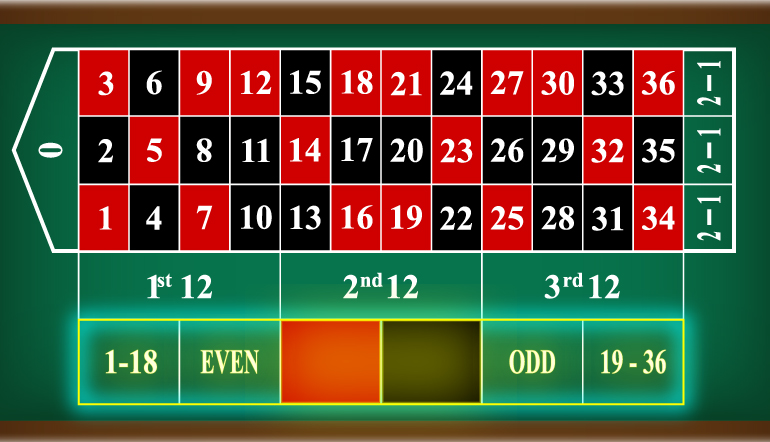
Don’t get confused here. There are two types of betting strategies at roulette. Many roulette players enjoy playing layout strategies; that is, they put their money here and there on the numbers that go in chronological order on the betting layout. You can’t beat roulette just by betting the layout; that game would be random unless you got lucky. 

The only possibility to beat roulette is if you beat the wheel itself. 

The numbers on the wheel are not in chronological order as they are on the betting layout. They are scattered and spaced out in such a way that players who just play the layout will not be able to see if groups of numbers near each other are hitting more than probability would predict. Usually biased numbers hit in small or even sometimes large groupings. But you will only know this if you study the wheel.

“You aren’t going to seduce Lady Luck for very long if you are just a layout kind of guy,” Nana cautioned. 

So to get those hot numbers we have to check out the arrangement of numbers on the wheels. There are different Roulette versions, either playing with the American or European wheel.

First let’s take a look at the American wheel, also known as the double-zero wheel. There are 38 pockets in which the ball can land. Here is the basic layout of the American wheel:

American Roulette wheel illustration

Arrangement of Numbers on the American Wheel

  • There are 38 numbered pockets for the ball to land in, 1-36 and 0, 00.
  • You can see that directly (or almost directly) across from each even number is an odd number. Check out 34 and you will see that it is almost directly across from 33. Then look at 36 and it is across from 35. 
  • The numbers 18 and 19 are only separated by the number 33.
  • Pairs of odd numbers alternate with pairs of even numbers except in the areas of the 0, which splits 2 and 28, and 00 which splits 27 and 1.
  • The colors of the numbers are irrelevant to hot number play.

Something that makes our European friends happy, the best wheels are known as the French or European single-zero wheels.

European Roulette wheel illustration

Arrangement of Numbers on the French or European Wheel

  • There are 37 numbered pockets for the ball to land in, 1-36 and 0.
  • Some of the positions of the numbers are similar to the American wheel with an odd number being directly across from an even number such as 27 across from 28 but this does not prevail throughout the wheel.
  • The colors of the numbers are irrelevant for hot number play.

Hot Numbers Have to Overcome the House Edge

Now, let’s just look at the American wheel. The probability of any one number coming up is one in 38; the odds are therefore 37 to one. The payout is 35 to one. The house edge is 5.26 percent because of the short payout of a winning wager.

On the French or European wheel there are 37 numbers with a probability of one number coming up one time in 37 spins; the odds are 36 to one. The (short) payout is the same 35 to one and the house edge is 2.70 percent – a far better bet than on the American wheel. 
Each spin of the Roulette wheels is independent, so the Roulette odds of winning don’t change based on the results of the previous spin.

Yes, the player looking for a bias must be able to overcome that house edge – not an easy thing to do. 

In any short term analysis of random numbers there will be wild streaks all over the place. Some numbers will get hot; some will be cold; some will go back and forth. That’s why you need a lot of decisions to study so you know you are dealing with a real bias as opposed to, as Nana said, “the usual madness of randomness.” (I know, I know, it was bad enough that you had to study in school, now you have to study roulette spins! Hey, life isn’t fair.)

So What is a Hot Number?

If us take 3,800 and 3,700 spins for the American and European wheels respectively, we can figure out what would be strong biases and weak biases. I have rounded the numbers on this chart (“because no one likes fractions Frankie” – Nana Margaret).

Roulette hot numbers chart

Now I would probably want to double – at least double – the total number of results to have a good feeling about such a distribution as the above chart but the chart is easy to work with so we’ll work with it.

Let’s take a look at the following numbers on the American wheel and see how often they have hit in 3,800 spins (change units into your monetary equivalent):

Roulette hot numbers chart 2

The above grouping shows some seriously hot numbers. They all appear in one continuous segment of the American wheel. You’ll note that the outside numbers of 5 and 17 are the weakest and those numbers get whatever your minimum bet happens to be. 

The strong “hotties” of 7 and 20 will get 90 percent of your maximum bet. So if 50 units is your highest betting level then you bet 45 units on both of these numbers.  Number 32 is your strongest number and that will get 100 percent of your maximum bet.

The pattern of bets is this:

  • Any number in the excellent category gets a maximum bet. 
  • Any number in the good category gets 90 percent of your maximum bet. 
  • Any number in the fair category gets your minimum bet.

The caution here is that if more than 10 numbers are hot, you might have to reduce your betting levels somewhat in order not to get hammered should you lose some spins in a row. 

The fact is also this: You can bet minimum amounts on all hot numbers to extend your bankroll. There is no hard and fast betting rule. You have to keep your betting reasonable even when you have the edge. Bad streaks occur even in good situations.

You can do the exact same analysis on the French or European wheel and use the same betting method.

More than One Group of Hot Numbers

If you have more than one grouping of hot numbers then you split your betting and obviously spread to all those numbers. Here you would more than likely bet minimum amounts. But you must be sure these groupings are legitimate.

And What about Our Non-Advantage Advantage Players?  

Now what about our #4 players? Those dreamers? Obviously these players are not going to analyze, catalogue and ascertain what is really going on while they play. In fact, they are probably right about not pursuing real hot numbers – it is extremely hard to find realistic hot numbers on the modern roulette wheels. All such streaks are usually just random. (“No kidding,” says Nana.)

However, using the scoreboards at a roulette table which usually list the last 16 or 20 numbers, you pretend that those numbers that have hit more than once are hot. In those casinos that have individual scoreboards that tell you the numbers that have hit on all the wheels, you can go from wheel to wheel betting the repeating numbers.

Can you get an edge this way? No. But, as Nana Margaret says, "Playing this way can give you a sense of pursuing something real even if it is false."

February 17, 2016

By Frank Scoblete

Frank Scoblete
Body

Frank Scoblete grew up in Bay Ridge, Brooklyn. He spent the ‘60s getting an education; the ‘70s in editing, writing and publishing; the ‘80s in theatre, and the ‘90s and the 2000s in casino gambling.

Along the way he taught English for 33 years. He has authored 35 books; his most recent publisher is Triumph Books, a division of Random House. He lives in Long Island. Frank wrote the Roulette strategy guide and he's a well known casino specialist. 

Frank Scoblete
factcheck
Off
hidemainimage
show
Hide sidebar
show
Fullwidth Page
Off

One of the most fundamental concepts of playing casino games to an advantage is the Gambler’s Ruin theory. In its simplest form the Gambler’s Ruin theory deals with how much of a bankroll does and advantage player need, and at what level a players need to size their bets at. It is a necessity for any serious advantage player to master to maximize their win rate while minimizing their risk. At some point during your play, most likely during a prolonged losing streak, you’ll be tempted to over bet your advantage. Doing so can lead to ruinous results. It’s likely the remainder of this article will save you from depleting your bankroll. So let’s get started.

Playing any gambling game to a positive advantage, and specifically the game of 21, leads to what mathematicians call a random walk with an upward drift. What this means is that you will go through a series of losing streaks and a series of winning streaks as the number of hands increases, but the overall trend is a positive upward slope.

The term random walk is an analogy used by mathematicians where you equate the desired result, the EV as the number of events (hands) gets larger and larger, will be realized. The analogy is equated to a drunken individual walking out of a pub and staggering towards the bus stop. He will eventually get their but the path will be twisted one filled with all sorts of bends and slants. The path is not the most direct one.

The take away here is that gambling, even with an advantage involves risk and the player needs to take appropriate precautions to ensure that they don’t bust out. The precautions involve having enough of a bank roll to outlast any negative swings that may occur. Think of it this way. If I paid you two dollars for every heads that came up on a coin flip and you paid me one dollar for every tails that comes up it would be a good bet for you. But you should have more than 5 dollars to wager because you could very easily hit a string of tails that could wipe you out. You have to have enough money to outlast the series of tails that comes up.

The same concepts apply to other games of chance. In blackjack one common method used to determine the players Risk of Ruin is the number of big bets the player has coupled with the percent advantage the player is playing too during those big bets. The following table gives the advantage for two counting systems. The first column gives a 1.75% advantage on a big which is the approximate advantage for a simple 1 level count like the Basic Omega system or the simple Hi-Lo count system. A 2.25% advantage is the approximate advantage for multi level counting system like the Advanced Omega 2 system or the USTON APC system. High efficiency counting systems scale the betting more accurately and more importantly while using the deviations from basic strategy by using the indices you get even more of an advantage. An additional ¼ % is the approximate additional advantage that can be expected from the indices plays.
 

Max BetsChance of Ruin @ 1.75%1 in X ChanceChance of Ruin @ 2.25%1 in X Chance
2548.52%1 in 2.139.46%1 in 2.5
5023.54%1 in 4.215.57%1 in 6.4
7511.42%1 in 8.86.14%1 in 16.3
1005.54%1 in 182.42%1 in 41.2
1252.68%1 in 37.20.95%1 in 105
1501.30%1 in 76.60.37%1 in 265
1750.63%1 in 1580.15%1 in 671
2000.30%1 in 3260.05%1 in 1701
2250.15%1 in 6710.02%1 in 4310
2500.07%1 in 13830.01%1 in 10870
2750.35%1 in 28490.00%1 in 27778

ADDITONAL RISK MANAGEMENT STRATEGY

An additional risk management strategy is to half your bet after losing half your original stake, the overall chance of ruin is reduced to the original risk of ruin multiplied by the square root of the original risk of return. This should not be used as a reason to over bet.

Another consideration is the financial strength of the player. If you have a solid six figure income you can then you afford to not be over conservative with your bankroll. This also influences the overall psychological factors that come into play. As stated earlier there is a tremendous psychological component to advantage gaming. A mental toughness is required to struggle through the negative swings and see it through till the positive expectation is realized.

The Gambler’s Ruin Theory is a key concept to make sure that people do not go bankrupt from playing. It is the way that we find the proper tension between risk and return. If we are too aggressive we increase our chances of going bankrupt, when we are too conservative we leave money on the table and are not maximizing are earning potential. Every player at one time or another will endure a losing streak and want to deviate from the defined strategy in an attempt to get the money back quickly. But it’s important that we let the math do its thing and let the money come to you. Don’t force it, it will come; patience in this case is a virtue.

June 26, 2017

By Nicholas Colon

Nicholas Colon
Body

Nicholas is a 17 year veteran of the casino gaming industry. He is former player manager with the infamous MIT Blackjack teams and is a regular attendee of the Blackjack Ball, a gathering of the world’s top professional gamblers.

He is the Managing Director of the Alea Consulting Group, a leading gaming consultant company with a focus on gaming economics and, is a frequent contributor to world class business publications like Forbes and Entrepreneur magazines’ and over 15 gaming trade publications. He is also the founder of Casino Exploits a player centric casino gaming site.

Nicholas has lectured at major US universities like Clemson University, Michigan State University and Duke University. His vast business and gaming  expertise, is supplemented by post graduate degrees in Medicine, Business Administration and Applied Physics.
 

Nicholas Colon
factcheck
Off
hidemainimage
show
Hide sidebar
show
Fullwidth Page
Off

Understanding the number of decks used and the rules being applied are a vital part of advantage player’s strategy when attacking blackjack games for profit.

  • In the late 1950s when Las Vegas and by extension casino gambling first started making an impact the only variation of blackjack that existed was the single deck game with good rules. 
     
  • This means dealer standing on soft 17s, doubling after splitting and 3:2 payouts on all naturals. 
     
  • The game was only a small fraction of a percentage point in favor of the house while just playing basic strategy developed by Ed Thorp in his book Beat the Dealer. After the Thorps analysis changes started being implemented to increase the houses advantage over the player. 
     
  • First, all at once; this caused a dramatic drop of in player rates. After a few months the casinos were forced to reinstate the original rules, and the player rates surpassed the original levels. The casinos then began introducing subtle rule changes over time. 
     
  • First the number of decks increased, and then various rules changes that gave the house an increased edge. Here, we will discuss how the number of decks and the various rule changes affect the houses edge.

When the blackjack rules applied, the biggest change that occurs from the increase in the number of decks is from 1 deck to 2 decks. The houses overall advantage increases by approximately 0.35% in this case. When the increase in decks goes beyond this the increase in the houses advantage gets lower, and eventually levels off at around 0.7% advantage over the house. The following table shows how as the number of decks used increases the house gains an additional advantage over the house.

% EFFECTS OF INCREASE IN DECKS

Number of DecksChange in %
10.01
2-0.34
3-0.45
4-0.5
5-0.53
6-0.55
7-0.56
8-0.57

Noted Blackjack Author Bryce Carlson states there are multiple reasons on why the player’s advantage decreases as the number of decks increase. The two most impactful situations involve naturals and double downs. In a 6 deck game the player will receive approximately 1.61% fewer naturals than in a single deck game. Similarly, the chances of catching a 10 on 6 deck game is an roughly 3.23% less than on a single deck game.

Another concept that occurs in multiple deck games over single deck games is that multiple deck games run flatter than single deck games. This means that the distribution of cards is more consistently normalized than in a single deck game. This reduces the number of times that a preponderance of high cards remain left to be played. This reduces the effectiveness of card counting by Advantage Players. It is easy to see why the casinos decided to implement the multi-deck usage.

The increase in the usage of number of decks was the first part of the changes introduced by casinos to increase the advantage the house has over the player. The second part was the rules used by the casinos in the game of blackjack. I’m going to go over a few of the major rule variances seen in 21, and then present the effect of the exact rule changes in for each rule seen in blackjack in table form.

The most predominant rule variation in blackjack is whether or not the dealer hits or stands on a soft 17 total. When the dealer hits a soft 17 total the houses advantage increases by 0.20% over the player. In multiple deck games a desirable rule for the player is the late surrender option. This is where the player has the option to give up one-half of their bet and give up the hand.  This option adds an additional 0.01% edge for the player.  The final rule we will discuss is used quite a bit in Europe and is the “dealer doesn’t take a hole card.”  There are 2 variations to this rule. The first is when the player only loses the original bet when the dealer gets a natural. This has no effect on the advantage of the player.  The second variation is when the blackjack player loses both bets on the dealers natural. This gives the house an additional advantage of 0.13% over the player. These are the most influential rules seen in blackjack variations. The following table list all the rule variations as well as the change in percent advantage.

HOW THE RULES CHANGE THE ADVANTAGE

RuleChange in Advantage
Double Down on 11 only-0.79%
Double Down on 10 & 11 only-0.28%
Double Down on 9, 10 & 11 only-0.14%
Double Down on 3 or more cards0.22%
Double after split0.14%
No re-splitting 1 deck-0.02%
No re-splitting 2 decks-0.04%
No re-splitting 4 decks shoe-0.05%
No re-splitting 6 or 8 decks shoe-0.06%
No re-splitting ∞ decks-0.08%
Re-splitting of Aces 1 decks0.03%
Re-splitting of Aces 2 decks0.04%
Re-splitting of Aces 4 decks0.05%
Re-splitting of Aces 6 or 8 decks0.06%
Re-splitting of Aces ∞ decks0.08%
No Aces splitting-0.16%
No splitting pairs-0.45%
Unlimited to draw to split aces0.14%
Late surrender 1 deck0.02%
Late surrender ∞ deck0.09%
Asian surrender0.14%
Early surrender0.61%
Player 21 ties dealer natural0.20%
Dealer hits soft 17-0.20%
 

SUMMARY

Now you understand how the number of decks and the rules in blackjack are a one of the top things that you should have in mind. Games vary from casino to casino and the player should apply the knowledge presented here because they need to know what the advantage they are playing to is. This is necessary to understand the statistic of the game and where you should be in your expectation as well as how far you are away from where you are you should be. As much most hate mathematics it is a dominating aspect of the game.
 
June 25, 2017

By Nicholas Colon

Nicholas Colon
Body

Nicholas is a 17 year veteran of the casino gaming industry. He is former player manager with the infamous MIT Blackjack teams and is a regular attendee of the Blackjack Ball, a gathering of the world’s top professional gamblers.

He is the Managing Director of the Alea Consulting Group, a leading gaming consultant company with a focus on gaming economics and, is a frequent contributor to world class business publications like Forbes and Entrepreneur magazines’ and over 15 gaming trade publications. He is also the founder of Casino Exploits a player centric casino gaming site.

Nicholas has lectured at major US universities like Clemson University, Michigan State University and Duke University. His vast business and gaming  expertise, is supplemented by post graduate degrees in Medicine, Business Administration and Applied Physics.
 

Nicholas Colon
factcheck
Off
hidemainimage
show
Hide sidebar
show
Fullwidth Page
Off

When it comes to splitting 10s in the game of blackjack, the bottom line should be: 

  • Average players should never split and should always stand on 20.
  • Card counters will sometimes split in ten-rich decks.
  • Smart tournament players will sometimes split when they need to bet more chips, especially if it’s the last hand.

There are two types of blackjack players who split a pair of 10s. The first is the casual player who has no idea what the right playing strategies are for blackjack. The other is the pro who knows the game inside and out. How can splitting tens be bad for the casual player and good for the pro?

WHAT IS A 10 VALUE CARD

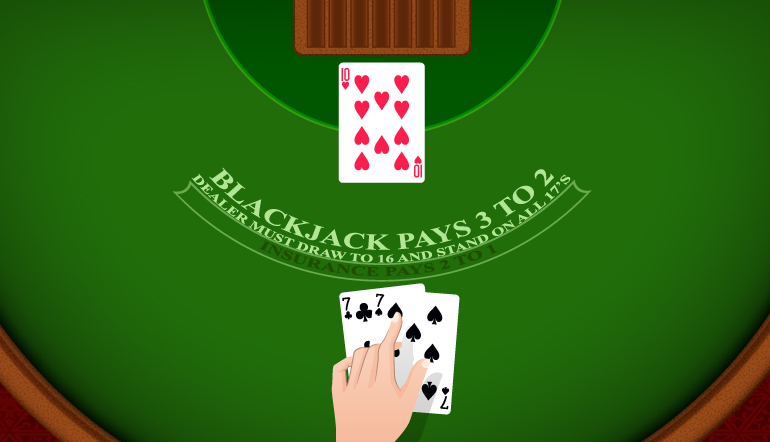
In blackjack, a 10-value card could either be a 10, Jack, Queen, or King.  A pair of 10s, therefore, could be composed of any two ten-value cards such as:

  • 10 plus 10
  • Queen plus 10
  • Jack plus King
  • Jack plus Queen

PLAYING OPTIONS FOR PAIR OF 10S

There are only two viable playing options when you are dealt a pair of 10s:

  • Stand
  • Split

If a player stands with a pair of 10s, he has a 20; if he splits, he is playing two hands, each starting with a 10. 

RE-SPLITTING 10S

Some land-based and online casinos allow players to resplit up to a maximum of three or four hands; therefore, if a player were to split 10s and draw another 10 to either split hand, he would have the option to split again to create three (or four) hands, each one starting with a 10. 

When playing live blackjack against the dealer, most casual players split 10s when he has a weak upcard like a 5 or 6 (although I have seen many players during my career split 10s no matter what the dealer shows). Their logic for splitting on the dealer’s 5 or 6 goes something like this: “The dealer has a weak card and I’ve got a good chance to make two good hands starting with a 10 so why not split and double my winnings.” Oh, really.

Let’s look at your expected value, or the average amount you would win per hand when you stand on your 10s compared to what you win when you split against the dealer’s upcard of 5. (Note: The following analysis is based on a typical six-deck game, where the dealer stands on soft 17.)

  • When you stand on your pair of 10s, you will win 83% of the time and lose 17% of the time. That’s not too surprising because it’s tough for the dealer to beat a strong hand of 20.
  • If you split the 10s one time, you stand to win 63% and lose 37% on each split hand. That’s a significant decrease in the number of hands won simply because if you split, you will often end up with less than 20 on both hands. 

This means that for an original wager of, say, $10, after 100 hands this is what you would net on average:

  • Standing will get you a $660 profit

You will win $10 x 100 hands x .83 = $830
You will lose $10 x 100 hands x .17 = $170
Your net profit is $830 – $170 = $660

  • Splitting the 10s will net you $520
You will win $10 x 100 hands x .63 = $630
You will lose $10 x 100 hands x .37 = $370
Your net profit is $630 – $370 = $260 per hand

Since you are playing two hands when you split the 10s, your net overall profit would be twice the $260 profit per hand, or $520

BOTTOM LINE

The above analysis shows that when you stand on a pair of 10s vs. splitting them against a dealer 5 upcard, you figure to win $140 more when you stand vs. when you split. This is a key point in solid blackjack strategy.

$660 profit when standing – $520 profit when splitting = $140

Note: A similar analysis can be done for any dealer upcard and any mix of playing rules and number of decks of cards being used and you’ll always arrive at the same result: for a basic strategy player who is not card counting, standing on a pair of 10s is always a more profitable play than splitting. Also, keep this in mind: Since splitting 10s is a bad strategy, then resplitting 10s is an even worse strategy, so never do it. 

WHEN TO SPLIT 10S

There are two instances where splitting 10s should be considered. The first occurs when there is an excess of 10s in the unplayed cards making it more likely that you will draw a 10-value card to each split 10 giving you two hands of 20.

The only way you would know if the unplayed cards are rich in 10s is by card counting. For example, card counters who use the popular Hi-Lo card-counting system will split tens vs. a dealer 5 upcard when the true count (or count per deck) is +5 or greater.

However, even though the latter is the correct mathematical play, splitting 10s in a land-based casino will attract suspicion from casino personnel that you might be a card counter. Therefore, even though it is the correct play, it is not wise to consistently split 10s in a single session.

The second instance where splitting 10s could be considered occurs in the last hand of blackjack tournaments where the goal is to have more chips than your fellow table players after a set number of hands are played.  For example, if it’s the last round and winning the hand with the chips that you’ve bet will still not be enough to overtake the leader, but betting twice as much will do the job, then a player should consider splitting the 10s.  

What follows is an example of how this worked for me once in a tournament. 

The table leader had $2,000 more than me going into the last hand. He bet first and made a $5,000 max bet. I matched his bet and put out $5,000. At this point I knew that if he won his hand and I won my hand, I would have been eliminated (because he'd still be ahead of me by $2,000). Therefore, I had to bet more to have any chance to overtake his $2,000 lead, and the only way to do that was to either pair split or double down (I still had $5,000 in unbet chips to use for a pair split). The leader had an 18 and stood. Fortunately, I was dealt of pair of queens so I split them, made another $5,000 bet, and fortunately drew two picture cards and stood with my two 20s. The dealer subsequently busted, and I won the round and advanced because I won $10,000 on the last hand while my opponent won only $5,000 (i.e., I had $3,000 more than he had at the final chip count).

The above scenario is an example of why splitting 10s in tournaments is sometimes a smart play, especially when you need to bet more money to beat an opponent. You've got to remember, however, to split your bankroll in half before you bet, otherwise, you won't be able to pair split. (Unlike doubling down, you can't pair split for less.)

For more information on land-based and online blackjack playing strategies, including playing and betting strategies in tournaments, consult Chapter 10 and Chapter 15 in the Ultimate Blackjack Strategy Guide.

June 22, 2017

By Henry Tamburin Ph.D

Henry Tamburin
Body

Henry Tamburin is one of world’s most respected blackjack experts and a world-class player. He is the author of the Ultimate Blackjack Strategy Guide, and Blackjack: Take The Money and Run. He edited the monthly Blackjack Insider Newsletter, and was a featured blackjack columnist for Casino Player magazine, Midwest Gaming and Travel magazine, Gaming South magazine, Southern Gaming magazine, New England Gaming News, Jackpot, Bingo Bugle, and Casino City Times.

He has appeared on numerous gaming shows on the Travel Channel and A&E network, and has been a guest on hundreds of radio shows. Tamburin is also a skilled blackjack tournament player, and an invited guest at the prestigious Blackjack Ball, an annual gathering of blackjack professionals.  He has taught thousands of players how to get the edge at blackjack in his seminars, card-counting classes, newspaper and magazine articles, and on his websites (smartgaming.com and bjinsider.com).

Besides is prowess at blackjack, Tamburin is also a skilled video poker and craps player. His column on video poker playing strategies appeared monthly in Strictly Slots magazine, and he also authored these books: Ten Best Casino Bets; Craps: Take the Money and Run; Henry Tamburin on Casino Gambling; and Winning Baccarat Strategies.    

Henry Tamburin earned a Bachelor of Science and Ph.D. degrees in chemistry and worked as a production and technical manager for an International Chemical company for 27 years while pursuing his avocation as a part-time professional blackjack player. 
 

Henry Tamburin Ph.D
factcheck
Off
hidemainimage
show
Hide sidebar
show
Fullwidth Page
Off

One of the hands that often confound blackjack players is when they are dealt a soft 17. Should I stand or hit? What about doubling down? What follows are the facts on how to play this hand accurately every time you play blackjack.

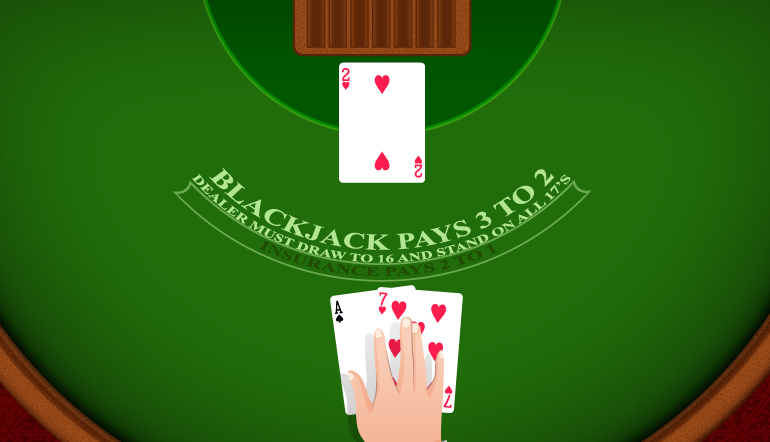
First, let me review some basics. A soft hand is any hand that contains an ace that is counted as 11. For example, an ace-6 is a soft 17; so is ace-3-3 and 2-2-ace-2. The basic playing strategy for, say, an ace-6 is much different than it is for a 10-7 (known as a hard 17 because It doesn’t contain an ace counted as 11). Yes, both hands total 17, but you play a soft 17 differently because you can never bust with a one-card draw (not so with a hard 17).

Regardless of whether you are playing blackjack in a land-based or online casino, when you are dealt a soft 17, if you are not counting cards, you should always follow the basic playing strategy, which is as follows.

WHEN YOU ARE DEALT A SOFT 17:

  • Never stand
  • Double down when the dealer’s upcard in 3 through 6 (2 through 6 in a single-deck game)
  • Hit when the dealer shows a 2 or 7 though ace (for single-deck, double against a dealer 2 rather than hit)
 

STANDING ON SOFT 17

The basic blackjack strategy for standing on soft 17 is simple: never stand! That’s right; you should never stand on soft 17 regardless of what the dealer’s upcard is.  That might seem odd since most players believe that 17 is a good enough hand on which to stand. In fact it’s not because you will lose more money standing than either hitting (or doubling).

"If you remember just one thing from this article it’s this: never stand on soft 17!"

If you are still not convinced that standing on soft 17 is a bad play, think about the dealer’s rule for soft 17. When the casino rules specify that dealer’s must hit their soft 17 (rather than stand), the house edge increases, meaning hitting a soft 17 is better for the dealer than standing. It’s the same for players … hitting soft 17 is always better than standing.

Standing on Soft 17 - Blackjack

DOUBLING DOWN ON SOFT 17

Many players pass up the opportunity to double down because they don’t understand the logic for doing so. The reason you double on soft hands is not so much to outdraw the dealer as it is to get more money on the table when the dealer is vulnerable to busting. The latter occurs more often when the dealer shows a low-value upcard (e.g., 3 through 6).

The basic strategy for doubling a soft 17 is easy to remember.

  • For double- and multi-deck games, double down when the dealer’s upcard is 3 through 6.
  • For a single-deck game, double down when the dealer’s upcard is 2 through 6.

MULTI-CARD SOFT 17

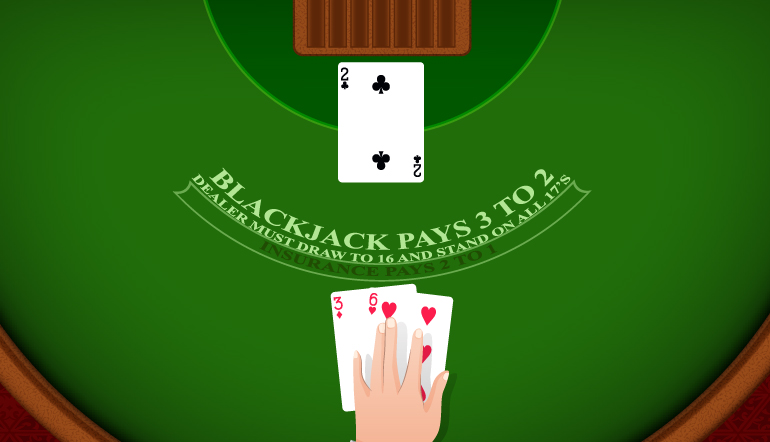
Sometimes you might hit your hand and after drawing one (or more cards) have a soft 17. For example, suppose you were dealt a 2-4 and the dealer’s upcard is a 6. You hit and draw an ace giving you a soft 17 (2-4-A). The playing rules in most land-based and online casinos prohibit you from doubling down on a hand once you draw a third card; therefore, if you hold a multi-card soft 17, you should hit.

Likewise, the rules in some land-based and online casinos allow players to double down only on hard hands (i.e., they are prohibited from doubling soft hands). In addition, the rules in most video blackjack games in land-based casinos don’t allow players to double down on soft hands.  So, the bottom line is this:

  • If you have a multi-card soft 17 or the rules don’t allow soft doubling, always hit soft 17.

Multi-card Soft 17 - Blackjack

HITTING SOFT 17

The basic strategy rules for hitting soft 17 are as follows:

  • For double- and multi-deck games, hit when the dealer‘s upcard is a 2 or 7 through ace.
  • For a single-deck game, hit when the dealer’s upcard is 7 through ace.

After you hit a soft 17, what you do next depends upon the total of your hand and the dealer’s upcard. (You need to refer to a basic strategy table for the rules on how to play your hand depending upon your total and the dealer’s upcard.)

BASIC STRATEGY TABLE FOR SOFT 17

The following color-coded blackjack strategy table summarizes the above rules for playing a soft 17.

Note:
Dh = Double down if permitted, otherwise hit.
H = Hit

Soft 17 Double- and Multi-Deck Basic Strategy

Dealer’s Upcard

2345678910A
HDhDhDhDhHHHHH

Single-Deck Basic Strategy

Dealer’s Upcard

2345678910A
DhDhDhDhDhHHHHH

QUIZ

To be sure you know when to hit or double-down on soft 17, decide how you would play each of the following hands against the dealer’s upcard.

  1. A-6 vs. 3
  2. A-6 vs. 9
  3. A-2-4 vs. 4
  4. 2-3-A-A vs. 2
  5. A-6 vs. 2
  6. A-6 vs. 5
  7. A-6 vs. 6 (rules don’t allow doubling)
  8. A-6 vs. 7

Answers:

  1. Double down
  2. Hit
  3. Hit
  4. Hit
  5. Double down in single-deck; hit in double- and multi-deck.
  6. Double down
  7. Hit
  8. Hit

CARD COUNTING AND SOFT 17

Card counters will sometimes vary their playing strategy depending upon the count; however, it’s rare when a card counter deviates with a soft 17 because there’s not much to be gained. The two times a card counter might consider doing so is as follows:

  • If the count is positive, double down on soft 17 against dealer’s 2 upcard
  • If the count is negative, hit against dealer’s 3 through 6 (rather than double down).

To be accurate, you should consult a table of index numbers for whatever counting system you are using for the specific index number for the above two plays.

July 5, 2016

By Henry Tamburin Ph.D

Henry Tamburin
Body

Henry Tamburin is one of world’s most respected blackjack experts and a world-class player. He is the author of the Ultimate Blackjack Strategy Guide, and Blackjack: Take The Money and Run. He edited the monthly Blackjack Insider Newsletter, and was a featured blackjack columnist for Casino Player magazine, Midwest Gaming and Travel magazine, Gaming South magazine, Southern Gaming magazine, New England Gaming News, Jackpot, Bingo Bugle, and Casino City Times.

He has appeared on numerous gaming shows on the Travel Channel and A&E network, and has been a guest on hundreds of radio shows. Tamburin is also a skilled blackjack tournament player, and an invited guest at the prestigious Blackjack Ball, an annual gathering of blackjack professionals.  He has taught thousands of players how to get the edge at blackjack in his seminars, card-counting classes, newspaper and magazine articles, and on his websites (smartgaming.com and bjinsider.com).

Besides is prowess at blackjack, Tamburin is also a skilled video poker and craps player. His column on video poker playing strategies appeared monthly in Strictly Slots magazine, and he also authored these books: Ten Best Casino Bets; Craps: Take the Money and Run; Henry Tamburin on Casino Gambling; and Winning Baccarat Strategies.    

Henry Tamburin earned a Bachelor of Science and Ph.D. degrees in chemistry and worked as a production and technical manager for an International Chemical company for 27 years while pursuing his avocation as a part-time professional blackjack player. 
 

Henry Tamburin Ph.D
factcheck
Off
hidemainimage
show
Hide sidebar
show
Fullwidth Page
Off

The first question on any slot machine player’s mind is, “How do I win?” The question evolves with experienced players who think about it a little. They wonder, “Maybe I can’t always win, but how to I maximize my paybacks?

Slot machines are games of chance, With rare exceptions, there is no skill involved, and there is no method of play that will make them pay more than they’re designed to pay.

With that in mind, maximizing slot payouts comes down to choice of games and making the wagers necessary to get the most they have to offer.

HIGH DENOMINATION VS. LOW DENOMINATION

In the United States, where many state gaming boards publish statistics each month, nationwide averages look like this:
 

Coin denomation and payback percentage
 

Those are national averages, but can vary widely from state to state and casino to casino, depending on the competitive situation and marketing goals of the casinos. For a real-world example, let’s look at the state of Mississippi and October 2015 payback percentages published by the Mississippi Gaming Commission:
 

coin denomation and payout percentage
 

On video slots, Mississippi casinos pay far above the national average on both penny non-progressives and on five-cent games. But the normal pattern holds in that the higher denomination slots pay a greater percentage back to players than the lower denomination games.

The 25-cent-and-up slots are mostly games with mechanical reels. Although in Mississippi the 25-cent and 50-cent games provide nearly equal returns, and the difference is narrower than usual between 25-cent and $1 games, you still can see a pattern where $5 games pay more than $1 games, which pay more than 25-cent games.

BOTTOM LINE

  • Playing higher-denomination slots usually will put you at higher-paying machines.
  • Caution: If you bet one coin per line on a 20-line video slot, you’re betting 20 cents on a penny slot, but $1 on five-cent slots.
  • That difference in wager size means you can lose more money even while getting a higher payback percentage. If the 1-cent slot returns 87 percent and the 5-cent game returns 90 percent, then your loss per 20-coin wager is 2.6 cents on the 1-cent game, and 10 cents on the 5-cent game.
  • Conclusion: Let your bankroll be your guide. If higher-denomination games fit within your entertainment budget, they can maximize payback and give you a better shot to win. But if they’d stretch your budget, it’s better to stay low. Never bet money you can’t afford to lose.

BETTING THE MAX

On many slot machines, including nearly all games with three mechanical reels, you get a higher payback percentage if you bet the maximum number of coins the game allows.

Here’s a sample pay table:

Wager Chart
 

Note the disproportionate jump in the top jackpot. If the payoffs were perfectly proportional, the payback percentage would be same regardless of how many coins you wagered.

But betting the third coin brings a rise in payback percentage. Look at it this way:

  • Each coin wagered brings the same return on cherries, bars, double bars and triple bars. A 15-coin payoff on three cherries breaks down into a 5-coin return for the first coin wagered, 5 for the second and 5 for the third.
  • Payoffs on 7s are proportional through two coins. A 2,000-coin payoff breaks down into 1,000 on the first coin and 1,000 on the second.
  • However, if you land the 7s on the payline with the maximum three-coin bet, the 5,000-coin return breaks down into 1,000 on the first coin, 1,000 on the second and a big leap to 3,000 on the third.
  • The average payback on three 7s is 1,000 per coin wagered if you bet one or two coins, but 1,667 per coins wagered if you bet the maximum three.
  • That higher average payback with three coins wagered means the payback percentage is higher when you bet the max.
  • Caution: You maximize return when you bet the max, but you also have more money at risk and can have larger losses. Don’t overbet your bankroll.

The situation is different on five-reel video slots. Paybacks are proportional to coins wagered per payline on these games, with no jackpot jump for betting the max.

Here’s a sample pay table for a 20-payline, five-reel video game:
 

Payline combination chart
 

There are a few notable things about that pay table:

  • It is simplified from the pay tables you actually see in casinos, which use more character symbols and also often use generic symbols such as A-K-Q-J-10. Many video slots also include more than one bonus event.
  • Despite the simplification, there are many more possible winning combinations than on the three-reel slot. Even two in a row of the top-paying symbol brings some payoff.
  • As set up, this game with 20 paylines and a five-coin maximum bet per line would have a maximum total bet of 100 coins. Games you’ll find in casinos often have much higher maximum bets, such as 20 coins per line on a 20-line game, or 10 coins per line on a 40-line game, for a total of 400 coins.
  • The pay table is proportional from to bottom, so there is no advantage to betting maximum coins. You’ll get the same payback percentage regardless of whether you bet one coin per line or five.

BE ELIGIBLE TO WIN

On the video slot game illustrated above, there is no pay table incentive to wager maximum coins per line. However, it might be to your advantage to make sure you bet on every payline.

Why? Because on some machines, the bonus symbols must land on an active payline for you to be eligible for the free spins, wheel spin, pick-a-symbol round or whatever other special event has been designed into the game.

An example:

  • You decide to bet a single coin. That activates only the center payline.
  • You go to the bonus event if three bonus symbols land on the center line. On most video slots, they don’t have to be on consecutive reels, from left to right, as most paying symbols do. You’ll go to the bonus even if the symbols are in the center of reels 2, 3 and 5, or 1, 2 and 4, or any other combination.
  • However, if the reels land on any line you have not activated, you do not go to the bonus.

you might miss a ig chance if you don`t activate the paylines

  • Time spent in bonus events is time you spend building credits without making extra wagers, so you want to maximize your chances of going to the bonuses.
  • Bottom line: To maximize payouts, make sure you’re eligible for the bonuses offered.
  • Note: Some newer games avoid the issue by eliminating the option to play fewer paylines than available. A 40-line game might have buttons labeled “Bet 40,” “Bet 80,” “Bet 120,” “Bet 160,” and “Bet 200,” giving you options to bet one, two, three, four or five credits per line, but no chance to play only one line. In the slot industry, these are called “forced bet” machines.

Reading the glass or help menu can save you in some other situations, too.

Consider this three-reel slot pay table:
 

Wins chart
 

This type of machine is called a buy-a-pay. Each coin you wager unlocks a set of symbols, if you wager only one coin and line up three 7s, you don’t hit the jackpot, you get nothing. It’s just a losing spin.

On such a machine, you maximize payouts by betting the max to such an extent that you should never play if you’re not prepared to make the maximum wager.

20 lines plus features

One more example of where reading the glass or help menu can save you some grief:

On many video slot machines with progressive jackpots, especially those with two, three, four or more levels of progressive, you must make a separate wager to be eligible for the jackpots.

Sometimes the button panel includes a separate button that includes covering all the paylines plus jackpot eligibility. Often it’s large and round and oval, to stand out from the small, square buttons for the usual choices of how many paylines to play and how many coins to wager per line.

The amount required for jackpot eligibility varies in different machines. It’s not unusual to see 10, 15 or 20-credit bets for the jackpot. On a game with a 10-credit jackpot bet, if you cover 20 paylines at 1 credit per line and make the jackpot bet, your total wager is 30 credits.  

If you bet five credits per line, you’re betting 100 credits in the main game and 10 on the jackpot for a total wager of 110 credits.

The progressive jackpots are the prime attraction of such games. You maximize your return by making the jackpot bet. If you do not want to make the jackpot bet, you’re better off to choose a different game.

SCOUTING PROGRESSIVES

Some players like to attempt to maximize their returns by scouting machines with progressive jackpots.

To do their scouting, they’ll visit casinos and note the starting points for progressive jackpots, and try to find out when they hit. Such charting requires frequent visits, and often requires asking slot attendants, “I see that jackpot just hit recently. How much was it?”

They build a data base that might look like this:

  • Jackpot starting point: $5,000.
  • Jackpot winners: $8,663; $5,981; $7,453; $9,012; $8,114; $7,888; $10, 576; $8,243.
  • More data collected over longer time is better.
  • From that, they determine that while jackpots sometimes hit at a little more than the starting point and sometimes exceed $10,000, they most often hit between about $7,400 and $8,700.
  • Based on that information, they don’t play unless the jackpot exceeds $7,400.
  • Actual jackpot amounts and average payout will differ from game to game and casino to casino.

Because such players do not bet when the jackpots are low, they always are playing at relatively high pay tables. That maximizes their payback percentage.

However, betting when the jackpot is high doesn’t increase your chances of hitting the jackpot, it just makes the average payout higher when you do win. Just as in any other method of maximizing payouts, rule Nos. 1, 2 and 3 are to stay within your bankroll, not bet money you can’t afford to lose, and to choose games that fit your budget.

January 6, 2016

By John Grochowski

John Grochowski
  • ">
  • Body

    For nearly 25 years, John Grochowski has been one of the most prolific gaming writers in the United States. He’s been ranked ninth by GamblingSites among the top 11 gambling experts at Gambling Sites and his Video Poker Answer Book was ranked eighth among the best gambling books of all time.

    He started a weekly casinos column in the Chicago Sun-Times at the beginning of 1994 and He soon found himself in demand by a wide range of publications. He has written for casino industry professionals in Casino Executive and Casino Journal magazines, and for players in Casino Player, Strictly Slots and many other magazines.

    John’s twice-weekly columns appear in Casino City Times, Atlantic City Weekly and several websites. He has written six books on casino games, including the “Casino Answer Book” series. And, of course, John is a regular at 888casino Blog.

    Today John’s work includes a weekly column on baseball metrics for the Sun-Times. He lives in the Chicago area with Marcy, his wife of 30 years.

    John Grochowski
    factcheck
    Off
    hidemainimage
    show
    Hide sidebar
    show
    Fullwidth Page
    Off

    Online casino gambling has exploded in the last decade, with the volume of worldwide online gambling expected to be reported in the $41.4 billion range for 2015, according to Statista. This is triple the $13.8 billion that was reported in 2005 - and this is mostly without United States participation, where online casino gambling is almost completely illegal.

    In fact, Morgan Stanley Research suggests that if 20 jurisdictions were opened in the United States, that $5.2 billion would be generated just in America by 2020.

    Statista defines online gaming as including such activities as poker, casinos (where people can play traditional casino games, like slot machines or blackjack,, sports betting, bingo and lotteries. Of these, casino games make up the largest market segment, with figures from 2012 finding that 23 percent of online gambling was casino-style gaming and 18 percent was poker games.

    Online casino gambling tripled in 10 years
     
    Delving deeper into the online casino numbers, it is clear that the most popular activity by far is playing slot machines. And while most online casino companies closely guard their numbers, it is believed that slots make a much higher percentage of the bottom line for online casinos than they do at their brick-and-mortar counterparts, which usually report slot revenues as around 30 percent of their overall take.

    The birth of an affordable computer in the early 1980s resulted in the introduction of computers to slot machines at brick-and-mortar casinos. Despite the immediate popularity of games like video poker, many players stayed away, feeling that if they couldn’t see the reels spinning, they couldn’t trust the machines. It didn’t take long for those players to see that they were like every other machine with payouts. 

    Skeptical video poker players

    Over time, computers in the machines allowed paper bills to be accepted and could offer a range of options on a single machine. Electronic bonus features were introduced and players found they had enough variety with one machine that the average time of a player staying at the same machine skyrocketed.
     

    Bringing the Casino to the Home


    Computerized casino games first found their way into homes around the same time, allowing players to wager pretend money in often rudimentary interfaces. Without the excitement of real money, most computer or console (like Atari, Nintendo, etc.) players chose different genres, be it sports or adventure and casino games were a tiny fraction of the gaming industry.

    But once the Internet began penetrating the computer market in the late ’90s and early into the 21st century, it became clear that, with the ability to introduce real money into the mix, the online casino market was about to take off and cater to a completely different person than the one that plays Grand Theft Auto or FIFA15.

    Generally, video games are aimed at the more casual players who are looking for some harmless fun, while real money gambling games - whether slot machines or table games - are of course aimed at those looking to replicate the excitement and potential monetary prizes of their favorite land-based casino at the comfort of their home or mobile device. Unlike video games, these users don't expect to pay for the software itself or abuse it for days over days, but rather they seek some immediate individualistic gratification in terms of cool features and prizes.

    Creating an Online Slot Machine 

    For the end user, or those unfamiliar with the world of casinos or computer programming, it may seem like the online slots is a basic tool. But when it comes to Internet casinos, they are the games that demand the most development, as well as the ones that change most frequently.   

     Workflow - slot machine creation

    A premium online slot machine takes approximately one year from the idea on a piece of paper to deployment on various platforms. About a dozen people are involved in the process, including a game designer, mathematician, server developer, between one and three front-end developers, a game tester, a project manager, a creative team of one or two people and a configurator. Depending on the specifics of the game, specialty graphic designers may also be brought in to be part of the team.

    While each game is different, development teams are able to often use a pre-existing slot mechanism or framework which will help streamline the process of research and development. It is a way to avoid having to reinvent the wheel each time a new game is produced. Whether a player is enjoying a simple Bars and 7s machine or one with a Hollywood branded tie-in, they likely take for granted that every detail has been meticulously planned out to the last pixel.

    A Long Process to Completion

    The first step in designing a game is to get a large group together to talk about a concept and determine if it has legs. This involves creative teams, marketing people, product management and development. 

    Making a slot 

    While the initial concept involves brainstorming, once a direction is chosen, marketing statistics, demographics and data are used to create several specific directions that may be taken. After additional meetings and votes, the concept becomes a concrete idea and is handed over to the creative team and the product team. The first thing these groups do is to take a look at what similarly-themed slot machines exist in the marketplace. The challenge then becomes figuring out how to present something different that will attract players.

    For instance, if one company were designing a machine featuring landmarks of the world, the teams would first see which, if any, competing games existed. If they found a couple slot games that utilized mostly ancient and medieval landmarks such as the Egyptian Pyramids or The Colosseum in Rome, they may decide to go with more traditional structures, such as The Eiffel Tower and The Empire State Building. 

    Once that theme is determined, the team figures out the mood of the game. Is it whimsical, perhaps benefitting from cartoon caricatures, or is it supposed to be more reality-based with real photographs being the best choice? How will bonus games be created in a way that reflects the theme and mood?

    Slot design is complex 

    Creativity and market research determine everything from the large details - like color schemes, fonts and audio - to the tiniest specifications; which, in the example above, might involve determining if shadows should be cast by the famous buildings, or if the bonus game should take three or five seconds to launch. Every last detail is figured out by the team long before the outside world even knows it’s being developed. 

    In the end, it simply comes down to trying to create the best possible experience for the player. 

    Sometimes, designers have corporate tie-ins, usually involving a current pop culture element like a specific movie or a musician, that need to be part of the mix. This can be a considerable professional challenge. Making a branded game requires the game team to study and research the brand itself in depth, to understand the characters, main scenes and highlights, and then to translate everything into a realistic game plan that can be executed in reasonable time and budget and of course to approve everything with the brand owner – often a Hollywood studio, with very stringent rules on protecting its intellectual property and copyrights.

    Slot machine figure
     
    But despite the additional layer of dealing with the owners of a brand, sometimes it’s harder to create a new online slot machine from scratch. A non-branded game brings other challenges – how to differentiate it from the hordes of other slot games created by dozens of other vendors each year? The challenge is to make the game compelling and engaging from the player perspective and yet not too complicated in terms of project execution.
     

    The Players Decide If It’s a Success


    Slot machine factory

    Online slot machines are continually being developed, with designers hoping each new offering will capture players’ imaginations and prompt repeat visits. However, once the slot machine is deployed to players, the designers must keep up with changes to technology, which may mean making occasionally tweaks to the games - especially if new platforms, browsers and operating systems enter the marketplace. Machines may also need to be changed as more jurisdictions allow online casinos.
    An online slot machine’s success is measured by several metrics, including the money it generates, its popularity and, perhaps most importantly, its “stickiness” with players (meaning how long they play the machine at any one sitting and how often they return to that particular machine). All of the data in the world, however, cannot guarantee a machine with be a big hit or a bust.
    Unfortunately, there’s no simple answer to this question. Designers can create very successful simple machines and very successful complex machines. Since there is no single player, there is no single answer. Nevertheless, a good game will often combine good returns to players with a rich feature set (often including a progressive jackpot) and outstanding creative – including sounds.
     

    The Variance System


    Slot variance system

    During the design process, the team must decide the variance of the machine: low-risk, medium-risk, or high-risk.

    • Low-Risk Variance machines are designed to appeal to a wide swath of players looking to play for as long as possible. Jackpots are generally lower in value than many machines, but there are more winning combinations that will keep the player engaged with the machine.
    • Medium-Risk Variance machines are the most plentiful kind found online, with both high and low jackpots. These game typically attract players by offering bonus features and special game-in-game opportunities to win additional money. Players can win more with these machines than low-risk ones, but they can also see their bankroll dwindle faster if luck isn’t on their side.
    • High-Risk Variance slot machines are the ones that offer the best jackpots, often progressives and wild multiplier symbols which can dramatically increase winnings, but the tradeoff is that small jackpots are much more rare, causing a higher number of non-winning spins.


    Each risk variance levels caters to a specific kind of player, meaning that developers must keep in mind who they are trying to attract when they are designing new online slot machines.
    As with the video poker slots that first hit brick-and-mortar casinos in the 1980s, players were first leery of the dependability and veracity of the odds that came with online slot machines, but the most reputable online casino sites will list the names of external auditors they use who specialize in testing random number generating systems. In countries that may demand additional proof, stringent testing labs also can confirm the fair and unbiased nature of online casino companies. 

    These random number generators, which are used in both online and brick-and-mortar casinos, feature proprietary algorithms that randomly chooses numbers, and those numbers are connected to the symbols the slots player sees. There is hefty security around these random number generators which manufacturers and sites will not talk about since they are at the heart of keeping games fair. 
    People who enjoy the online slot machine experience may find one of many “slot machine builders” on the Internet, but it's important to note that these don’t have a fraction of the dependability and comprehensive measures utilized by legitimate designers. Traditional table games are still difficult to create, even if they lack the design variables of online slot machines, as  table games such as blackjack, roulette and craps are often played by the more conservative players, who seek to replicate the exact land-based casino experience down to the same table, chips, rules and strategies.

    In slot games, the game designer can express his originality and innovation and thus create something differentiated and unique. So this is often more enjoyable and engaging from a professional standpoint. Nevertheless, designing any game is a considerable professional challenge and even mimicking a standard table game brings its own particular issues.

    Did you realize so many variables went into slot machine design? Do you have any other questions about how these games are created? Leave us a comment below sharing your thoughts:

    February 22, 2016

    By Louis Wheeler

    Louis Wheeler
    Body

    With digital marketing strategies in his blood Louis Wheeler has traveled around the world, exploring gambling cultures and gaining experience in casino games from 2003. If you are in a casino anywhere around the planet, you may find him right next to you, playing blackjack, roulette or texas hold'em. 

    Louis Wheeler
    factcheck
    Off
    hidemainimage
    show
    Hide sidebar
    show
    Fullwidth Page
    Off

    THE 5 BEST VIDEO POKER TIPS ARE: 

    1. Play maximum coins
    2. Check pay schedules
    3. Know the strategy for the game you are playing
    4. Practice before you play
    5. Watch your bankroll

    TIP #1: PLAY MAXIMUM COINS

    Playing maximum coins gives you the full value for the royal flush --- typically 800-for-1. Playing fewer coins gives you less for that hand --- typically 250-for-1.

    You won’t get that royal flush very often (usually once every 40,000 to 45,000 hands on average), but you NEVER know when the next one is coming. So playing maximum coins gets you paid well when the royal comes.

    TIP #2: CHECK PAY SCHEDULES

    For Video Poker games where you get your money back for a pair of jacks or better, every additional unit you receive for a full house or flush returns an extra 1.1%.

    Compare these two Double Double Bonus games.


    Double Double Bonus video poker payout
     

    The first one returns 99.0% with perfect play. The second one returns 97.9%. Most of the plays are the same over the two games, but your money will last longer on the first one. Often you can find both games at the same casino. It’s up to you to know the difference or you’ll be taking the worst of it

    If you don’t know how much each pay schedule returns, a good source of this information is my Video Poker for the Intelligent Beginner.

    TIP #3: KNOW THE STRATEGY FOR THE GAME YOU ARE PLAYING

    Say you’re playing deuces wild and you’re dealt 4♠ 4♥ 6♣ 6♦ 7♠. How do you play it? Do you hold one pair or both pairs?

    Actually either could be correct. Consider the two games below, both of which return approximately 98.9% when played well. In the first game you just hold one pair (it doesn’t matter which one). In the second game you hold both pairs.


    Deuces Wild video poker paytable
     

    How can you tell which is which? Look at the amount you get when you receive a full house. In the first game, you get paid 3-for-1 (15 for a 5-coin bet). Whenever you see that in Deuces Wild, you hold one pair when you’re dealt two.

    In the second game you get paid 4-for-1 for the same hand (20 for a 5-coin bet). That’s when you hold both pair.

    TIP #4: PRACTICE BEFORE YOU PLAY

    Computer software is available to tell you how to play any hand. The images you see today are inspired by Video Poker for Winners, which is the one I recommend, but there are other good ones as well.

    Here we see a hand dealt in a Bonus Poker game. The player held the jack and the ten to go for the royal flush --- certainly a play that looks reasonable. The computer, however, tells you that’s a mistake. Holding the queen and jack is actually better.


    test your video poker skills
     

    After you get corrected a few times, you won’t be making this mistake any more. A little bit of practice can make a big difference in your results!

    TIP #5: WATCH YOUR BANKROLL

    Everybody wants to win, and everybody wins some of the time. But we all lose some of the time as well, and we can’t know what’s going to be the result today until we actually play.

    If losing a few hundred credits will be a disaster for you, you can’t afford the stakes you’re playing. If you play for a modest amount compared to your overall bankroll, you’ll be able to absorb the swings, both plus and minus, and enjoy the game.

    I wish you lots of royal flushes!

    May 22, 2016

    A blackjack player once asked me this question: “Every time I play blackjack against the dealer, he always seems to beat me. So why shouldn’t I just mimic the dealer’s strategy?” That’s a good question and to answer it you first have to understand two things:

    1. How to play blackjack
    2. How the casinos get their edge in blackjack in the first place. 

    More Blackjack School tips and videos:

    When I ask most blackjack players how the house gets their edge in blackjack, this is what they usually say: “They get their edge because players don’t know how to play their hands.”  It’s true that a player who plays blackjack and guesses on whether to hit or stand results in an increase in the house edge against this player. But what’s more important to understand is this: what is the inherent house edge in blackjack?

    Simply put, the casino gets its edge in blackjack because players act on their hand before the dealer acts on her hand, and if the total of a player’s hand exceeds 21, the player is an automatic loser even if the dealer subsequently busts in the same round. There are more reasons why blackjack players lose besides mimicking the dealer's strategy. 

    The “double bust” rule is the casino’s sole built-in advantage in blackjack, and if everything else were equal and a player mimicked the dealer’s playing strategy (i.e., always stand on 17-21 and hit on 16 or less) the house edge would be about 8%. That’s because the player and the dealer would have about a 28.3% probability of busting, if they played in the same manner; therefore, 0.283 times 0.283, or about 8% of the time both hands would bust and the dealer would win. 

    Mimicking the dealer will increase the chance of get bust with 8% more than not mimicking

    Fortunately, not all is equal when you play blackjack. Players have certain advantages and options that are not available to the dealer. They include:

    • Receiving a 3 to 2 bonus payoff on a blackjack, whereas the dealer gets paid only at 1 to 1 on his winning blackjack (advantage to player). 
    • Being able to double their wager in favorable situations (like being dealt a two-card 11), whereas the dealer cannot double down (advantage to player).
    • Being able to split, and sometimes resplit pairs, whereas dealers cannot split (advantage to player).
    • Players can stand on totals of 12–16, whereas a dealer must always hit a total of 16 or lower (advantage to player), and players can hit some soft hands whereas the dealer cannot (advantage to player).
    • Being able to surrender, when rules permit (advantage to player).

    I trust you now understand why mimicking the dealer strategy when you play blackjack is a very bad idea. So is guessing on whether to hit or stand on a particular hand or using your “intuition” that says you should hit because you are “due” to win the hand. No, blackjack is not a guessing game; in fact, brilliant mathematicians have calculated the best way to play every hand and have condensed this information into what is known as the basic playing strategy. By learning the basic strategy, meaning knowing when to hit, stand, double down, or pair split, and playing every hand accurately, you can reduce the initial 8% double-bust house edge down to 0.5% or less (depending on the number of decks of cards and the playing rules). 

    The following table summarizes the effect the 3 to 2 bonus blackjack payoff and the player advantage (options) has in reducing the initial 8% house edge. Getting paid 3-2 for a blackjack reduces the house edge by 2.3% (and that’s for doing nothing at all); using the correct standing and hitting strategies reduces it another 3.5%, and so forth.  (To reiterate, the percentages will vary slightly based on the number of decks of cards and the playing rules.)
     

    Intial House Edge8%
    3 to 2 bonus for BJ-2.3% = 5.7%
    Correct Standing/Hitting-3.5% = 2.2%
    Correct Doubling-1.6%=0.6%
    Correct Pair Splitting-0.4% = 0.2%

    SUMMARY

    • Mimicking the dealer’s strategy is a very poor strategy that should never be used.
    • Guessing or playing by “intuition” is another losing strategy.
    • The only way to improve your chances of winning at blackjack is to learn the basic playing strategy.

    The complete basic playing strategy for any given mix of playing rules and number of decks of cards being used is summarized in Chapter 3 of the Ultimate Blackjack Strategy Guide.

    April 19, 2017

    By Henry Tamburin Ph.D

    Henry Tamburin
    Body

    Henry Tamburin is one of world’s most respected blackjack experts and a world-class player. He is the author of the Ultimate Blackjack Strategy Guide, and Blackjack: Take The Money and Run. He edited the monthly Blackjack Insider Newsletter, and was a featured blackjack columnist for Casino Player magazine, Midwest Gaming and Travel magazine, Gaming South magazine, Southern Gaming magazine, New England Gaming News, Jackpot, Bingo Bugle, and Casino City Times.

    He has appeared on numerous gaming shows on the Travel Channel and A&E network, and has been a guest on hundreds of radio shows. Tamburin is also a skilled blackjack tournament player, and an invited guest at the prestigious Blackjack Ball, an annual gathering of blackjack professionals.  He has taught thousands of players how to get the edge at blackjack in his seminars, card-counting classes, newspaper and magazine articles, and on his websites (smartgaming.com and bjinsider.com).

    Besides is prowess at blackjack, Tamburin is also a skilled video poker and craps player. His column on video poker playing strategies appeared monthly in Strictly Slots magazine, and he also authored these books: Ten Best Casino Bets; Craps: Take the Money and Run; Henry Tamburin on Casino Gambling; and Winning Baccarat Strategies.    

    Henry Tamburin earned a Bachelor of Science and Ph.D. degrees in chemistry and worked as a production and technical manager for an International Chemical company for 27 years while pursuing his avocation as a part-time professional blackjack player. 
     

    Henry Tamburin Ph.D
    factcheck
    Off
    hidemainimage
    show
    Hide sidebar
    show
    Fullwidth Page
    Off