• In casino gaming there are a variety of mathematical based systems that are touted as a sure fire way to beat the casino.
     
  • This is especially true for roulette. While some systems can be applied under a very specific set of circumstances, most can’t be applied over an extended period of time.
     
  • When they are, the roulette system fails and the player usually lose the game.
     
  • There is however one method of attacking roulette that can be applied over an extended period of time, when done correctly, gives the player a positive outcome. That system is the Kesselgucken roulette system.

Kesselgucken is a German word which most closely translates to the English word observational. It is appropriate because what the player is doing is observing influencing factors of where the ball will land, and using the laws of physics to predict where that will be. Usually within a sector range of octants, (1/8th of a pie like section of the wheel).  This approach was pioneered by Ed Thorp, when he and Noble Laureate Claude Shannon, developed the world’s first wearable computer, that was designed to predict where the roulette ball would land.

Roulette physics has many factors go into the classical mechanics calculations. Some of these factors include:

  1. Release point
  2. Initial Speed of the Ball
  3. Gravity
  4. Initial Speed of the Wheel
  5. Bounce coefficient - how many times the ball would bounce before resting in a basket

By using a computer program that accounted for all these factors, all Thorp and Shannon had to do was input the initial velocity of the ball after one revolution and the computer would take care of the rest. The series of equations used required a computer to complete before the croupier would call “no more bets”. It’s worth noting that when the two MIT Professors did this the use of computers in casinos was allowed. We are not that lucky any more. The two made vast amounts of money using the roulette physics computer, and their success ultimately led to the ban of computer devices in casinos.

When the casinos successfully banned the use of computers, the player had to come up with ways to attack the wheel without the assistance of any device. The result was the Kesselgucken approach. The methodology wasn’t as accurate as the system that used the computer but it was still good enough to gain a healthy advantage over the house.

Using the computer the where the ball would land could be predicted to a range of 5 numbers or 1/8th of the wheel. If a player were to bet $1 dollar on 5 different numbers, with 100% accuracy you would earn a staggering profit of $33 per spin. And the numbers just get bigger as the wager amount increases. The profit levels are not that high when using a non computer approach but are still very good. Instead of 5 numbers a player increase the number of dollar inputs to $15, and at a payout of 36:1 a net profit of $20 per spin is possible on 100% hit rate. A profit can be made with a hit rate as low as 35%, so this is a very powerful system when properly executed. Let’s go over a couple of things you need to execute the system.

STEP 1: RELEASE POINT

Every roulette croupier has a signature. A croupier signature is few physical components of how the croupier releases the ball into the wheel. The first part of the croupier signature is where on the outer rim the dealer releases the ball onto the track. A croupier will usually release the ball from the same position for every spin. Starting position is very important.

STEP 2: INITIAL SPEED OF THE BALL

The next thing to consider is the initial velocity at which the ball is released on to the track. When Thorp and Shannon developed their roulette physics computer the player would click a button once to measure starting point and a second time when the ball made one complete revolution. The initial angular velocity was then used to run through all of the calculations to predict the landing point. Without a computer the player observes the croupier for a few hours before playing live roulette against the dealer and uses a stop watch to time the length of one revolution. The times are then averaged to get a mean time for the distance traveled. Approximately 100 spins should suffice for an average. The distance traveled for one revolution is approximately 2 πr, where π = 3.14 and r is the radius of the wheel. Then using the simple equation:

Velocity=2πr/time

A hand releasing the roulette ball with some speed and a wide shot showing the ball being releasing in the same spot

What the player will find after 100 trials and 100 calculations is that the velocity is very consistent for each individual croupier.

STEP 3: GRAVITY

By knowing where the ball is released and what the initial velocity is the player can determine where the ball will enter the area of the wheel where number baskets are. The ball separates from the outer track at the same velocity every time. Then gravity takes over and the ball slides down the angled track until it hit enters the area with the numbered basket slots in it.

STEP 4: INITIAL SPEED OF THE WHEEL

Determining where the ball will enter the basket area is accounting for the ball aspect of the roulette game. The other half is the roulette wheel itself. The wheel remains in motion (under almost zero friction) and spins the direction opposite of the way the ball is spun. The velocity of the wheel, like that of the ball, is fairly consistent between dealers. It should be measured over the same100 spins as dealer’s initial velocity measurements. And like the velocity calculations, the average should be taken and applied. 

The roulette ball entering the basket of the roulette wheel

STEP 5: BOUNCE COEFFICIENT

The final component is the bounce coefficient. This refers to how many spaces the ball travels past before it comes to rest. It is the part of the calculation with the most variance involved. Determining the bounce coefficient is more of a technical art than hard calculation. Like before it depends heavily on the croupiers signatures and requires several observations, recording and averaging.
 

SUMMARY

Using Physics to beat a roulette wheel is possible, but as seen here is very complex. It takes lots of preparation and work. The first mistake most players who try this method, is that they jump right into taking measurements at a casino and often become frustrated and give up. The player has to make an investment in the game, so that he can practice roulette. By working out the methodology at home under controlled conditions they can perfect there methodology at home and then take the approach into real world, under real world conditions.


The roulette physics approach is a challenging way to attack the game of roulette. When exact calculations are used (the ones that require computers) you can predict where the ball will land within approximately 5 spaces. This is an overwhelming edge. The estimation method is far less accurate and the player needs expand the range of numbers from 5 to 15. And the hit ratio will be less than that of the computer aided approach. The take away is that it can be done but requires a lot of practice to be competent in this method. Before executing this method with real money the player can engage in simulation to make sure they have the ability to execute the Physics based approach. It’s hard, and like anything worthwhile it takes a lot of effort, but well worth it.

May 29, 2017

By Nicholas Colon

Nicholas Colon
Body

Nicholas is a 17 year veteran of the casino gaming industry. He is former player manager with the infamous MIT Blackjack teams and is a regular attendee of the Blackjack Ball, a gathering of the world’s top professional gamblers.

He is the Managing Director of the Alea Consulting Group, a leading gaming consultant company with a focus on gaming economics and, is a frequent contributor to world class business publications like Forbes and Entrepreneur magazines’ and over 15 gaming trade publications. He is also the founder of Casino Exploits a player centric casino gaming site.

Nicholas has lectured at major US universities like Clemson University, Michigan State University and Duke University. His vast business and gaming  expertise, is supplemented by post graduate degrees in Medicine, Business Administration and Applied Physics.
 

Nicholas Colon
factcheck
Off
hidemainimage
show
Hide sidebar
show
Fullwidth Page
Off

Video poker games have a loyal bunch of players. The games they love best and play most have been around 20 years, 30 years or more.

Once Jacks or Better gave the game its big popularity boost at the beginning of the 1980s, it was quickly followed by Deuces Wild and Bonus Poker, with Double Bonus Poker and Double Double Bonus Poker not far behind.

That doesn’t mean players that now how to play video poker for years are unwilling to try something new. As by far the world’s leader in video poker games, International Game Technology introduces new games every year. 

The coming attractions are mostly games with multiple hands and bonus multipliers. The multi-hand format was launched with Triple Play Poker, in which you start with one hand and after you decide what to hold, the deck is cloned and the draw played out three times. You could win on none, one, two or all three of the hands.

Since then we’ve seen Five Play, Ten Play, Fifty Play and Hundred Play Poker, with more cloned hands and potential winners.

Layered onto that in games such as Ultimate X and Super Times Pay are multipliers, where the potential value of the next hand is increased. The most successful of these is Ultimate X, and it’s only natural IGT would want to play off that success. It’s doing just that with Ultimate X Bonus Streak and Ultimate X Spin Poker.

ULTIMATE X BONUS STREAK

Ultimate X Bonus Streak is available in Triple Play, Five Play and Ten Play formats. Each has a 10-credit per hand maximum bet – five credits for basic play plus five credits to buy the bonus feature. If you’re playing in a 25-cent unit, the max bet on a Triple Play version of Ultimate X Bonus Streak is $7.50, and that rises to $12.50 on the five-hand version and $25 for Ten Play.

As in Ultimate X, winning hands can bring multipliers for subsequent hands. The multipliers apply only to the same line on which you had the winner. If you had losing hands on the bottom two hands of Triple Play Ultimate X but a winner on top, then only the top hand gets a multiplier on your next play.

The smallest-paying hands, Jacks or Better and two pairs, do not bring multipliers on Bonus Streak. That’s a change from original Ultimate X, where any winner earns a next-hand multiplier.

But there’s something extra in Bonus Streak, and this is the part players will love. You don’t just get a multiplier for the next hand. Instead of a one-hand-only multiplier, you get a streak of multipliers. On Jacks or Better, Double Double Bonus and other games with no wild cards, three of a kind, flushes and straights bring multipliers on the next three hands. If it’s a full house or better, you get a five-hand streak.

Not only that, the multiplier increases for each hand on the streak. When you have the maximum streak, multipliers are 2x, 3x, 4x, 8x and 12x – that is, payoffs on a winning hand are doubled on the next play, tripled on the one after and so on. 

If you have a winner during the streak, it increases payoffs for the remainder of the streak to 12x. Losing hands still pay nothing – 12 times zero is still zero. But a pair of Jacks or Better could pay up to 60 coins instead of five. The ultimate coup would be a royal flush with a 12x multiplier – 48,000 coins instead of 4,000.

Bonus Streak, like original Ultimate X, is likely to have its biggest appeal at low coin denominations. You might not want to bet $25 to get Bonus Streak on Ten Play in 25-cent denominations, but it’s a different story with a 5-cent denomination and a $5 maximum bet. That way you can keep the wagers affordable and still have a chance at big wins when the 12x multipliers come up.

Ultimate X Spin Poker is just what it says. It puts the Ultimate X multipliers on a Spin Poker format, where the cards are on five spinning reels with nine paylines.

Each payline makes up a five-card hand. Since there are nine lines with a maximum bet of 10 credits per line, the total max bet is 90 credits -- $22.50 on a 25-cent game or $4.50 on a five-cent game.

The odds are the same as on other video poker games with the same pay tables. Double Double Bonus Poker is still Double Double Bonus Poker. It’s just that you wait till reels stop spinning to see where your cards land.

In Ultimate X Spin Poker, you also get a multiplier after any winning hand. If you get a pair of Jacks on payline No. 5, then any winner on payline No. 5 on the next play will be multiplied by two.

Away from the Ultimate X variations, another new game has an option that can create extra winners. And this one is even available in single-hand games as well as multi-hand formats.

FLIP AND PLAY POKER

Flip and Play Poker  has what veteran slot players know as a “nudge feature.” If you’re one card away from a winning hand on the deal, it will nudge your card up or down one rank to make that winning hand. There is no flip after the draw; it happens only on pre-draw hands.


With a Jack and two Queens as the starting hand, for example, the Jack would flip to reveal a third Queen. If you have a 4, 5, 6, 7 and 9, that 9 would flip down one rank and become an  8 to complete a straight. Players have the option of rejecting the flip if it gets in the way of a desired draw.

As in the Ultimate X variations, it takes an extra bet to activate the flip feature, but it creates so many great starting hands that Flip and Play is sure to find an enthusiastic niche.

June 19, 2017

By John Grochowski

John Grochowski
  • ">
  • Body

    For nearly 25 years, John Grochowski has been one of the most prolific gaming writers in the United States. He’s been ranked ninth by GamblingSites among the top 11 gambling experts at Gambling Sites and his Video Poker Answer Book was ranked eighth among the best gambling books of all time.

    He started a weekly casinos column in the Chicago Sun-Times at the beginning of 1994 and He soon found himself in demand by a wide range of publications. He has written for casino industry professionals in Casino Executive and Casino Journal magazines, and for players in Casino Player, Strictly Slots and many other magazines.

    John’s twice-weekly columns appear in Casino City Times, Atlantic City Weekly and several websites. He has written six books on casino games, including the “Casino Answer Book” series. And, of course, John is a regular at 888casino Blog.

    Today John’s work includes a weekly column on baseball metrics for the Sun-Times. He lives in the Chicago area with Marcy, his wife of 30 years.

    John Grochowski
    factcheck
    Off
    hidemainimage
    show
    Hide sidebar
    show
    Fullwidth Page
    Off
    • A trending approach on the internet for roulette is the 666 strategy.
    • In the past I wrote how the roulette 666 strategy can be a good, but also explained why the system doesn't work sometimes, 
    • In this piece I will briefly explain the 666 strategy, as well as the 2 other popular strategies; the Martingale and the D’Alembert.
    • We will then compare the 666 strategy to those others popular roulette strategies.

    ROULETTE 666 STRATEGY

    The concept of the 666 strategy is to cover almost all of the numbers on the felt with different size bets, adhering to the faulty thought that one of the numbers will always hit. The most popular variation of the 666 strategy is for the European Wheel variant and is below. The proof can be applied to any of the 3 variants of roulette,  American version and the elusive French wheel.

    The roulette 666 system covers all of the numbers on the table except for four. You need at least $66 per spin to use this system, but you could use multiples of $66 instead (like $132 or $198, etc.). If you did that, you’d simply multiply the betting amounts in the example below by the factor you’re using.

    The roulette 666 strategy betting protocol works like this:

    1. You bet $36 on Red.
    2. You bet another $24 on the following numbers: $4 on each of the following two-number bets: 0/2, 8/11, 10/13, 17/20, 26/29, 28/31.
    3. You place $2 bets on any 3 single numbers that you choose from the following: 4, 6, 15, 22, 24, 33 and 35. 
    4. This will leave only four numbers on the table that you haven’t bet on. In the image below you can see that the four numbers without any bets are: 6, 22, 24 and 35. 
    5. What kind of results can you expect to see using this system? If one of the four numbers you didn’t bet on comes up, then you lose all of your $66 or the multiple of this that you bet. 
    6. In all other case, the player sees a net win of $6 or the multiple of this that you bet.

    The roulette 666 betting protocol


    THE MARTINGALE STRATEGY

    The Martingale strategy is one of the most popular roulette betting strategies implemented by recreational players. This is not because it is effective, but it is such a straight forward and simplistic system to apply. The player does not have to memorize any complex equations, using physics or quickly and mentally calculate expressions.

     In most cases the Martingale system is applied to games of chance that have a near 50/50 win to loss outcome, such as the Roulette black and red bets.

    The traditional Martingale system simply doubles the next bet after a loss is attained. When a win is achieved the cycle begins anew. For example, when a player starts with a 1 dollar bet and loses the first bet, the next bet would be 2 dollars, and if the player loses that bet, the next bet would be four dollars. If that bet is won the cycle begins at one dollar again. This approach dictates that the player will win the largest bet of their betting cycles.

    THE D'ALEMBRT STRATEGY

    The D’Alembert Roulette is a system with a minimal amount of variance associated with it. You do increase your bets after a loss, but it’s at a much smaller rate than in the Martingale system. The D’Alembert approach works best when used for an even chance game. In roulette it can be can be used on Red-Black, Odd-Even and 1-18/19-36 bets.

    The system works in the following way:

    D'Alembert strategy module

    First you pick a starting bet, than you increase your bets by one after a loss, and decrease them by one after a win. The theory is that once you have as many wins as losses, you will be in profit by the amount of bets you’ve placed. The following example shows a betting sequence with a starting bet of 5:

    Bet 5 and lose ➨ Bet 6 and lose ➨ Bet 7 and win ➨ Bet 6 and lose ➨ Bet 7 and win ➨ Bet 6 and win ➨ Bet 5 and lose ➨ Bet 6 and win

    The maths for the D'Alembert strategy above is as follows: 0 – 5 – 6 + 7 – 6 + 7 + 6 – 5 + 6 = 4

    COMPARING THE ROULETTE 666 TO THE MARTINGALE & THE D'ALEMBERT STRATEGIES

    Each one of these systems is subject to a mathematical negative expectation. This means that over the long term the player will lose money. There are circumstances where a positive expectation can be achieved. This usually involves some type of free play coupons or promotional chips. Keeping with the ideology that each system has a negative expectation the question becomes:  Under normal playing conditions which system has the slowest loss rate?

    The 666 and the Martingale systems are heavily dependent on the fact that events that will be disastrous, and wipe a players bankroll out, are very rare. They are very streaky. The idea is you a win many small amounts often and only lose big dollars on rare occasions.

    Conversely, the D’Alembert Roulette system results is a more linear decline in a players bankroll. The player does raise and lower their bet after a loss and win respectively, but it is not as extreme as in the Martingale systems. As in the previous systems, it is possible to flip the advantage temporarily, with the use of free play coupons and pit chips.

    SUMMARY

    From my experience the 666 and Martingale system are best utilized in short advantage gaming trips, no more than a few days. This is because there is a high percentage chance that the rare event will never be experienced, and the player could likely be a winning player on that trip. In trips that extend more than a few days (a week or more), the player would be best served to use the slow reduction D’Alembert system. This will ensure the players bankroll will remain intact and the player can maximize their comp value. Whatever system is used the player needs to understand that over the long term, and without the use of promotional chips, bonus or coupons the player is playing a negative game.

    June 18, 2017

    By Nicholas Colon

    Nicholas Colon
    Body

    Nicholas is a 17 year veteran of the casino gaming industry. He is former player manager with the infamous MIT Blackjack teams and is a regular attendee of the Blackjack Ball, a gathering of the world’s top professional gamblers.

    He is the Managing Director of the Alea Consulting Group, a leading gaming consultant company with a focus on gaming economics and, is a frequent contributor to world class business publications like Forbes and Entrepreneur magazines’ and over 15 gaming trade publications. He is also the founder of Casino Exploits a player centric casino gaming site.

    Nicholas has lectured at major US universities like Clemson University, Michigan State University and Duke University. His vast business and gaming  expertise, is supplemented by post graduate degrees in Medicine, Business Administration and Applied Physics.
     

    Nicholas Colon
    factcheck
    Off
    hidemainimage
    show
    Hide sidebar
    show
    Fullwidth Page
    Off

    When you are playing blackjack and dealt a pair of 2s (also known as “deuces”), you have two viable playing options:

    • Split
    • Hit

    Which strategy you should invoke depends upon what the dealer’s upcard is, the number of decks of cards being used, and whether double down after pair splitting is allowed.

    More Blackjack School Articles:

    The basic playing strategy for a double- or multi-deck game where doubling down after pair splitting is not allowed (NDAS) is to:

    • split 2s against a dealer’s 4, 5, 6 or 7; otherwise hit

    How to play a pair of 2s - playing options

    • If the playing rules allow doubling down after pair splitting (DAS), you should also split against a dealer’s upcard of 2 and 3.

    When to split a pair of 2s in blackjack

    In a single-deck game, the basic playing strategy is:

    • If NDAS, Split against a dealer's upcard of 3, 4, 5, 6 or 7; otherwise hit
    • If DAS, split against dealer’s upcard of 2 through 7; otherwise hit

    Splitting situations with a pair of 2s
     

    Pair of 2s basic strategy
    The following color-coded charts summarize the basic strategy for a pair of 2s.
    (Note: P = Split; H = Hit.)
     
    Action table of how to play a pair of 2s in blackjack

    REASON FOR SPLITTING

    Splitting 2s becomes the better option than hitting if it meets one of these criteria:

    • You will win more money on average
    • You will lose less money on average
    • You will turn a losing hand into a winning hand on average

    Here is an example. Suppose you are playing a six-deck game with DAS and you are dealt a pair of 2s. The dealer’s upcard is a 4. If you hit, you have a negative expectation of winning. However, if you split, you expectation of winning is positive. Pair splitting is, therefore, the preferred option over hitting because it turns a negative expectation into a positive expectation (criterion #3 above).

    Here’s another example. Suppose you are playing a double-deck game with NDAS. You are dealt a pair of 2s and the dealer is showing a 2 upcard. Whether you split or hit, your expectation is negative; however, hitting has a lower negative expectation than splitting, meaning you will lose less money in the long run if you hit (criterion #2).

    The reason you split 2s against a dealer’s 2 and 3 upcard when DAS is allowed (double- and multi-deck game) is because the latter is a player-favorable rule that allows you to double your bet if you were to receive a favorable draw card on one or both of your split hands (such as a 9 plus 2 equals 11). To take full advantage of DAS, you split 2s not only against the dealer’s 4, 5, 6, or 7 but also against the dealer’s 2 and 3 upcards.

    RESPLITTING 2S

    If the playing rules allow you to resplit, then it is advantageous for you to do so. For example, if you are dealt a pair of 2s against a dealer’s 5 upcard, you should split them. Suppose on the first 2, you are dealt another 2 on the draw. You should resplit to form a third hand. If the casino allows resplits up to a total of four hands, then you should resplit again if you are dealt another 2. Resplitting pairs is a player- favorable option that you should always take advantage of.

    How to resplitting 2s in blackjack

    BOTTOM LINE

    You will always win more or lose less if you follow the above basic playing strategy for splitting or hitting a pair of 2s.

    For a complete basic playing strategy for any set of playing rules, consult Chapter 3 in the Ultimate Blackjack Strategy Guide.
     

    May 7, 2017

    By Henry Tamburin Ph.D

    Henry Tamburin
    Body

    Henry Tamburin is one of world’s most respected blackjack experts and a world-class player. He is the author of the Ultimate Blackjack Strategy Guide, and Blackjack: Take The Money and Run. He edited the monthly Blackjack Insider Newsletter, and was a featured blackjack columnist for Casino Player magazine, Midwest Gaming and Travel magazine, Gaming South magazine, Southern Gaming magazine, New England Gaming News, Jackpot, Bingo Bugle, and Casino City Times.

    He has appeared on numerous gaming shows on the Travel Channel and A&E network, and has been a guest on hundreds of radio shows. Tamburin is also a skilled blackjack tournament player, and an invited guest at the prestigious Blackjack Ball, an annual gathering of blackjack professionals.  He has taught thousands of players how to get the edge at blackjack in his seminars, card-counting classes, newspaper and magazine articles, and on his websites (smartgaming.com and bjinsider.com).

    Besides is prowess at blackjack, Tamburin is also a skilled video poker and craps player. His column on video poker playing strategies appeared monthly in Strictly Slots magazine, and he also authored these books: Ten Best Casino Bets; Craps: Take the Money and Run; Henry Tamburin on Casino Gambling; and Winning Baccarat Strategies.    

    Henry Tamburin earned a Bachelor of Science and Ph.D. degrees in chemistry and worked as a production and technical manager for an International Chemical company for 27 years while pursuing his avocation as a part-time professional blackjack player. 
     

    Henry Tamburin Ph.D
    factcheck
    Off
    hidemainimage
    show
    Hide sidebar
    show
    Fullwidth Page
    Off

    RNG - The RNG continuously generates thousands of numbers per second while the machine is on. Some RNGs may use a device that collects thermal noise and converts it into electrical signals to help generate the numbers, as computers alone are only able to generate pseudo-random numbers.

    Reels - Reels are for show, and by the time they’re spinning the slots machine already knows what the outcome will be. Spinning and stopping reels in sequence helps build suspense and excitement for the player, keeping them more interested.

    EPROM - The EPROM (Erasable Programmable Read-only Memory) controls the weighting of the machine to make sure the desired payout percentage is reached.

    Stops - Each reel usually includes 20 to 30 stops, which are the symbols and blank spaces on the reel.

    Bet button - When the bet button is pressed, the number generated by the RNG at that exact moment is selected and used.

    March 30, 2017

    By 888 Casino Editorial Team

    888casino
    Body

    888 Casino is one of the world’s premier online casino destinations. As pioneers in the online gaming industry, and part of the prestigious 888holdings group, 888 Casino first opened the doors to players back in 1997 and more than 25 million members have enjoyed our multi-award winning casino games and promotions ever since. 

    888 Casino Editorial Team
    factcheck
    Off
    hidemainimage
    show
    Hide sidebar
    show
    Fullwidth Page
    Off

    Many people are enticed by the game of Roulette and specifically is it possible to win at roulette everytime. We’ll, the answer is no, but here's how you can increases your chance of winning:
     

    • Find a Single Zero (European) Wheel: cuts the house advantage in half
    • Get a Playing Partner: A friend or relative to play with you as a partner
    • Playing Techniques: Ways for players to manipulate the casino comp system 
    • Avoid Playing Systems: the Martingale and d’Almbert systems were designed to get a players dollars 

    The objective of beating a casino game is to get more from a casino than he gives the casino. If you lose $1,000 on while playing, but you receive $1,300 in free rooms, food, alcohol and show tickets you have beaten the casino at their own game. You have gotten more from the casino than you have given them. The following steps illustrate just how a player can do that.

    FIND A SINGLE ZERO ROULETTE WHEEL

    This is an important first step in beating Roulette. The single Zero Roulette reduces the house edge from 5.26% to 2.63%, this gives the player a very good starting position. However, if the player can find it, the rare French Roulette wheel gives the player the best possible starting position with an advantage of 1.35%. The following chart gives the exact percentages for the American, European and rare French Wheel.
     

    Bet NameWinning SpacesPayoutAmerican RouletteEuropean RouletteFrench Roulette
    0035 to 15.26%2.70%1.35%
    Double ZeroDouble Zero35 to 15.26%2.70%1.35%
    Straight UpAny Single #35 to 15.26%2.70%1.35%
    Row0, Double Zero17 to15.26%2.70%1.35%
    SplitAny two Adjoining Numbers 17 to 15.26%2.70%1.35%
    Basket0,1,2 or Double Zero, 2,3 or 0. Double Zero,211 to 15.26%2.70%1.35%
    StreetAny 3 Horizontal Numbers11 to 15.26%2.70%1.35%
    CornerAny 4 Adjoining Numbers in a Block8 to 15.26%2.70%1.35%
    Top Line0, Double Zero, 1,2,36 to 15.26%2.70%1.35%
    Six LineAny Six Numbers From Two Horizontal Lines5 to 15.26%2.70%1.35%
    1st Column1,4,7,10,13,16,19,22,25,28,31,342 to 15.26%2.70%1.35%
    2nd Column2,5,8,11,14,17,20,23,26,29,32,352 to 15.26%2.70%1.35%
    3rd Column3,6,9,12,15,18,21,24,27,30,33,362 to 15.26%2.70%1.35%
    Odd1,3,5,7,9,11,13,15,17,19,21,23,25,27,29, 31,33,351 to 15.26%2.70%1.35%
    Even2,4,6,8,10, 12,14,16,18,20, 22,24,26,28,30,32,34,361 to 15.26%2.70%1.35%
    RedAll Red Numbers1 to 15.26%2.70%1.35%
    BlackAll Black Numbers1 to 15.26%2.70%1.35%
    1 to 181-181 to 15.26%2.70%1.35%
    19 to 3619-361 to 15.26%2.70%1.35%


    The next tip is to find a playing partner to go in cahoots with to swindle as many comps as you can from the casino.

    PLAYING TECHNIQUES

    The playing techniques aspect is where the players gain their edge. Roulette is a game that can be comp hustled under a specific set of circumstances. Roulette hustling relies on deception and misdirection. The first criteria, is that you must find a full table. By full I mean that you have ideally have to wedge yourself in to play.

    The best time to play is weekends, holidays, big event days or at the very least a weeknight. Decide how you and your partner will bet, in a offsetting manner. One of you can play red and one can play black. Or one can play 1-19 and the other 20-36, one play even one play odd. The idea is to offset the losses with wins by the other party. Next bet a large amount on your first 3 off setting spins. 50 dollars is great 100 dollars is awesome.

    Here the pit bosses will label you as a high-level player and rate your play as such. Your comp offers will reflect your level of play and you’ll be offered rooms, food and show tickets. After that, reduce your denomination to 25 or 15 dollars and then only one out of every 4 spins. Since roulette is the only game where players can fiddle with their chips constantly, it is easy to pull back your chips prior to the dealer saying “no more bets”.  Place your chips out on the felt constantly moving them around and then pull them back. Since the table is crowed there will be a lot of motion over the felt and no one will notice or care if you pull your chips back. Try to play with the action. If a few players are playing the outside bets with green or black chips place your bets next to theirs using the same chip denominations and pull back after a few seconds. There is multiple people playing and no one in the pit is paying attention so you will get credit for this play.

    Every once in a while (1 in 37 times) the ball will land on the single zero. But with the reduced bet frequency the amount that the player will earn in comps between the two players will greatly surpass the amount of the loss. And the player will have beaten the game consistently.

    AVOID PLAYING SYSTEMS

    Playing systems were designed by casino owners to get their players money and should be avoided always. The Martingale system is far and away the most popular betting strategy known to recreational players. This is not because it is effective. It's because it is such a straight forward and simplistic system to apply.  

    Over the years there has been dozens, and possibly hundreds of variations on the Martingale system. All of these variations orbit around the central idea of increasing the bet after a loss. In most cases the system is applied to games of chance that have a near 50-50 win to loss outcome, such as the Roulette black and red bets.

    Roulette wheel numbers

    The traditional Martingale system simply doubles the next bet after a loss is attained. When a win is achieved the cycle begins anew. For example if the player starts with a 1 dollar bet and losses the first bet, the next bet would be 2 dollars, and if the player loses that bet the next bet would be four dollars. If that bet is won the cycle begins at one dollar again. This approach dictates that the player will win the largest bet of each betting cycle.

    The d’Alembert betting system has characteristics similar to the Martingale in that the player increases or decreases their next bet dependent on the outcome of the previous bet. The d’Alembert betting system is popular among players who want to keep the amount of their bets and subsequent losses to a minimum.
     

    The betting progression is very simple: After each loss, you add one unit to the next bet, and after each win, one unit is deducted from the next bet. Starting with an initial bet of 5 units a typical betting sequence would like the following:

    • Bet 5 and lose
    • Bet 6 and lose
    • Bet 7 and win
    • Bet 6 and lose
    • Bet 7 and win
    • Bet 6 and win
    • Bet 5 and lose
    • Bet 6 and win

    The general point is that these systems do not and will not work. They should be avoided at all cost.

    SUMMARY

    The idea of comp hustling is to make the casinos think you have lost more money than you actually have. Some additional hints for making the casino think you are a losing player is to “rat-hole“ chips. This means placing chips preferably 25 dollar chips in your pockets as inconspicuously as possible over the course of play. This again gives the illusion that you are losing player. Be sure to be very nonchalant about this, you don’t want noisy croupier who will rat you out to the pit boss. Regardless of what they say, losing players ALWAYS get more stuff. So the more you look like a loser, the better off you are going to be, and that’s how you can win at Roulette everytime.

    January 18, 2017

    By Nicholas Colon

    Nicholas Colon
    Body

    Nicholas is a 17 year veteran of the casino gaming industry. He is former player manager with the infamous MIT Blackjack teams and is a regular attendee of the Blackjack Ball, a gathering of the world’s top professional gamblers.

    He is the Managing Director of the Alea Consulting Group, a leading gaming consultant company with a focus on gaming economics and, is a frequent contributor to world class business publications like Forbes and Entrepreneur magazines’ and over 15 gaming trade publications. He is also the founder of Casino Exploits a player centric casino gaming site.

    Nicholas has lectured at major US universities like Clemson University, Michigan State University and Duke University. His vast business and gaming  expertise, is supplemented by post graduate degrees in Medicine, Business Administration and Applied Physics.
     

    Nicholas Colon
    factcheck
    Off
    hidemainimage
    show
    Hide sidebar
    show
    Fullwidth Page
    Off

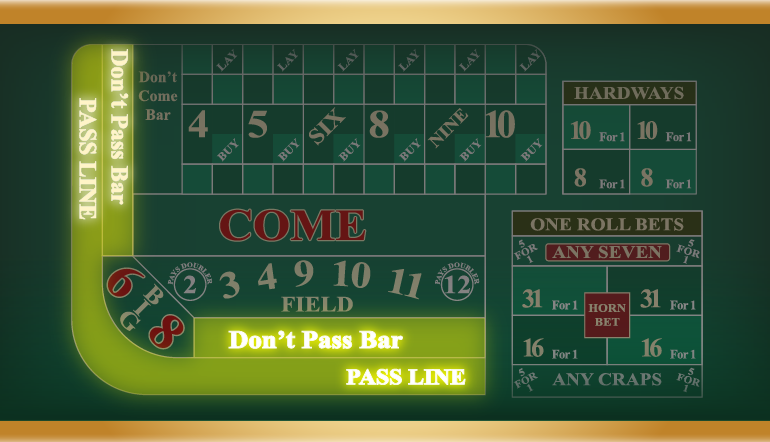
    When craps players learn the basics of how to play craps online or offline, they’re taught that the time to make a pass line bet is on the comeout roll. If it’s not the comeout, you can bet on come instead, with the same basic odds and gameplay.

    But what if you bet on the pass line and it’s not the comeout? Will the casino still accept your bet? Yes it will. A pass bet made on a roll other than the comeout is called a “put bet.”

    WHAT IS A PUT BET IN CRAPS?

    Put bets usually are a bad deal for players, but under certain conditions involving backing your wagers with free odds, put bets can be a viable way to play.

    The reason they’re bad bets is because they’re made after the comeout, so there is no initial roll with eight ways to win and only four ways to lose. On a regular pass bet, you win on the comeout if the shooter rolls any of the six ways to roll 7 or two ways to roll 11, and lose only on the one way to roll 2, one way to roll 12 and two ways to roll 3.

    Instead, the put bettor jumps into the action after a point has been established. You win if the shooter rolls your number again, and lose if he rolls a 7 first.

    CRAPS PUT BETS HOUSE EDGE

    The house has an edge on every point number. There are six ways to roll a 7 and only five ways to roll a 6, so if the point is 6 and you make a put bet, you’re a 6-5 underdog. Similarly, you’re a 6-5 underdog if the point is 8, 3-2 underdog if the point is 5 or 9 and 2-1 underdog if the point is 4 or 10.

    Like pass bets, put bets pay even money. You’re being paid less than the true craps odds of winning, so the house edge on a put bet is 9.1 percent on 6 or 8, 20 percent on 5 or 9 and a whopping 33.3 percent on 4 or 10.

    The lack of a comeout roll makes an enormous difference. If you bet pass before the comeout, the house edge is only 1.41 percent. With options such as 1.41 percent on come or 1.52 percent on place bets on 6 or 8, put bets usually are wagers to avoid, with four of the numbers even worse than the 16.67 percent edge on any 7.

    However, you can back put bets with free odds just like you can take free odds on pass bets.

    Free odds are secondary wagers made after a point has been established, and they are paid at true odds. Instead of being paid even money as on your pass or put bet, winning free odds bets are paid 6-5 if the point is 6 or 8, 3-2 if the point is 5 or 9 and 2-1 if the point is 4 or 10.

    Let’s look at what that does and imagine you bet $5 in free odds on 6 a total of 11 times, and the dice come up in the normal proportions of six 7s and five 6s.

    Your total risk is $55. On each of your five wins, you keep your $5 bet and get $6 in winnings. That’s $11 on your side of the table five times, so at the end of the trial you still have $55. There is no edge to the house.

    The size of the free odds wager permitted varies from casino to casino. A dwindling few allow a free odds bet equal to your pass, come or put bet. Others allow your free odds to be twice your original bet, some allow three times, and it’s not rare to see five times, 10 times and sometimes even 100 times.

    For a put bettor, it means you can choose your number, playing 6s and 8s while skipping the higher house edge numbers, and also put large proportions of your wager in free odds.

    That doesn’t help a lot with relatively little in free odds. At low odds multiples, you’d be better off making a place bet on 6 or 8. Winners on those bets pay at 7-6 odds and have a house edge of 1.52 percent.

    However, let’s look at what happens with 5x odds – that is, when your odds bet is five times your put bet.

    Now on the same 11 rolls where 7 comes up six times and 6 comes up five times, you risk $30 per roll with $5 on put and $25 in odds. That’s a total risk of $330.

    On each of the five winning rolls, you keep your $30 in wagers, get $5 in winnings on the put bet and $30 in winnings on your odds. That’s a total of $65 on your side of the table per win, and with five wins you have $325 of your original $330 at the end of the trial.

    Divide the $5 kept by the house by $330 in wagers, the multiply by 100 to convert to percent, and you get 1.52 percent – the exact same house edge as on place bets on 6 or 8.

    That’s the break-even point for put bets on 6 or 8 vs. place bets. With 5x odds, you’re getting as good a deal on place as on put. With more free odds, the balance shifts in favor of put plus odds. With 10x odds, for example, the house edge on a put-plus-odds combo drops to 0.83 percent.

    With the other place numbers, the tipping point is at 4x odds. When your odds bet is four times your put bet, the house edges are 4 percent on 5 or 9 and 6.67 percent on 4 or 10. Those are the same as the house edges on place bets on those numbers, though neither place nor put-plus-odds is as good a deal as when the points are 6 or 8.

    Do keep in mind that even on 6 or 8, getting the house edge as low as place bets requires wagers well above table minimums. Don’t overbet your bankroll and risk money you can’t afford to lose. If you wouldn’t normally bet enough to back a put bet with 5x odds or more, stick to smaller bets on pass, come or place bets.

    March 10, 2017

    By John Grochowski

    John Grochowski
  • ">
  • Body

    For nearly 25 years, John Grochowski has been one of the most prolific gaming writers in the United States. He’s been ranked ninth by GamblingSites among the top 11 gambling experts at Gambling Sites and his Video Poker Answer Book was ranked eighth among the best gambling books of all time.

    He started a weekly casinos column in the Chicago Sun-Times at the beginning of 1994 and He soon found himself in demand by a wide range of publications. He has written for casino industry professionals in Casino Executive and Casino Journal magazines, and for players in Casino Player, Strictly Slots and many other magazines.

    John’s twice-weekly columns appear in Casino City Times, Atlantic City Weekly and several websites. He has written six books on casino games, including the “Casino Answer Book” series. And, of course, John is a regular at 888casino Blog.

    Today John’s work includes a weekly column on baseball metrics for the Sun-Times. He lives in the Chicago area with Marcy, his wife of 30 years.

    John Grochowski
    factcheck
    Off
    hidemainimage
    show
    Hide sidebar
    show
    Fullwidth Page
    Off

    You don’t have to be rich to play baccarat and you definitely do not need to wear a tuxedo or evening gown when you play. Baccarat has come out of the ritzy, high-roller tables and into the casino proper.

    You can play for very reasonable sums on online casino and if you go to land-based casino there are usually a few mini-baccarat tables from which to choose. You will never have to longingly look at all those rich people acting, well, rich.
    However, you must learn how to correctly pronounce the name of the game or you forever be banished to someplace you don’t want to be vanished to.

    The game is not pronounced “back-a-rat.” No, it is pronounced “bah-cah-rah.”  If you call it “back-a-rat” you should only play the game in the back alleys of New York City where everyone mispronounces everything anyway.


    So here are the top eight ways to play the game, seven of them are positives and one is a warning to avoid something that should be avoided. I’ll get that one over first.

    STRATEGY TIP 1 - NEVER MAKE THE “TIE” BET

    Baccarat has very low house edges on two of its three bets; those three bets being Banker, Player and Tie. Banker comes in with a house edge of 1.06 percent. Player comes in with a house edge of 1.24 percent. Your expectation is to lose 1.06 units for every 100 units wagered on Banker and 1.24 units for every 100 units wagered on Player.

    Now, those are great house edges in the scheme of casino things.

    And now the rotten bet, the Tie. That bet comes in (hold your breath ladies and gentlemen) with a house edge of approximately 14.4 percent. Yes, I am not kidding, 14.4 BIG percent. Yikes! That means you lose 14.4 units for every 100 units wagered.

    This bet is a total waste of money and should only be played by individuals playing back-a-rat in alleyways.

    STRATEGY TIP 2 - BANKER IS CLEARLY THE BEST BET

    You come to the live baccarat table and you are going to make your first bet. That bet should be on the Banker. The Banker will win slightly over 50 percent of the time. In order not to give the player an edge on that bet every win has a 5 percent commission taken from it.

    You might as well go with the Banker.

    STRATEGY TIP 3 - KEEP GOING WITH BANKER UNTIL IT LOSSES

    We are looking to capitalize on streaks and the bet that will have the (slightly) better chance for a streak will be the Banker. If you find that the Banker does go on a streak from your first bet then keep betting it.

    Do keep in mind, however, that the fact a streak has occurred is no indication that it will continue to occur (meaning don’t be too aggressive with your betting amounts). You still face a house edge on every bet you make and you can’t bet your way out of such an edge.

    STRATEGY TIP 4 - WAIT ONE DECISION AFTER A BANKER LOSS

    So you finally lose on the Banker bet. Player wins. Don’t jump in with another bet. Wait for the next decision. Whatever that decision is then that is what you bet. Keep in mind that if the Tie is the decision neither the Banker nor the Player loses. (That’s why it’s called a tie.)

    STRATEGY TIP 5 - MINI-BACCARAT CAN BE MAXI-DANGEROUS!

    The traditional (meaning the high-roller room) version of baccarat, where players actually deal the cards, is a leisurely game; you might play 40 decisions an hour. But there is a fly in the ointment of baccarat. That fly is the mini-baccarat version of the game.


    There are two major differences between traditional baccarat and mini-baccarat. The first and obvious one is that the dealer deals the game, not the players. The second is the fact that the game is fast, as in fast, as in some dealers will get of between 150 to 200 decisions! Yes, that is fast.

    baccarat strategy

    Yes, the table minimum bets are usually lower than the traditional game but 200 decisions even with 1.06 and 1.24 house edges can be devastating if things go against you.

    If you are going to play mini-baccarat then you should utilize a Banker-only betting system. That’s right. You bet Banker until it loses. Then you wait until Player loses and go back to betting Banker. That will theoretically reduce in half (more or less) how many decisions you face. That will also theoretically reduce in half (give or take) your losing expectation.

    STRATEGY TIP 6 - TIE BETS DO NOT COUNT

    In this recommended style of play all Tie bets are invisible --- they don’t count; they are simply a pause in the action. If the sequence goes Banker, Banker, Tie, you treat the Tie as if it did not occur. You would therefore continue to bet Banker.

    STRATEGY TIP 7 - RIDE THE PLAYER BET UNTIL IT LOSES

    Here I am going to throw you a curve ball. When Player loses to Banker you will not wait out the next decision. You will immediately hop on the Banker. That’s right, when Banker wins you immediately bet it.

    Now, should Banker lose, follow number 4! We are always looking for Banker streaks.

    STRATEGY TIP 8 - MONEY MANAGEMENT IS CRITICAL IN BACCARAT

    Essentially you are betting a coin flip when you play baccarat. That makes it a tight game. Still, even with coin flips you can experience outrageous streaks for good or ill. Good is good but ill isn’t.

    If you are betting, say, 10 units per decision, give yourself 200 units as your session bankroll and should you lose that you take a break. And by break, I don’t mean you should yawn stretch and start playing again.

    Get up and get out. Take a walk. People watch. Take a nap. Give yourself some decent amount of time before you start playing again.

    If you have won a decent amount but you don’t want to quit right then; though you do want to leave the session a winner (whew, that was long winded), then split your win in half and only use that to continue your play. Lose it then take the rest of you win and go on break.

    Baccarat is a fun game. If you have a friendly table you can get in some socializing as well.
     

    June 14, 2016

    By Frank Scoblete

    Frank Scoblete
    Body

    Frank Scoblete grew up in Bay Ridge, Brooklyn. He spent the ‘60s getting an education; the ‘70s in editing, writing and publishing; the ‘80s in theatre, and the ‘90s and the 2000s in casino gambling.

    Along the way he taught English for 33 years. He has authored 35 books; his most recent publisher is Triumph Books, a division of Random House. He lives in Long Island. Frank wrote the Roulette strategy guide and he's a well known casino specialist. 

    Frank Scoblete
    factcheck
    Off
    hidemainimage
    show
    Hide sidebar
    show
    Fullwidth Page
    Off