Perhaps it is no coincidence that Las Vegas is located only 277 miles away from Hollywood. The short drive across the desert or one-hour flight via private jet provides easy access to casino tables for celebrities who look as striking on casino surveillance monitors as they do on the big screens where they prefer to be seen.

Not surprisingly, the biggest names are drawn to the hottest casinos. Spots like Bellagio, Wynn, Hard Rock, Venetian and Cosmopolitan all rank as magnets for Tinsel Town VIPs who like to get down. And it’s no wonder that they do.

The best casinos make ordinary people feel like movie stars. When bonafide stars roll in, with their deep pockets and recognizable faces, gambling bosses pay special attention. “Celebs love coming to Vegas because the casinos are very accommodating,” Howard Lefkowitz, president of Vegas.com, told Forbes. “They can have a spectacle or be shielded from the public eye.”

Ben Affleck walk of fame star with a king of hears card on it

BEN AFFLECK

Sometimes, though, the stars are not quite as appreciated as you would think. Such was the case with Ben Affleck, who learned to count cards and managed to bring down the house at the Hard Rock in Vegas.

Things ended for him in the same way that they end for most any advantage player, famous or not. A casino security guy tapped him on the shoulder and, according to Variety, said, “You’re too good at this game.” If it’s any consolation, he can heed the words of Bill Benter, formerly a card counter and now one of the world’s most successful horse betters. As the legendary gambler once told me, “If the casinos are not chasing you out, you’re doing something wrong.”

That said, Affleck’s back-off must have annoyed at least one group: dealers, pit-bosses and cocktail waitresses. During a particularly lucky night at the tables, he managed to rake in  $145,000 and showed his appreciation by giving it all away to casino employees.

Bruce Willis walk of fame star with a king of hearts card on it

BRUCE WILLIS

Bruce Willis, on the other hand, seems more than welcome on casino gaming floors. It doesn’t hurt he has reportedly been down some $100,000 at a Palms craps table. That he once snagged $500,000 playing baccarat in Atlantic City seems to bother no one.

Most recently, on the night of the Floyd Mayweather vs Conor McGregor fight, Willis, wearing a black leather jacket with a matching tee shirt emblazoned with the words New York City, was rolling the bones at MGM Grand. But that’s nothing new for the man made famous by “Die Hard.” Back in 2003, soon before he blew minds as a mob-burning boxer in “Pulp Fiction,” a fan spotted him at the Route 66 Casino in Albuquerque, New Mexico. Willis’s side-gigging band had just finished a set at the second-tier gambling den and he bought in for $5,000 at the craps table. The star ran his stake up to $9,000 and ultimately cashed out for $25,000 – which may be more than his short-lived band received for playing at this small-town joint.

John Cusack walk of fame star with craps dice on it

JOHN CUSACK

Another craps lover? John Cusack who’s next appearing as a vengeful white-collar criminal in the movie “Blood Money.” When it comes to casino action, he’s been heard to say, “A hot hand with dice is my idea of heaven. I can’t describe it. Anyone who thinks gambling isn’t for them would instantly change if they caught a winning streak playing craps.”

DEADMAU5

Famous nightclub DJ deadmau5 can surely relate. He embraces the risk of casino gambling and, perhaps, whenever he buys in, the mega-gambler/mega-partier Don Johnson ought to get a cut. “Deadmau5 wasn’t a gambler until he started playing blackjack with me,” Johnson relates “I was in a casino nightclub with Matt Bon Jovi [brother of rocker Jon Bon Jovi]. We went backstage to chat with deadmau5 and kicked around some stuff music-wise. I told [deadmau5] that if he has time after the show, he should join us for blackjack. He said he didn’t play, so I posted up his first few bets and they happened to hit. I gave him a free roll. It’s easy to enjoy blackjack that way.” Considering it all, Johnson remembers, “He wound up having a big night at the table and he’s been playing ever since.”

According to a story in Rolling Stone, deadmau5, these days, has gotten over any qualms about putting his own cash at risk. In describing his post-show activities, the magazine reports him making “a trip to the blackjack table where he was down nearly $100,000 before winning it back in 20 minutes and winning $50,000 more.”

Drew Carey walk of fame star with an ace of diamonds card on it

DREW CAREY

Sometimes, when it comes to celebrity gambling, it takes two to tango. TV star Drew Carey and the late “Simpsons” co-creator Sam Simon were hanging out together in Las Vegas. Both of them enjoy gambling and decided to indulge in that pursuit while waiting for lunch at Mandalay Bay (a hamburger for Carey, a veggie burger for Simon). Betting $1,000 a hand as their meals were being prepared, the pair managed to drop $200,000 or so between them. But Carey doesn’t mind gambling alone either – and having fun in the process. One anecdote has him playing blackjack for $500 per hand and trying to double down with a bobble head doll of himself.

Charlie Sheen star at the walk of fame with a ten of clubs card

CHARLIE SHEEN

That was entertaining, but, for Charlie Sheen, gambling has been anything but the stuff of amusement. During his divorce with Denise Richards, it came out that he was blowing $200,000 a week playing games of chance. En route to the hospital, for the birth of their child, Richards claimed, Sheen placed a call to his bookie to bet on a sporting event. Supposedly, he’s since given up on gambling for good. Maybe, though, he was just approaching it the wrong way. Sheen’s brother Emilio Estevez made the most of his gambling by serving as the big player for the blackjack team run by Rob Reitzen, one of the most successful gamblers in history.

Of course, though, few things would be more memorable than sitting at a blackjack table with Sheen and hearing him shout his oft voiced “Winning!” every time an ace and picture card came his way. Surely that’d earn the star a steak dinner and cement his status as a Sin City legend.

November 16, 2017

By Michael Kaplan

Michael Kaplan
  • ">
  • Body

    Michael Kaplan is a journalist based in New York City. He has written extensively on gambling for publications such as Wired, Playboy, Cigar Aficionado, New York Post and New York Times. He is the author of four books including Aces and Kings: Inside Stories and Million-Dollar Strategies from Poker’s Greatest Players.

    He’s been known to do a bit of gambling when the timing seems right.

    Michael Kaplan
    factcheck
    Off
    hidemainimage
    show
    Hide sidebar
    show
    Fullwidth Page
    Off

    In this article you will learn how to play a hard 16 when you play blackjack.

    A hard 16 is a blackjack hand that contains either no Aces, or if an Ace is present, it counts as one. Some examples of hard 16 are:

    • 10-6
    • 7-9
    • 4-4-8
    • 7-8-A

    HARD 16 PLAYING OPTIONS

    There are three viable options: hit, stand, or surrender. Which strategy you invoke depends on what the dealer’s upcard is and the rules of the game.

    HARD 16 BASIC PLAYING STRATEGY

    The following generic basic playing strategy summarizes how to play your hard 16 without regard to the actual cards that comprise your hand.

    • In a single- and double-deck game, surrender against a dealer’s 10 or Ace upcard, stand against a dealer’s 2 through 6 upcard, and hit against a dealer’s 7, 8, or 9 upcard.
    • In a multi-deck game, surrender against a dealer’s 9, 10, or Ace upcard, stand against a dealer’s 2 through 6 upcard, and hit against a dealer’s 7 or 8 upcard.
    • If the surrender option is not allowed, then hit your hard 16 instead.

    HARD 16 ADVANCED PLAYING STRATEGY

    A more advanced blackjack strategy with extra precision considers the composition of cards that make up your 16. For example, if your 16  is comprised of three (or more) cards, say 5 plus 6 plus 5, it is played differently than if it is comprised of, say, a 10 plus 6. The composition-dependent strategy is as follows:

    • If your hard 16 is comprised of three (or more) cards, in all cases, you should follow the above strategy for hard 16 with this exception:
      • Stand on 16 (instead of surrendering) against a dealer’s 10 upcard.
    • In a single-deck game with s17, hit a 9 plus 7 against a dealer’s Ace upcard (instead of surrender). 

    Additionally, if the hard 16 is the result of a pair split, then stand (instead of hit).

    REASON FOR THE STRATEGY

    A hard 16 is one of the worst hands you can get when you play blackjack because you will lose more hands than you win no matter what strategy you invoke. However, you can minimize your losses if you follow the previous playing strategy.

    The reason you should surrender a hard 16 is when your chance of winning is less than one out of four hands, i.e., your expected loss is worse than 50%. This means that statistically, if playing the hand has less than a 25 percent chance of winning and consequently greater than a 75 percent chance of losing, you will save money in the long run by surrendering the hand instead. This is the case with surrendering hard  16 per the previous strategies.

    The reason you stand on hard 16 when the dealer’s upcard is small (namely 2 through 6) is because the dealer’s chances of busting are relatively high (35 to 42%). In this situation, you don’t want to risk busting your hard 16 hand by drawing another card because you automatically lose even if the live blackjack dealer subsequently busts in the same round.

    When the dealer’s upcard is 7 through Ace, the probability of the dealer’s busting is lower, and she or he is more likely to make a pat (17 through 21) hand. In this situation, you are better off hitting 16 (if surrender is not a viable option), even at the risk of busting, since you will lose less in the long run (compared to standing).

    In the case of a multi-card 16, you should stand instead of hit against a dealer’s 10 upcard because of these reasons:

    • By having just one small-value card in your hand when you hold , say a 4 plus 6 plus 6, you increase the chances that the dealer will bust with a hit just enough to tip the balance in favor of standing (rather than hitting).
    • You also decrease your own chances of filling the hand with a hit, since you already hold two cards that you’d like to get when you hit.

    SUMMARY

    Keep these rules in mind before surrendering, hitting, or standing on a hard 16 and you will always lose less in the long run.

    For a complete basic playing strategy for any given mix of playing rules, consult Chapter 3 in the Ultimate Blackjack Strategy Guide.

    November 8, 2017

    By Henry Tamburin Ph.D

    Henry Tamburin
    Body

    Henry Tamburin is one of world’s most respected blackjack experts and a world-class player. He is the author of the Ultimate Blackjack Strategy Guide, and Blackjack: Take The Money and Run. He edited the monthly Blackjack Insider Newsletter, and was a featured blackjack columnist for Casino Player magazine, Midwest Gaming and Travel magazine, Gaming South magazine, Southern Gaming magazine, New England Gaming News, Jackpot, Bingo Bugle, and Casino City Times.

    He has appeared on numerous gaming shows on the Travel Channel and A&E network, and has been a guest on hundreds of radio shows. Tamburin is also a skilled blackjack tournament player, and an invited guest at the prestigious Blackjack Ball, an annual gathering of blackjack professionals.  He has taught thousands of players how to get the edge at blackjack in his seminars, card-counting classes, newspaper and magazine articles, and on his websites (smartgaming.com and bjinsider.com).

    Besides is prowess at blackjack, Tamburin is also a skilled video poker and craps player. His column on video poker playing strategies appeared monthly in Strictly Slots magazine, and he also authored these books: Ten Best Casino Bets; Craps: Take the Money and Run; Henry Tamburin on Casino Gambling; and Winning Baccarat Strategies.    

    Henry Tamburin earned a Bachelor of Science and Ph.D. degrees in chemistry and worked as a production and technical manager for an International Chemical company for 27 years while pursuing his avocation as a part-time professional blackjack player. 
     

    Henry Tamburin Ph.D
    factcheck
    Off
    hidemainimage
    show
    Hide sidebar
    show
    Fullwidth Page
    Off

    If you are like most video poker players, you do not expect a lot when you are dealt nothing but a low pair for your initial hand. It seems like these hands never turn into winners. But, is that really the case? If a low pair is such a bad initial hand. If they are, why do they end up so high on playing strategy charts?

    Let us take a look at what you can really expect when you are dealt a low pair and how to play video poker with that kind of hand. A full pay (9 for 1 for a full house, 6 for 1 for a flush) Jacks or Better game is used for the example, but other games have similar results. In order to be accurate with the results, we need to make sure the hands being considered have only a low pair. The information shown below is based on a hand with a low pair only and no possibility of a straight or flush.

    Let us look at the following sample hand. The initially dealt hand consists of the 6 of clubs, 6 of diamonds, king of diamonds, 8 of hearts, 2 of spades.

    Low Pair Video Poker

    Note that any hand with a low pair and no shot at a flush or straight produces exactly the same results.

    The highest return of any possible hold comes from holding the two 6’s.

    Pair of 6s at video poker

    The return for this hold is 4.1184 credits based on an initial five credit bet. That is better than an 80 percent return. While the return varies with other games and pay tables, a low pair does have a fairly decent return in any non-wildcard game.

    But, what makes up the return of 4.1184 credits? How many different hands are possible and how is that return spread over those hands?

    These are all very good questions. Here is the breakdown.

    Let us take a look at all the possible hands when holding just a low pair. The table below shows the number of occurrences, the percentage of that occurrence and the return rate for each possible resulting hand.

    HandFrequencyPercentReturn
    Loser11,55971.3%0
    Two Pairs2,59216%2 for 1
    Three of a kind1,85411.4%3 for 1
    Full House1651%9 for 1
    4 of a kind450.3%125 for 1

    Notice that a player loses a bit more than 71 percent of the time. What do video poker players remember? Actually, what does any gambler remember? They remember big wins. They remember royal flushes. Unfortunately a held low pair will never become a royal flush.

    So, other than big wins, what do gambles remember?

    Video poker players also remember losses. With a low pair, this means they remember the over seven losses out of every 10 hands. What they remember is not the minor winning hands, it is the hand after hand that ends up as a loss.


    While it may seem like more than seven losses out of every 10 hands, if you keep good records of your actual results over several thousand hands, you will find the results would be fairly close to the 70 percent losing hand rate.

    So why is a low pair rated so high in the returns and strategy?

    The table shows that every winning hand returns a profit to the player, not just the return the initial bet that often happens with a high pair. Not only that, but sometimes the profit is considerable.

    Additionally, while this table represents the game of Jacks or Better; had the game been Double Double Bonus Poker, there would have been additional lines for 4 Aces with a 2, 3, or 4; 4 Aces; 4 2s, 3s, or 4s, with an Ace, 2, 3, or 4; 2 2s, 3s, 4s, and 4 5s thru Kings. The frequency and percentage of these additional hands would have been lower, but the return would have been higher – dramatically higher in some cases (4 aces with a kicker of 2, 3, or 4 returns 400 for 1). Had the game been Triple Double Bonus, the return for 4 aces with a kicker would have been 800 for one – the same return as a royal flush!


    While it is true that a low pair will most often return nothing (more than seven out of 10 times), making it seem that one never wins with it, at times the win can be very healthy (up to 800 for 1 in Triple Double Bonus Poker). This explains its fairly high position in returns and strategy. The winning hands may not be very frequent, but they can pay extremely well.

    Remember also, in the game of Jacks or Better, the actual return for an initial hand of a low pair is 82 percent. While this number includes the fairly infrequent full house and four of a kind hands, it is still a very decent return – better than most of the holds on a strategy chart.


    While a high pair will guarantee you at least the return of your initial bet, you will always improve upon a 1-for-1 return when you win after holding a low pair. Maybe this type of thinking can help you get through that miserable 71+ percent loss rate of low pair hands.

    October 18, 2017

    By Jerry Stich

    Jerry "Stickman" Stich
    Body

    Jerry “Stickman” has been involved in casino gambling for nearly 30 years. He is an expert in blackjack, craps, video poker and advantage slot machine play. He started playing blackjack in the late ‘80s, learned several card counting systems and used these skills to become an advantage blackjack player and overall winner of this game. He also acquired the skills necessary to become an overall winner in the game of craps, accomplishing this by a combination of throwing skill and proper betting techniques. Stich is also an overall winner playing video poker. This was accomplished by playing only the best games and using expert playing strategy. 

    Jerry used his skills to help others also become better gamblers. He has taught advantage play techniques in blackjack, craps, video poker and slot play to hundreds of students. He is a regular contributor to top gaming magazines and has authored and co-authored various books on gambling.

    Jerry Stich
    factcheck
    Off
    hidemainimage
    show
    Hide sidebar
    show
    Fullwidth Page
    Off

    Video poker tournaments have been around almost from video poker’s beginnings. They are still popular events today. Many tournaments are free, or they require only a nominal fee to participate. While the prize amounts vary greatly, a first-place prize for a video poker tournament can be several thousand dollars. This certainly is enough to make a player want to do whatever possible to try to win a portion of that prize fund.

    There are two basic types of video poker tournament. They are either limited to a certain number of hands or limited to a specific length of time. Sometimes the tournament has both a time limit and a limit to the number of hands. Examples:

    • Video poker tournament session is limited to 15 minutes. The player attempts to play as many hands as possible in 15 minutes.
    • Video poker tournament session is limited to 200 hands per session with no limit time limit.
    • Video poker tournament session is limited to 200 hands or 15 minutes – whichever comes first.

    With no time limit, a player can take the time to play a strategy that is more complicated. However, if there is a time limit play should be as fast as possible. This will give the player the best chance to get a royal which will almost certainly lead to a prize. Most of today’s video poker tournaments have time limits making the “fast play” strategy more desirable.

    vp

    This article will cover one fast play strategy. Other articles will cover more complex strategies that are more useful when the tournament is not timed.

    So, how to play video poker tournament with the best strategy? Some prefer to play the same strategy as in non-tournament play; that is, play the optimum strategy designed to get the most return from each hand played. The reasoning is that the player will have to be lucky to win the tournament and this strategy will give you most from each hand. Hopefully that will be enough to put the player in the winner’s circle.

    Others advocate forgetting about all the lower paying hands and “go for broke” by simply saving for a royal flush on every hand. Those who favor this strategy also realize that to win a video poker tournament the player will need luck. It does not matter whether he or she is out of the money by 10 points or by 10,000 points. Either way, no money will be won. So why not give yourself the best chance you can to get some royals? If you are lucky with this strategy, you will win video poker – and win big. If you are not lucky, nothing will change – you will be out of the money either way.

    While normal video poker strategy varies based on the specific game and pay table, a “royals-only” tournament strategy remains the same regardless of the game or pay table. It really does not matter since you will only be saving for royal flushes.

    To use the “royals-only” strategy, you save only those cards that could produce a royal flush.  This is so simple that you may not even need to generate a formal strategy. Simply save for a royal flush.

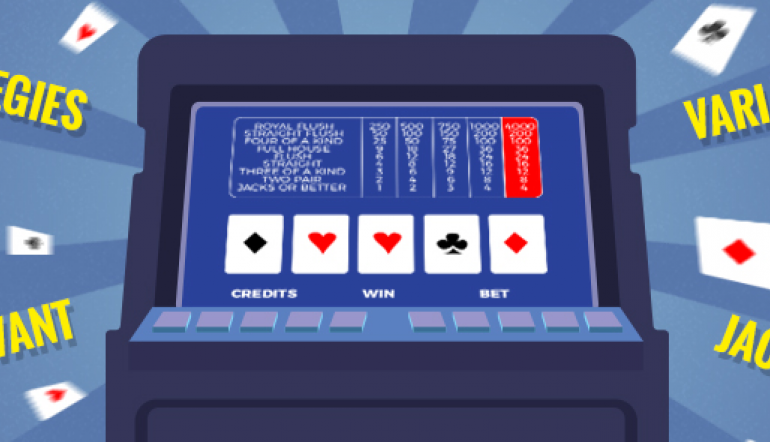
    If you have a video poker strategy program that will generate playing strategies, here is how you would set up the five-credit column of the pay table for jacks or better. For other games, enter “0” for any hand other than the royal.

    HandPays
    Royal Flush4,000
    Straight Flush0
    4 of a Kind0
    Full House0
    Flush0
    Straight0
    3 of a Kind0
    2 Pairs0
    Jacks or Better0

    The only hand that means anything in this strategy is the royal flush. Using a video poker strategy program, the following strategy was generated. Since fast play is the goal, we don’t mind simplifying our play a little so the “basic” strategy option was chosen over the advanced strategy option. In some cases, more than one line was generated that had the same exact return. When that is the case it does not matter if the lines are combined. The strategy after combining the equal paying lines follows:

    1. Dealt Royal Flush
    2. 4 cards of a Royal Flush
    3. 3 Cards of a Royal Flush
    4. Suited QJ, KQ, or KJ
    5. Suited AK, AQ, or AJ
    6. Suited JT, QT, KT, or AT
    7. A, K, Q, or J

    This strategy is simple while still zeroing in on the hands that will boost the appearance of a royal flush and your total score. It can be learned quickly and played rapidly since the lines of the strategy are very intuitive. That makes this royals-only strategy a great tournament strategy.

    Now you have a strategy that can be used to help improve your chances of ending up in the money in a video poker tournament. This strategy will work for any video poker game where the highest paying hand is a royal flush.


    video poker player


    Remember, all tournaments require luck, but if luck is on your side, a very simple strategy focused upon royal flushes will allow you to play the most hands giving you the best opportunity to score a tournament win.

    October 28, 2017

    By Jerry Stich

    Jerry "Stickman" Stich
    Body

    Jerry “Stickman” has been involved in casino gambling for nearly 30 years. He is an expert in blackjack, craps, video poker and advantage slot machine play. He started playing blackjack in the late ‘80s, learned several card counting systems and used these skills to become an advantage blackjack player and overall winner of this game. He also acquired the skills necessary to become an overall winner in the game of craps, accomplishing this by a combination of throwing skill and proper betting techniques. Stich is also an overall winner playing video poker. This was accomplished by playing only the best games and using expert playing strategy. 

    Jerry used his skills to help others also become better gamblers. He has taught advantage play techniques in blackjack, craps, video poker and slot play to hundreds of students. He is a regular contributor to top gaming magazines and has authored and co-authored various books on gambling.

    Jerry Stich
    factcheck
    Off
    hidemainimage
    show
    Hide sidebar
    show
    Fullwidth Page
    Off

    Casino players have the rare opportunity to play craps with a house edge of less than 1 percent. Unfortunately for low rollers, may require wagers too large for their comfort zone.

    What’s a player on a budget to do? We’ll do some comparison shopping right after we look at what’s needed to get the lowest house edge.

    To get that less than 1 percent deal, players either back pass and come bets with free odds or lay the odds behind don’t pass and don’t come bets.

    There is no house edge on the odds, and the house edge on pass or come combined with single odds is 0.8 percent, and that drops to 0.6 percent with double odds, 0.5 percent with triple odds and so on – the more of your bet is taken in odds, the lower the edge.

    It’s the same with don’t pass and don’t come and laying the odds. At single odds, the house edge on the combination is 0.7 percent, and that drops to 0.5 with double odds, 0.3 with triple odds and so on.

    However, most players don’t stop with one bet working at a time. One common method is to follow a pass bet with two come bets so you have three numbers working at a time.

    If the minimum bet is $5, then a pass and two comes means bets totaling $15 are at risk. If each is backed with single odds equaling the original bets, that’s a $30 total, and that grows to $45 with double odds and $60 with triple odds.

    All those bets could be wiped out at once if the shooter rolls a 7.

    It’s enough t make a $5 bettor more than a little nervous.

    What if you can’t afford that kind of money? What if your bankroll dictates table minimum bets? Should you just skip craps and move to a different game?

    You can still play and win at craps, although the house edge will be a little higher than in the method above.

    Here are some methods that keep the house edge under 2 percent while conserving your bankroll.

    TIP #1: STICK TO ONE PASS OR DON’T PASS BET, WITH ODDS

    Instead of having three numbers working, go with only one.

    You still drop the house edge to less than 1 percent, but instead of having $30 at risk with a pass and two comes backed with single odds, your wager total drops to $10. At double odds, the total rise to $15, with triple odds it’s $20 and so on.

    Where you stop is between you, your bankroll and how much odds are permitted at your casino of choice. But you can get the house edge under 1 percent while risking only twice the table miniumum.

    One drawback: Many players find this method boring. They’re drawn to the fast action and multiple wagering possibilities of craps. The remaining methods are for such players.

    Craps table

    TIP #2: SKIP THE ODDS

    This just feels wrong to some craps players because the odds are the best deal at the table, but there’s no point in low rollers worrying about bets they can’t afford.

    If they use the tried-and-true pattern of following a pass bet with two come bets to get three numbers working, then at a $5 table they would have $15 at risk at one time. 

    If they’re willing to limit themselves to one come bet after the pass, the risk is reduced to $10, and they can go with a rock-bottom $5 with just the pass bet.

    Nowhere near as much money is at risk as when you add free odds to the equation.

    Bottom line: The house edge on this method is 1.41 percent. It’s not as good a deal as those who can afford odds get, but it’s still one of the best bets offered in casinos.

    TIP #3: PLACE 6 AND / OR 8

    The most frequently rolled number in craps is 7. Six of the 36 possible two-dice combinaions total 7

    Rolled next most often are 6 and 8. There are five ways to make each of those numbers, making them numbers players love to have working.

    When you place 6, you’re betting the shooter will roll a 6 before the next 7. It works the same way when you place 8 – you want that 8 to come up before a 7.

    The house pays 6 and 8 at 7-6 odds, and that means you want to be in multiples of $6 to make that payoff possible.

    If you want to go with just one number working, you’ll have $6 at risk at a $5 minimum table. If you be both, then the total is $12, still far less than backing multiple pass and come bets with odds.

    Bottom line: The house edge on either 6 or 8 is 1.52 percent. You get a reasonably low house edge without putting too much of your bankroll at once.

    TIP #4: FOLLOW A PASS BET WITH 6 AND / OR 8

    For those who love to have multiple bets working, this assures you of having the two most frequent winners.

    Start with $5 on the pass line. If the shooter rolls a 6 or 8 on the comeout to establish that as the point, then make a $6 place bet on the other number in this pair.

    That gives you wagers totaling $11 at a $5 minimum.

    If the point is not 6 or 8, then follow your pass bet with $6 place bets on both numbers for a total risk of $17.

    Bottom line: You face a 1.41 percent house edge on pass and 1.52 percent on the place bets, giving you a nice combo with frequently rolled numbers at a reasonable house edge.

    SUMMARY

    If you can afford free odds, great. You can get the best of what craps has to offer. But if your bankroll is limited – and you should never bet more than you can afford to lose -- you still can play with house edges of less than 2 percent.

    These other methods may not be the absolute best in craps strategy, but sometimes the best deal you can afford is the way to go.

    August 21, 2017

    By John Grochowski

    John Grochowski
  • ">
  • Body

    For nearly 25 years, John Grochowski has been one of the most prolific gaming writers in the United States. He’s been ranked ninth by GamblingSites among the top 11 gambling experts at Gambling Sites and his Video Poker Answer Book was ranked eighth among the best gambling books of all time.

    He started a weekly casinos column in the Chicago Sun-Times at the beginning of 1994 and He soon found himself in demand by a wide range of publications. He has written for casino industry professionals in Casino Executive and Casino Journal magazines, and for players in Casino Player, Strictly Slots and many other magazines.

    John’s twice-weekly columns appear in Casino City Times, Atlantic City Weekly and several websites. He has written six books on casino games, including the “Casino Answer Book” series. And, of course, John is a regular at 888casino Blog.

    Today John’s work includes a weekly column on baseball metrics for the Sun-Times. He lives in the Chicago area with Marcy, his wife of 30 years.

    John Grochowski
    factcheck
    Off
    hidemainimage
    show
    Hide sidebar
    show
    Fullwidth Page
    Off

    Ever since Ed Thorp published his book Beat the Dealer in 1962 it has been an accepted that the diligent player can beat the casino at blackjack. As a kneejerk reaction to this, the casino owners met and decided to implement a series of changes to the game. After a late night meeting, in a smoke filled backroom, all the casino owners unanimously decided to change the rules of blackjack to make Thorps approach no longer valid. The result was that practically everyone stopped going to casinos. Occupancy ratings at the Las Vegas resorts dropped almost 90% in the weeks after the changes were implemented. The overnight changes made players think that the casinos were not playing fair. After only a few weeks the casinos were forced to reinstate the original rules. But the casinos decided to implement smaller changes over an extended to period of time to again make Thorps analysis invalid. The casinos went from 1 to 2 decks, than to 4 decks then to 6 and finally 8, as well make changes to the hitting, standing doubling rules. Over the years authors have made the appropriate adjustments to compensate Thorps analysis to account for the various rule changes. However some decisions are often misplayed by novice and professional players alike. One of the most commonly misplayed hands is the when the player holds a soft 19 (A-8). Here we will discuss some of the more costly misplays of that hand.

    The soft 19 total is a strong hand for the player. In fact it is such a strong hand that it is profitable against every dealer’s up card. It is so profitable that even when the player makes the wrong basic strategy decision the long term expectation is still positive. But our goal as an advantage player is to extract as much money from the casino as possible. So it is our objective to make the right decisions when we are playing.

    Mistake #1: The Playing Rules

    MISTAKE #1: BE AWARE OF THE PLAYING RULES

    The first notion for the soft 19 total is that the rules of blackjack you are playing impact some of the playing decisions of basic strategy. This is the strategy that on should adhere to if they were not keeping track of the cards played. For a 2 deck blackjack game whether or not the dealer hits or stands on a soft 17 impacts a critical decisions the player will encounter.

    The decision the player faces is when they hold A-8 when the dealer is showing a 6 up card. The reason is that when the rules dictate that the dealer must hit on a soft 17 the correct play is for the player to DOUBLE the original bet. In the case where the dealer is bound by the rules to stand on a soft 17 the correct play is for the player to stand against the 6. This is why the player has to be aware of the rules of the game before sitting down to play. In both cases the correct play gives the player a positive expectation of positive 49.7%. So for every dollar wagered the player will win 49.7 cents. Playing the hand wrong lowers the expectation to around 44%. This means we are making less money than we would get if we played the hand correctly, which is opposite of what the advantage player seeks to do.

    Mistake #2: Against a Dealer's 2 Upcard

    MISTAKE #2: AGAINST A DEALER’S 2 UPCARD

    Blackjack basic strategy is how a player plays any given hand when there is no information about the remaining composition of the deck. There are a few instances when the A-8 should be deviated from the basic strategy, this is when there is a preponderance of high cards to low cards remaining in the deck. The one soft 19 hand that causes some confusion is when it’s against a dealer’s 2 upcard.

    Basic strategy states that soft 19 should stand against a 2 upcard. When the player is playing and keeping track of the cards played, the player should double the hand when the normalized number of high cards to low cards ratio per deck exceeds 7.5 using a simple high low count.  This contradicts when the player has a hard total of 9 against a 2, when the doubling index number is just below 1.5, for the simple high low counting system. Basic strategy yields a positive expectation of approximately 38%. Doubling the A-8 in the defined circumstances gives an EV of approximately 50% which is a substantial increase.

    Mistake #3: Against a Dealer's 5 or 6 Upcard

    MISTAKE #3: AGAINST A DEALER’S 5 OR 6 UPCARD

    Another A-8 basic strategy hand that should be altered when the player is keeping track of the cards played is when facing a 5 or 6 dealers up card.  When the ratio of high cards to low cards exceeds 2 per deck using the simple hi lo count the player should double their original bet. The EV against a 5 and 6 respectively is approximately 44% and 50%. Doubling these at the defined ratio will drastically increase the EV of the player for these hands.

    SUMMARY

    These are some common mistakes seen for the soft 19 hand in blackjack. A-8 is a strong hand and will yield positive long term results, even if it is not played correctly. The astute player needs be aware of these common errors. Being aware of the errors will aid the player in squeezing every bit of money out of the casino. And that is the overall objective for the advantage player.

    October 25, 2017

    By Nicholas Colon

    Nicholas Colon
    Body

    Nicholas is a 17 year veteran of the casino gaming industry. He is former player manager with the infamous MIT Blackjack teams and is a regular attendee of the Blackjack Ball, a gathering of the world’s top professional gamblers.

    He is the Managing Director of the Alea Consulting Group, a leading gaming consultant company with a focus on gaming economics and, is a frequent contributor to world class business publications like Forbes and Entrepreneur magazines’ and over 15 gaming trade publications. He is also the founder of Casino Exploits a player centric casino gaming site.

    Nicholas has lectured at major US universities like Clemson University, Michigan State University and Duke University. His vast business and gaming  expertise, is supplemented by post graduate degrees in Medicine, Business Administration and Applied Physics.
     

    Nicholas Colon
    factcheck
    Off
    hidemainimage
    show
    Hide sidebar
    show
    Fullwidth Page
    Off

    One of the most persistent and powerful methods used to beat baccarat has been to use the knowledge of the rank of exactly one card in the shoe, (see this post). A "known-card" AP patiently counts down the shoe until their card reaches the window where it is eligible to be dealt in the following round, that is, the card is one of the next six in the shoe. The AP then follows a fixed baccarat strategy that tells him which wager to make to take full advantage of this information.

    One procedure that can lead to an exposed card is known as the “ribbon spread.” Bill Zender explains the ribbon spread as follows:

    “The dealer will remove approximately 20 to 25 cards from the front of the eight decks following the cut. The dealer will spread the cards face down on the layout, and starting from the dealer’s left count each card. Once the dealer locates the 14-th card, he/she places the plastic cut card between the 14-th and 15-th. The entire spread of card are picked up in order and placed behind the eight decks.”

    The point is that when the cards are removed from the shoe to be spread, the back card of the shoe may be exposed. This exposure is the key. First, the rank of the exposed card is noted by the AP. The AP then visually counts out the exact number of cards that were removed from the back of the shoe and spread. By subtracting this number from 416 (eight decks), the AP knows the exact location of the exposed card. For example, if a Seven of Clubs was exposed and 22 cards were spread then the AP knows that "a Seven is the 394-th card."

    It recently came to my attention that APs are engaged in using "known-carding" against the Dragon 7 (Fortune 7) and Panda 8 baccarat side bets. That makes sense. After all, if an AP is going to go through all the trouble to track a single card through a shoe, he may as well get whatever additional value he can from that knowledge. This post gives the edge for known-carding the Dragon 7 and Panda 8 side bets, based on the known card and its location in the six-card window. As will be evident, there are several situations when the AP can get a substantial edge.

    DRAGON 7 SIDE BET

    I begin with the Dragon 7 side bet. As a reminder, this side bet pays 40-to-1 if the Banker hand is a three-card winning 7, otherwise it loses. The combinatorial analysis for the Dragon 7 shows that the house edge for the Dragon 7 side bet is 7.6113%.

    The following table gives the edge for the Dragon 7 side bet based on the known card and its location in the six-card window:

    Dragon 7 Baccarat Side Bet


    SUMMARY

    The AP should make the Dragon 7 side bet in the following situations:

    • Ace in position 2 or 4.
    • 2 in position 2, 4 or 5.
    • 3 in position 2, 4 or 5.
    • 4 in position 5 or 6.
    • 5 in position 5 or 6.
    • 6 in position 1, 3, 5 or 6.
    • 7 in position 5 or 6.
    • T,J,Q,K in position 2 or 4.

    Overall, if the AP makes a Dragon 7 wager precisely when he has a known-card edge, then his average edge will be 29.3343%.

    Note the incredible edge possible when a 4, 5, 6 or 7 is the sixth card in the window. The reason for these extremes is that 4, 5, 6, 7 are premium drawing cards for the Banker hand to end with a three-card total of 7. On the other hand, it is impossible to get a three-card Banker total of 7 by drawing an 8, 9, T, J, Q, K.

    PANDA 8 SIDE BET

    The story for the Panda 8 side bet is not quite as lucrative. As a reminder, the Panda 8 side bet pays 25-to-1 if the Player hand is a winning three-card 8, otherwise it loses. The following table gives the edge for the Panda 8 side bet based on the known card and its location in the six-card window:


    SUMMARY

    The AP should make the Panda 8 side bet in the following situations:
    • Ace in position 6.
    • 3 in position 5.
    • 4 in position 5.
    • 5 in position 1, 3 or 5.
    • 6 in position 5.
    • 7 in position 5.
    • 8 in position 5.
    • T,J,Q,K in position 1, 3 or 6.

    Overall, if the AP makes a Panda 8 wager precisely when he has a known-card edge, then his average edge will be 28.8035%.

    Like the Dragon 7, there is an impressive edge possible when a 3, 4, 5, 6, 7 or 8 is the fifth card in the window. The reason for these extremes is that 4, 5, 6, 7 are premium drawing cards for the Player hand to end with a winning three-card total of 8, given that the Player is drawing to 0-5. Also, note that the Panda 8 is a sure loser if the fifth card is an Ace, 2, 9, T, J, Q, K. The table above shows a flat 100% losing probability in each of these cases.

    Side bets often have severely restricted maximum wagers. It is very unlikely that known-card play against the Dragon 7 and Panda 8 will take place on a table with a $25 maximum. Internationally, however, much higher limits can be found on these side bets.

    The key to defending against known-carding in baccarat is to carefully inspect the shuffle procedure. If a single card is exposed at any point in the shuffle procedure, then known-card play becomes a possibility.

    February 13, 2017

    By Eliot Jacobson Ph.D.

    Eliot Jacobson Ph.D.
    Body

    Received his Ph.D. in Mathematics from the University of Arizona in 1983. Eliot has been a Professor of both Mathematics and Computer Science. Eliot retired from academia in 2009. Eliot Jacobson

    After a decade as an advantage player, Eliot founded Jacobson Gaming, LLC in 2006. His company specializes in casino table game design, advantage play analysis, game development, and mathematical certification. Eliot's most recent book, "Advanced Advantage Play," based on material first published on his infamous blog apheat.net, has quickly become an industry best-seller on the topic of legally beating casino table games, side bets and promotions. Eliot consults with casinos internationally and is a sought after keynote speaker, trainer and seminar leader.

    Eliot is widely recognized as one of the world's top experts on casino table games

    Eliot Jacobson Ph.D.
    factcheck
    Off
    hidemainimage
    show
    Hide sidebar
    show
    Fullwidth Page
    Off

    As his name would imply, Richard Munchkin started small. As his high-flying status among professional gamblers confirms, however, he did not remain that way. In fact, he ranks among the most astute, most successful advantage players in the casino business. 

    Years ago, I had a chat with Stanford Wong, an icon of advantage playing who turned to book publishing after he got too hot to make a serious go of it in the casinos. I was unschooled on the ins and outs of the high-stakes world and felt compelled to get a handle on Munchkin. I asked Wong what he thought Munchkin’s strong suit was. “Richard Munchkin’s strong suit is anything he wants it to be,” Wong told me. “Munchkin can do whatever he wants and be successful at it.”

    FROM BACKGAMMON TO BEATING BLACKJACK

    For the big-time gambler with the diminutive sounding alias, it began when he was attending university in the United States during the 1970s. “I played backgammon and poker, making maybe $100 or $200 a week,” he tells me, standing in the living room of the home he recently purchased in Las Vegas. “I was playing backgammon with a dentist in a bar and he told me that he had a way of beating blackjack. He explained card counting to me and I thought it made sense.”

    For his 21st birthday, Munchkin bought himself a trip to Las Vegas. He knew basic strategy perfectly, applied it to blackjack games at casinos on the Strip and won a couple hundred dollars. Then he taught himself to card count, moved to Vegas and got a job as a dealer. The idea, ultimately, was to win money at blackjack and poker so he could finance a trip to Los Angeles, have a bit of a bankroll there and pursue his real passion: acting.

    DISCOVERING HOLE CARDING

    Munchkin eventually made it to LA, but, by then, gambling was too lucrative to forsake for acting. His big break as a casino player came when he met Alan Woods. Now deceased, Woods was a world-class blackjack master who went on to become one of the planet’s most successful gamblers by using computer models to crush horse racing betting. Woods wound up providing financing for Munchkin and partnered with him at blackjack. “We played for three months and I could not win,” Munchkin remembers. “I got buried but discovered that I was doing nothing wrong. I was just running badly.”

    Things improved dramatically when Woods recruited Munchkin to shuffle track with a team of five others. An advantage play invented in the late 1970s, it involves observing shuffles and predicting where certain cards in the new deck will be. Munchkin was taught the then-groundbreaking maneuver from a gifted bridge player of his acquaintance. Hole-carding – spotting the bottom cards of sloppy dealers – was enjoying a heyday as well. Munchkin took advantage of it. “There were so many casino games where you could just sit at first base and catch the dealer’s cards,” he says. “I would get barred on day shift and go right back on swing shift. Being out there and taking down casinos is part of the fun. I made enough money that I didn’t have to deal. I realized that it’s nice to not need a day job.”

    Richard Munchkin opinion on card counters

    "EVERY SINGLE GAME IN THE CASINO CAN BE BEATEN"

    Astute, adventurous and creative, Munchkin also learned that successful gambling does not begin and end with blackjack. “I believe that every single game in the casino can be beaten,” he says. “I have played winning games at almost everything.” And he is not even including the ever popular rebate gambits – in which advantage players find situations where casinos give back more money, in the form of rebates on loss, than gamblers necessarily will lose. “I don’t think that rebate plays count as beating the game. They count as beating the rebates.”

    Surely, though, Munchkin does not view slots as being beatable. Or does he? “With slot machines, to beat them, you focus on the progressives,” he says, referring to machines that must pay off when a certain amount of money builds up in the jackpot. “If the machine has to hit by $30,000 and it is at $28,000, then it might be a play. A sign tells you [if there is a point at which it must pay] and there are teams that do nothing but beat slot machines. They check the machines as if they are on a route.”

    As we talk, Munchkin underscores his point by beating horse racing. He makes wagers based on information coming in from a knowledgeable source. Then he smiles and says, “I just found out that a sports book will take more racing bets than I thought.”

    He places a few more wagers, then resumes his discussion on the soft spots to be found in casinos. “I know people who have beaten craps, roulette, the Big Six wheel,” he says, recognizing that I find the last of these gambling opportunities to be a little far fetched. “It’s the old dealer’s signature. You find live roulette dealers who spin the wheel consistently. At the Sahara [now defunct; SLS Las Vegas stands in its place], they had a promotion where you could spin the wheel yourself. People figured out how to make it land on the 50-to-1 spot. They kept spinning onto that until they got kicked out.”

    Just knowing one card in the deck and how to get it to a blackjack dealer is massive – drive a 5 his way and every hand on the table is playing at a 23-percent advantage – but for Munchkin, and others of his ilk, it goes way beyond that: “You can win at craps by controlling a single die; it’s not easy to learn but there are guys who do it. You beat roulette by watching the speed of the wheel and being able to predict where the ball will drop. It’s a learned skill – and you won’t pick it up in your basement over the course of a week.”

    REGRETS FOR NOT USING EDGE SORTING

    One play Munchkin did not do – and he seemingly finds it impossible to keep from envying – is the baccarat maneuver pulled off by Kelly Sun and Phil Ivey. It was a famous edge sorting play in which they manipulated dealers into turning cards so that Sun would be able to recognize them from the manner in which their patterns on back were trimmed. “If you want to win a lot of money from a casino, you have to play the major games,” says Munchkin. “If you want to win a real lot of money, you play baccarat. People routinely bet massive sums and the casinos don’t sweat the action because they think there is no way to beat it.”

    He hesitates for a second and adds, “Kelly is f*****g brilliant. She made millions and millions of dollars with that edge sorting play.”

    As for everyone else who wants to make serious money in casinos, Munchkin advises that you do not think like a card counter. “Card counters have tunnel vision,” says Munchkin. “They walk to a blackjack table, measure the card counting possibilities and ignore everything else. Me, I walk into a casino and I see opportunity everywhere.”


    August 6, 2017

    By Michael Kaplan

    Michael Kaplan
  • ">
  • Body

    Michael Kaplan is a journalist based in New York City. He has written extensively on gambling for publications such as Wired, Playboy, Cigar Aficionado, New York Post and New York Times. He is the author of four books including Aces and Kings: Inside Stories and Million-Dollar Strategies from Poker’s Greatest Players.

    He’s been known to do a bit of gambling when the timing seems right.

    Michael Kaplan
    factcheck
    Off
    hidemainimage
    show
    Hide sidebar
    show
    Fullwidth Page
    Off

    Updated on March 18, 2025

    In the world of casino table games, Ultimate Texas Hold'em (UTH) stands out as one of the most popular poker variants. While games like roulette and blackjack have long dominated the casino floor, UTH has carved out its own dedicated following. This article explores the optimal Ultimate Texas Hold'em strategy and analyzes the Ultimate Texas Holdem house edge to help you make informed decisions at the table.

    The Basics of Ultimate Texas Hold'em

    Ultimate Texas Hold'em shares similarities with traditional poker but includes unique betting structures that affect strategy. Unlike the unpredictable spin of a roulette wheel, UTH combines skill and probability in a way that rewards strategic thinking. Before diving into advanced concepts, let's review the basic rules:

    1. The player makes equal bets on the Ante and Blind.
    2. Five community cards are dealt face down.
    3. Each player and the dealer receive two face-down cards.
    4. Players then choose to either check OR make a Play bet of 3x or 4x their Ante.
    5. The dealer reveals the first three community cards (the "Flop").
    6. Players who checked previously can either check again OR make a Play bet of 2x their Ante.
    7. The dealer reveals the final two community cards (the "Turn/River").
    8. Players who haven't made a Play bet can either fold OR make a Play bet equal to their Ante.
    9. The dealer reveals their cards and announces their best five-card hand.
    10. The dealer needs a pair or better to "qualify."
    ultimate texas holdem casino game
    The Basics of Ultimate Texas Hold'em

    Now what? Well, either the dealer qualifies or they don't. The player beats, ties or loses to the dealer. Either the player's hand is good enough to qualify for a "Blind" bonus payout, or it isn't. The following table hopefully clarifies all of these possibilities and shows the payouts in every case:

    Ultimate Texas Hold'em Payouts Table
     Wager Result
    Winning HandDealer Qualifies?Ante PaysPlay PaysBlind Pays
    PlayerYes1-to-11-to-1Win
    PlayerNoPush1-to-1Win
    DealerYesLoseLoseLose
    DealerNoPushLoseLose
    TieN/APushPushPush

    The Blind bet pays according to hand strength when the player wins, with payouts ranging from 1:1 for a Straight to 500:1 for a Royal Flush. The complete pay table for the Blind bet is:

    • Royal Flush: 500-to-1
    • Straight Flush: 50-to-1
    • Four of a Kind: 10-to-1
    • Full House: 3-to-1
    • Flush: 3-to-2
    • Straight: 1-to-1
    • All other hands: Push

    These payouts form a crucial component of the game's overall house edge and significantly impact Ultimate Texas Hold em strategy decisions.

    Ultimate Texas Hold'em Strategy

    Ultimate Texas Hold'em is one of the most popular novelty games in the market. For that reason, it is important to understand the multitude of ways that UTH may be vulnerable to advantage play. Many of my recent posts have concerned some of these possibilities. But the computations are tedious. It took my computer 5 days to run the cycle where the AP sees one dealer hole card (see this post). Then my computer spent 8 days analyzing the situation where the AP sees one dealer hole card and one Flop card (see this post). After that, my computer crunched hands for just over 2 days, considering computer-perfect collusion with six players at the table (see this post). After all of this time spent on more advanced plays, I decided to take a step back to compute the ultimate texas holdem house edge off the top, using perfect basic strategy and no advantage play. It took my computer three days to run the pre-flop cycle and another two days to run the Flop cycle. Finally, I have some basic ultimate texas hold'em strategy data to present.

    ultimate texas holdem cards
    Ultimate Texas Hold'em Strategy

    After extensive combinatorial analysis of all 169 unique starting hands, evaluating both the edge for checking and raising 4x, I've reached several key conclusions. The analysis accounted for hand equivalence through suit permutations. For example, because the starting hand (2♣7♦) is equivalent to (2♥7♠), only one representative configuration needed to be analyzed.

    In particular:

    • The house edge for UTH is 2.18%.
    • Players should check pre-flop on 62.29% of the hands.
    • Players should raise 4x pre-flop on 37.71% of the hands.
    • Players have a pre-flop edge over the house on 35.29% of the hands.
    • The player should never raise 3x pre-Flop.

    Ultimate Holdem Strategy: Pre-Flop Decisions

    Developing a solid ultimate texas hold em strategy begins with pre-flop decisions. Based on comprehensive analysis, here's the optimal approach:

    When to Raise 4x Pre-Flop:

    • Any pair of 3's or higher
    • A2 through AK (suited or unsuited)
    • K5 through KQ (suited or unsuited)
    • Q8 through QJ (suited or unsuited)
    • JT (suited or unsuited)
    • Suited K2, K3, K4
    • Suited Q6, Q7
    • Suited J8, J9

    For all other starting hands, the correct play is to check. Note that raising 3x pre-flop is never the optimal choice, despite being an option in the game.

    Ultimate Holdem Strategy: Flop Decisions

    A Flop decision to check or raise 2x is only possible if the player checked pre-flop. By reference to the pre-flop strategy above, it turns out there are exactly 100 equivalence classes of starting hands where the player checked pre-flop. I re-ran my UTH basic strategy program to consider each of these 100 hands and each possible flop that can appear with that starting hand. For each starting hand where the player checked pre-flop, there are combin(50,3) = 19,600 Flops to consider. Thus, altogether, I had to evaluate the Flop decision to check or raise 2x for 100 x 19,600 = 1,960,000 situations. Shackleford's simplified approach to flop decisions sacrifices minimal expected value (typically less than 0.4%) while drastically reducing the cognitive burden on players. This practical approach to ultimate holdem strategy represents an excellent balance between optimality and usability.

    When to Raise 2x on the Flop:

    • Two pair or better
    • Any hidden pair (except pocket 2's)
    • Four to a flush with a kicker of Ten or higher
    ultimate texas holdem table
    Ultimate Holdem Strategy: Flop Decisions

    While this simplified strategy isn't perfect (it misses some subtle opportunities), the difference in expected value is minimal. For example, with (8♣J♦) against a flop of (2♣3♣Q♣), the optimal play is to raise 2x despite having only four to a flush with an 8 kicker. This likely stems from the combined possibilities of runner-runner straight draws, flush draws, and pairing possibilities. However, checking in this situation costs only 0.377% in expected value – a small price for strategic simplicity.

    Ultimate Holdem Strategy: Turn/River Decisions

    The final decision point comes after seeing all five community cards. At this stage, you must decide whether to fold (surrendering your Ante and Blind bets) or make a Play bet equal to your Ante.

    One can certainly use Shackleford's very easy Turn/River strategy for that final decision:

    • Raise 1x when you have a hidden pair; or
    • Raise 1x when there are fewer than 21 dealer outs that can beat your hand
    • Otherwise, fold

    This derives from the mathematics of expected value. When you fold, your EV is -2 (losing your Ante and Blind). When you raise and face N potential dealer "outs," your expected value equals 1-4p, where p is the probability the dealer beats you. For raising to be correct, this value must exceed -2, which occurs when the dealer has 20 or fewer outs to beat your hand.

    Mathematical Derivation of the "20 Outs" Rule

    My complete method here, were I to do it, would be to post spreadsheets containing computer-perfect play so that the reader could devise his own turn/river strategy. Of the 1,960,000 flop possibilities mentioned above, exactly 1,273,842 of them correspond to the player checking on the flop. Each of these checking possibilities yields an additional combin(47,2) = 1,081 Turn/River hands to complete the board, where the player has to then choose to either fold or raise 1x on each. That is, the complete spreadsheet analysis of the Turn/River decision would mean posting a total of 1,960,000 x 1,081 = 1,377,023,202 hands for the reader to consider.

    Yeah, well ... at any rate, for the curious, here is my derivation of Shackleford's result concerning playing hands with 20 or fewer dealer outs.

    When you fold, your expected value is clearly -2 units (losing both Ante and Blind).

    If N represents the number of dealer outs that can beat your hand, the probability of the dealer's first card being an out is p₁ = N/45. For the dealer's second card, if their first card missed, they typically have approximately 3 additional "pair outs" plus potential runner-runner outs. This gives a second-card probability of approximately p₂ = (N+4)/44.

    The overall probability of the dealer beating you becomes: p = N/45 + [(45-N)/45] × [(N+4)/44]

    Simplifying this equation: p = (-N² + 85N + 180)/(45×44)

    Note that if the dealer doesn't hit an out, then he won't qualify. It follows that the EV for the player who raises 1x on the Turn/River bet is:

    EV = p*(-3) + (1-p)*(1) = 1 - 4p.

    We make the raise whenever EV > -2. That is, 1 - 4p > -2. Solving for p gives

    p

    That is, the player raises 1x when his chance of beating the dealer is 25% or higher.

    Substituting our expression for p and solving the resulting quadratic equation: N² - 85N + 1305 > 0

    This yields roots of approximately 64.9 and 20.1. Since the number of outs must be positive and must satisfy the inequality, the solution is N ≤ 20.

    This mathematical foundation gives us the practical "fewer than 21 dealer outs" rule for Turn/River decisions in ultimate texas hold em strategy.

    Understanding the Ultimate Texas Holdem House Edge

    deck of cards
    Understanding the Ultimate Texas Holdem House Edge

    After extensive computational analysis, we can quantify the house edge for Ultimate Texas Hold'em:

    • Computer-perfect strategy: 2.18497%
    • Shackleford's practical strategy: approximately 2.43%
    • Grosjean's strategy (from Exhibit CAA): 2.35%

    This house edge is quite favorable compared to many casino games. For comparison, American roulette odds heavily favor the house with a 5.26% edge due to the double zero on the roulette wheel. Even single-zero European roulette maintains a 2.7% house advantage.

    The moderate house edge makes Ultimate Texas Hold'em attractive to strategic players. While not as favorable as blackjack strategy with its potential sub-1% house edge (under optimal rules), UTH offers better odds than most other poker-based table games and nearly all blackjack side bets.

    Ultimate Texas Hold em Strategy - Final Thoughts

    Ultimate Texas Hold'em rewards strategic play while offering a reasonable 2.18-2.43% house edge when using optimal ultimate texas hold'em strategy. While perfect play requires complex calculations, simplified approaches like Shackleford's provide excellent results for practical use. By applying the strategies outlined above, you'll minimize the ultimate texas holdem house edge and improve your chances at the tables.

    Remember to play responsibly and enjoy the strategic depth UTH offers compared to many other casino games.

    Originally published on June 1, 2015

    March 18, 2025

    By Eliot Jacobson Ph.D.

    Eliot Jacobson Ph.D.
    Body

    Received his Ph.D. in Mathematics from the University of Arizona in 1983. Eliot has been a Professor of both Mathematics and Computer Science. Eliot retired from academia in 2009. Eliot Jacobson

    After a decade as an advantage player, Eliot founded Jacobson Gaming, LLC in 2006. His company specializes in casino table game design, advantage play analysis, game development, and mathematical certification. Eliot's most recent book, "Advanced Advantage Play," based on material first published on his infamous blog apheat.net, has quickly become an industry best-seller on the topic of legally beating casino table games, side bets and promotions. Eliot consults with casinos internationally and is a sought after keynote speaker, trainer and seminar leader.

    Eliot is widely recognized as one of the world's top experts on casino table games

    Eliot Jacobson Ph.D.
    factcheck
    On
    factcheck text
    Frederico Pereira
    hidemainimage
    show
    Hide sidebar
    show
    Fullwidth Page
    Off