One Million Dollars Says I Can Beat Donald Trump at His Own Game

As President of the United States Donald Trump is expected to take on some tough adversaries, from the heads of other countries to special prosecutors in his own. But throughout Trump’s colorful and outrageous public life he has taken on plenty of challenges - in business, in his personal life, and even across the live tables at his casinos in Atlantic City. Sometimes he’d emerge the victor. Other times he’d lose. But occasionally, when Trump knew he didn’t stand a chance to win, he’d duck out. That’s exactly what he did when Las Vegas casino owner Bob Stupak came calling in 1989.

Bob Stupak was a classic Las Vegas story. The son of a professional gambler who ran a dice game in Pittsburgh for fifty years, the younger Stupak had a hustler’s heart. He made a fortune in the burgeoning coupon book industry in 1970s, mostly on the strength of his personality and salesmanship, selling a deal to both businesses and customers that neither likely needed. He parlayed his success into a small parcel of land north of the Las Vegas Strip that he transformed into Vegas World, a bargain-priced second-rate hotel and casino. But Stupak used his gifts for self promotion and hustling to draw outsized-attention to the under-sized property. From offering his own rules on blackjack (both dealer cards face up) to making a million dollar Super Bowl bet with another casino owner, to running for mayor of Las Vegas, Stupak knew how to get publicity for his Little Casino That Could.

As Vegas World grew throughout the 1980s, the gaming establishment began to take the upstart Stupak more seriously. When he built Vegas World in 1979 he had 100 rooms and grossed $15 million. By 1989 he had a thousand rooms and grossed $100 million a year. The slogan at Vegas World was “The Sky’s the Limit,” and Stupak put his money where his mouth was. His betting limits were $2,000, double the limit at the ritzy Caesar’s Palace on the Strip. And he was planning to literally reach into the sky with the construction of the 1,000-plus foot Stratosphere Tower.
But no matter how much success Bob Stupak had, he couldn’t seem to emerge from the shadow of another casino mogul on the East Coast, Donald Trump. Trump, too, was gifted at generating publicity for himself - and most importantly building a cult of personality around himself as a genius businessman with no equal. In 1989 Trump made Forbes’ list of the world’s billionaires for the first time, and they estimated his worth at $1.5 billion. While we now know that much of his wealth at that time came from borrowing heavily to purchase money-losing properties, at the time he looked like someone who had amassed a billion dollar fortune in less than four years. And though the following year his net worth would be estimated by Forbes at possibly zero, in 1989 he was still thought of as the country’s avatar of success, and a media darling with bestselling books, a football league, a number of properties in New York and casinos in Atlantic City with his name across the side in capital letters.

In February 1989 at a press conference at Trump Tower, Trump unveiled his latest business venture: a board game called “Trump: The Game.” The tagline for the game was “It’s not whether you win or lose, it’s whether you win!” The game would retail for $25 and Trump pledged his portion of the profits to go towards charities for AIDS research and cerebral palsy.

"Trump: The Game" board game

The game wasn’t designed by the casino mogul, but by game designer Jeffrey Breslow. Trump’s one requirement of the game was that he “didn't want a game based solely on chance. I wanted a game based on talent. And I wanted to teach people if they have business instincts. It's great if they can learn that from a game instead of having to go out and lose your shirt." Breslow and Milton Bradley did their best, creating a game that was similar to Monopoly, although much more complex, using a system of blind bidding for properties and relying less on the luck of the dice. As a consequence, the rulebook was more than 12 pages long.

When Bob Stupak heard about the game, he had an idea. He drew up a letter to Trump. The letter began: “Dear Mr. Trump, I realize how great you are. You have reminded us many times through the media and through your book, which I greatly enjoyed. And now, among your many, many endeavors, I see that you have introduced your very own game, ‘Trump: The Game.’ I have heard you quoted on television to the effect, ‘This game will show if you have it, and if you don’t, just enjoy the wife and the kids.’

Well Donald, now you’ve entered my arena…” 

The letter went on to read in all capital letters: “ONE MILLION DOLLARS SAYS I CAN BEAT DONALD TRUMP AT ‘HIS OWN GAME.’”

The letter Stupak wrote to Trump

Stupak took the letter and sent it to the New York Times, offering to take out a full page ad to run the letter in full. The Times declined. He then went to the Wall Street Journal, who also turned him down. Finally he convinced the New York Post to run his letter as a full page ad. He also took out a page in the Atlantic City press as well, just for good measure.

After Stupak’s challenge, many of his friends in Vegas said they didn’t think Trump would even respond. So Stupak, like a true gambler, offered them to bet. He got 2-1 against and took all comers, stacking up plenty of side action to go along with the publicity his challenge was generating. Those who bet against Stupak didn’t understand Donald Trump the way Bob Stupak did. Perhaps it was because the two men were kindred spirits - larger-than-life self-aggrandizing men who let the media and the public define them. Stupak would collect from his doubters when Trump issued a statement in response to media inquiries about the challenge, a response that doubled as a dig at Stupak. “Playing a man I don’t know and haven’t heard of for $1,000,000 is a no win situation,” Trump told reporters. “It’s always possible to lose, even for someone who’s used to winning.”


Stupak’s response? “Well if he doesn’t know me and hasn’t heard of me, he must have been living in Russia.” And he had a point. It was unlikely Trump didn’t know about Bob Stupak. Like Trump, Stupak put his name across the top of his hotel in big lights. He made his business more about himself and his personality than anything else. When Stupak was asked if his challenge was an attempt to ride on Trump’s coattails he showed just how much the two men were cut from the same cloth when he said “I’m not looking to ride on Donald Trump. I’m giving him an opportunity to ride on my reputation,” a Trumpian answer if there ever was one.

Not to be deterred, Stupak pressed on with his challenge. He produced his own board game called “Stupak: The Ultimate Game of Skill and Chance.” He offered Trump a new bet: Trump wouldn’t have to put up a penny, and Stupak would put up $250,000 and the winner of the game could decide which charity Stupak would give it to. Stupak chose Las Vegas disability services non profit Opportunity Village. “I read that things are a bit tight at your place,” Stupak wrote in reference to massive losses reported at Trump’s Atlantic City properties, “so I’ll put up all the money. Surely you can spare a few hours away from your lawyers for a friendly game when your favorite charity (or mine) will be the big winner.”

"Stupak: The Ultimate Game of Skill and Chance" cover

Again Trump rebuffed Stupak’s challenge, though this time it was a bit harder. The public clamored for Trump to accept. After all, he had nothing to lose and it would all go to charity. Opportunity Village sent a telegram to Trump asking him to please accept.

One issue at play beneath the surface of this gambit by Bob Stupak was that Donald Trump had been making statements about moving into Las Vegas and developing property there. “Donald says he wants to come to Las Vegas,” Stupak said at the time. “If he does, then he should come out and get involved in the community. I hope he accepts the challenge this time, because it’s for a worthwhile cause.”

Trump never responded, but Stupak had won plenty. He got his name in papers from coast to coast. He made himself look more outlandish and bold than his rival. He earned some respect from the Las Vegas community. And he had people talking about Vegas World and Bob Stupak once again.

Trump: The Game, meanwhile, was a flop. Milton Bradley had hoped to sell two million units in the first year. It sold only 800,000. People were reluctant to purchase a game from a real-life billionaire and line his pockets. So Milton Bradley re-cut the commercial and added in a voiceover declaring that Trump’s proceeds from the game were going to charity. It didn’t help. The truth was that the game was overly-complicated and not very fun. Why would people want to play Trump: The Game when they could play Monopoly?

Years later when talking about the challenge with his biographer, Las Vegas Review columnist John Smith, Stupak admitted that he never even read the rules of Trump: The Game. If he had, he’d have noticed that the game requires at least three players. It’s not even possible to play it heads-up. For all his carping about why he couldn’t accept Stupak’s challenge, Trump never even mentioned this important, disqualifying point. Perhaps Trump, too, didn’t even know how to play his own game.

January 7, 2018
David Hill
Body

David Hill is a writer and author from New York. His work has focused on the world of gambling, from chess hustlers to poker pros and everything in between.

He is the author of the forthcoming book "The Vapors: A Casino in Southern Gothic" from Farrar, Strauss & Giroux. 

factcheck
Off
hidemainimage
show
Hide sidebar
show
Fullwidth Page
Off

Why Would I Rather to Play at Live Casino?

 I think I speak for all of us when I say that I would rather enjoy family dinners in casinos than at the homes of relatives. Considering that I sometimes find myself joining in on those very sorts of meals in London, a long way from my base in the United States, I feel that it’s only fair for me to have a say in where we do the dining. But, as I’ve found, it’s tough to corral my loved ones and convince them that we should caravan to, say, Crockford’s, in order to break things up with sessions of craps, roulette and blackjack between courses. It simply never works.

Recently, though, I’ve discovered that it’s easy enough to bring casinos to the homes of family members, which makes going all the way to England for familial gatherings all the  more agreeable. I live in New York and Elite Lounge Live Casino — the latest iteration of online gaming, with live dealers sliding out cards, spinning roulette wheels and tossing dice — is not yet authorized there. But that doesn’t stop me from toting along my laptop and playing in England, a long hop across the Atlantic Ocean, where online gaming is totally legal.


Most importantly, while there, I am not risking my money with a fly-by-night operation. Elite Lounge Live Casino is put on by one of the world’s most highly regarded online casino giants, 888 Casino. The company has been in business since 1997, maintains a stellar reputation and its sharply designed logo adorns the shirts of countless World Series of Poker superstars. So I am sold on the legitimacy of it all. Plus what the dealers are doing is plain to see. That seriously boosts my confidence — and enjoyment.

Elite Lounge live roulette

Apparently, I am not the only one who feels this way — about the honesty and aesthetics of Elite Lounge Live Casino. “It looks like our members appreciate the investment and the attention to detail we put into this top-end environment,” Itai Pazner, 888’s COO. “As far as feedback from our customers, they have recognized that we have provided them with a unique environment that has shattered the barrier between land-based casinos and the online live casinos.”

Blackjack stands firmly as my casino game of choice and, via Elite Lounge and Live Casino, it plays much like the versions in brick-and-mortar properties. Rather than putting me up against a random number generator, which always starts with fresh decks of virtual cards, Live Casino allows me to play against real dealers who deal actual cards out of a regulation shoe.

As in traditional casinos, the tables at Live Action feature six-decks of cards that get reshuffled at various points. So when I get dealt, say, an Ace, 8 of spades (soft 19), I know that those cards are out of the game until the next shuffle. There is also a sense of elegance, similar to what can be found in the high-end gaming enclaves of casinos such as Venetian and Palazzo in Macau and Las Vegas. “We definitely took inspiration from this world in creating our Elite Lounge,” confirmed Pazner.

Elite Lounge blackjack table at 888casino live casino

Contributing to the reality of it all, there’s socializing at the table — chatting it up with other players via messaging —  and the rest of my family members can’t help but join in, busting out their devices and putting up their money. It’s the next best thing to being in a casino and a far cry from the online gambling of yore, where you played against invisible technology.

The well-dressed dealers — men wear suits; women show up decked-out in finery that’s sexy enough to catch your eye but not so revealing that you lose focus on your cards — are hooked up with microphones and can actually talk to players at the tables. So they totally keep it real, as do the ambient casino sounds. You hear cards being shuffled, people chattering away, chips riffling. And you can play new, innovative games that include Speed Roulette and Dream Catcher (one more new-comer, Double-Ball Roulette, is in the offing). “888 Casino understands that it is important to provide tailored experiences that meet the various preferences and demands of [our] players,” Guy Cohen, VP B2C at 888.

As far as I’m concerned, he’s right. Once logged in and set up with chips, I feel like I am playing at my local gambling joint. All I need is for somebody to bring me cocktails.

However, it wasn’t until I did a bit of snooping around that I discovered why the online environment seems so authentic: it is actually a real casino in Malta. No wonder it all feels so true to life.

Clearly, little has been spared in making Elite Lounge & Live Casino into the best possible experience for the players. In some regards, it is actually better than being in the kind of casino to which you travel. The visuals here are all high-definition and the the roulette games alone are outfitted with 15 or so cameras. The beauty part there is that they allow you to watch the game from various angles and even to slow down the movement of the ball so that you can view it in slow motion.

Blackjack dealer at the elite lounge blackjack table

To my mind, that feature accomplishes two things: For one, you can milk the moment by observing the ball making its turns in tiny increments. This is the roulette equivalent of slowly turning up a card at blackjack or poker — what gamblers call “sucking it” — so as to slowly reveals suit and value. Furthermore, making the circle in slow motion provides incontrovertible proof that the game is completely legitimate. There is nothing happening that is  too fast for the naked eye to see. Even the fanciest casinos on the Vegas Strip can’t do that for you.

What you don’t see when you play Live Casino is how it all happens. For that, a trip behind the scenes and to the actual location is required. Dealers there are all trained not only to divvy out cards like the pros that they are but also to communicate clearly with players. It all goes down in a manner that seems completely in line with the way thing transpire in the physical casino of your choice.

Because the Elite Lounge Live Casino experience comes to your location from an actual gaming floor in Malta, you play alongside gamblers who walked into the brick-and-mortar casino. It gets no realer than that. High tech, well lit, shot with the best camera gear out there, the experience is completely transporting. There is even a Grand VIP table where you can play for stakes as high as 10,000-pounds per hand. However, that game is a little rich for my blood, so it’s also nice to be able to play for as little as 50p.

It all adds up to the perfect combination of real-world casino play, complete with action and interaction, and the online casino option, which feels as convenient as ordering in dinner from your local burger joint. Best of all, for me, until 888’s Elite Lounge Live Casino comes to New York, it’s one more reason to visit the relatives in England. Considering the real-life backdrops of Elite Lounge Live Casino, playing on the site brings a sense of exoticism to the proceedings. As Pazner put it, “The unique build of the environment allows us to transport our players to the top casino locations around the world.”

And, clearly, I’d rather be there than in a relative’s dining room.


January 7, 2018
Michael Kaplan
  • ">
  • Body

    Michael Kaplan is a journalist based in New York City. He has written extensively on gambling for publications such as Wired, Playboy, Cigar Aficionado, New York Post and New York Times. He is the author of four books including Aces and Kings: Inside Stories and Million-Dollar Strategies from Poker’s Greatest Players.

    He’s been known to do a bit of gambling when the timing seems right.

    factcheck
    Off
    hidemainimage
    show
    Hide sidebar
    show
    Fullwidth Page
    Off

    Blackjack Hands That Play Differently Depending on the Playing Rules

    I usually get an email or phone call a few times each month from a blackjack player who asks me the following question: “Your article said to stand on (a specific hand). I’ve read in a book (or on the Internet) that you should hit that hand. Who’s right?”

    The reason you might see someone say or write something different from what I wrote is because the playing strategy for some hands will change depending upon the number of decks being used and/or the mix of playing rules. (This is why I always include the number of decks and pertinent playing rules whenever I discuss a playing strategy.) To give you some examples of what I mean, take a look at the following blackjack hands and decide how to play them for two sets of different rules.

    Note: I’ll use the following abbreviations:
    h17 = dealer must hit soft 17
    s17 = dealer must stand on soft 17
    das = player may double down after pair splitting
    ndas = player may not double down after pair splitting

    Ace and 8 vs. Dealer 6

    A-8 VS. DEALER 6

    1. Six-deck game s17
    2. Six-deck game h17

    In a multi-deck blackjack game with h17, you need to be more aggressive and double down on soft 19 against a dealer 6 rather than stand (which is the correct strategy for s17). The major contributor as to why doubling down is better is because when the dealer must hit soft 17, is because she will bust more often compared to when she must stand on soft 17.  (Note: There are other contributing factors but this is the main one.)

    A-7 vs. Dealer 2

    A-7  VS. DEALER 2

    1. Double-deck game, h17
    2. Double-deck game, s17

    When the live blackjack dealer has to hit soft 17, a player needs to be more aggressive and double down on soft 18 against dealer 2 for the same reason as the above hand. (Betting  more by doubling when the blackjack dealer’s chances of busting increases with h17 rule.)

    A pair of 7s vs Dealer 10

    7-7 VS. DEALER 10

    1. Six-deck game, h17
    2. Single-deck, 17

    In a six- (and double-) deck blackjack games, the correct strategy is to hit your pair of 7s (and hope you draw a 3, 4, 5, 6, or 7). (You’ll lose less in the long run by hitting, compared to splitting.) In a single-deck game, the better play is to stand (rather than hit). The logic for standing is you have removed from play two 7s (the cards in your hand) making the likelihood of drawing a third 7 (for a 21), and beating a potential blackjack dealer’s 20, slim. This shifts the odds in favor of standing vs. hitting. (The effect of card removal is more pronounced with a single deck as opposed to, say, six decks. Thus you are less likely to draw a third 7 in a single-deck game as opposed to a six-deck game where there could be as many as twenty-two more 7s remaining in the unplayed cards.) (Note: Surrender is not common in single-deck games; however, if it were offered, the better play when dealt a pair of 7s against a dealer’s 10 upcard in a single-deck game is to surrender the 7s.)

    6-3 vs. Dealer 2

    6-3 VS. DEALER 2

    1. Double-deck game, h17
    2. Six-deck game, s17

    In a six-deck game, you should hit 9 against a dealer 2. (You double only when the blackjack dealer shows a 3 through 6 upcard). In a double-deck game, you should double down on your 9 against a dealer’s 2 upcard. (You double 9 against a dealer’s 2 through 6 upcard.) The logic for doubling against a dealer 2 in a double-deck game is because the fewer the number of decks of cards, the more you don’t want to draw the cards that you hold in your hand when you double down.  Since you’ve removed two small-value cards that make up your 9 (which you don’t want to draw when doubling), this makes doubling a better play over hitting in a double-deck game.

    6-5 vs. Dealer Ace

    6-5 VS. ACE

    1. Six-deck game, s17
    2. Double-deck game, s17

    In a six-deck game with s17, the correct strategy is to hit against a dealer’s A. (The rule is to double down your 11 if the blackjack dealer shows 10 or less; otherwise hit, meaning you hit against a dealer A.) In a double-deck game with s17, the optimal play is to always double down on 11 (even when the blackjack dealer shows an A). (The logic for doubling 6-5 in a double-deck game is the same as for the previous hand; namely, you’ve removed two cards that you don’t want to get on the draw, which is a more pronounced effect in a double-deck than for a six-deck game.)

    10-7 vs. Dealer Ace

    10-7 VS. ACE

    1. Six-deck game, h17, surrender.
    2. Six-deck game, s17, surrender.

    In a six-deck game, you should stand on hard 17 vs. A, with s17. However, if the rules specify h17, then the correct play is to surrender your hard 17 against dealer ace. Logic: When the blackjack dealer hits her soft 17, she is more likely to end up with a total greater than 17, and correspondingly, less likely to end up with 17 that would push your 17.  The removal of a potential push with the h17 rule increases the expectation of losing to the point that surrendering your 17 becomes a better play. (Meaning, you’ll lose slightly more than 50% of your bet in the long run if you stand with the h17 rule, making surrender, where you lose exactly 50% of your bet, the better option.)

    The point I‘m trying to make with the above sample hands is this: the basic playing strategy is dependent on the number of decks of cards being used and the mix of playing rules. If you want to play every hand accurately (and I hope you do), then you should use the basic playing strategy that corresponds to the number of decks of cards and mix of playing rules in whatever game you intend to play.

    You’ll find 12 accurate, color-coded, basic playing strategy charts covering single-, double-, and multi-deck games with different playing rules in Chapter 3 of my Ultimate Blackjack Strategy Guide.

    January 7, 2018
    Henry Tamburin
    Body

    Henry Tamburin is one of world’s most respected blackjack experts and a world-class player. He is the author of the Ultimate Blackjack Strategy Guide, and Blackjack: Take The Money and Run. He edited the monthly Blackjack Insider Newsletter, and was a featured blackjack columnist for Casino Player magazine, Midwest Gaming and Travel magazine, Gaming South magazine, Southern Gaming magazine, New England Gaming News, Jackpot, Bingo Bugle, and Casino City Times.

    He has appeared on numerous gaming shows on the Travel Channel and A&E network, and has been a guest on hundreds of radio shows. Tamburin is also a skilled blackjack tournament player, and an invited guest at the prestigious Blackjack Ball, an annual gathering of blackjack professionals.  He has taught thousands of players how to get the edge at blackjack in his seminars, card-counting classes, newspaper and magazine articles, and on his websites (smartgaming.com and bjinsider.com).

    Besides is prowess at blackjack, Tamburin is also a skilled video poker and craps player. His column on video poker playing strategies appeared monthly in Strictly Slots magazine, and he also authored these books: Ten Best Casino Bets; Craps: Take the Money and Run; Henry Tamburin on Casino Gambling; and Winning Baccarat Strategies.    

    Henry Tamburin earned a Bachelor of Science and Ph.D. degrees in chemistry and worked as a production and technical manager for an International Chemical company for 27 years while pursuing his avocation as a part-time professional blackjack player. 
     

    factcheck
    Off
    hidemainimage
    show
    Hide sidebar
    show
    Fullwidth Page
    Off

    How People Try to Cheat While Playing Blackjack

    “Have you ever caught anyone card counting?” As a croupier, working in London’s high end casinos, this was one of the questions I was asked most – often by people who’d never been to a casino, who wouldn’t even know how to play blackjack. The notoriety of this form of cheating is probably due at least in part to Ben Mazrich’s bestselling account of a group of card counting students who won millions in Vegas. Mazrich’s 2002 book, Bringing Down the House: The Inside Story of Six M.I.T. Students Who Took Vegas for Millions, was followed by 21, a 2008 film adaptation starring Kevin Spacey as the Svengali behind the students’ Vegas trips.

    In the story (billed as non-fiction, but possibly embellished) the students work as a team, with some taking the role of "spotters" who place the minimum bet and keep track of the count, while others take on the role of big players who come over and place large bets when the spotters send them a signal that the count is in the players’ favour. 

    Had I read the book? I was often asked. Had I seen the film, and was it really like that? Actually no. A bunch of chancers working together would have stood out a mile in a small private members’ club in London. In one casino I worked in, the main gaming floor offered just two roulette tables, and two card tables – only one of which was blackjack. Membership was granted to such a select few that staff often outnumbered players by about ten to one, so there was no chance of a rogue group of con artists slipping in and getting a card counting scam going.

    Players sometimes tried card counting, but the fact is, it’s pretty tricky to make a success of it. So although we were trained to spot card counting, it wasn’t considered an issue as long as the players were losing. In over a decade, I only knew two players to be barred for it, and that was because they were winning consistently – the card counting itself wasn’t really the concern.

    In fact, the most common form of cheating on blackjack can simply be summed up as “lying.” Here are the top five ways I saw players lie in an attempt to win more money on blackjack:
     

    blackjack cards


    BLACKJACK CHEAT #1: PRETENDING THEY DIDN’T WANT A CARD

    In its most basic form, this means a player asking for a card, then claiming they didn’t want it, if the card makes their hand go bust. Players will try this even if they’ve clearly tapped their box for a card, or verbally asked for one – or a combination of both. They then expect the dealer to take back the card they’ve now decided they don’t want. As outrageous as this may sound, it should be no surprise if you’ve read my recollections of how players in Mayfair cheat on roulette.

    A variation of this is waiting to see what the live blackjack dealer gets, then deciding they didn’t want the card they’d asked for. In one case, a guy who was always cheating got a three when he asked for a card. I then drew a ten, on the ten I had already – this made twenty, which beat both his hands. I took the losing bets, put away the cards and only then, when he’d had time to consider it, did he claim he hadn’t wanted a card. His rationale was that if I took the three, then drew the ten, I’d go bust with 23, and he’d be paid on both boxes. And as so often happens in Mayfair, he got away with it.
     

    BLACKJACK CHEAT #2: PRETENDING THEY HAD WANTED A CARD 

    This is my friend Jack’s pet hate. He says, “the worst thing is when they have something like 17, and of course they don’t want a card. But say the dealer has a ten, then they pull an Ace – so the dealer has blackjack – suddenly the player claims they wanted a card on 17!”
     

    BLACKJACK CHEAT #3: PRETENDING THEY’D WANTED TO DOUBLE 

    So in this instance, a player asks for a card, then when it turns out to be a good one, they’ll claim they wanted to double their initial bet. Of course, they haven’t asked to double, or put out the money to double, or given any indication that they want to double – because of course this is only something they’ve only decided afterwards once they’ve seen the card!
     

    BLACKJACK CHEAT #4: BETTING OVER OR UNDER THE TABLE MINIMUM

    Players sometimes deliberately bet over or under the table minimum, in the hope that the dealer won’t notice, and that they’ll be able to turn that to their advantage. If they bet below the table minimum and the bet loses, they’ll declare it was a “no bet” and ask for their money back, on the grounds that you shouldn’t have allowed it. If it wins, they’ll want to be paid as if they’d bet the higher amount that meets the table minimum. Conversely, if a player bets over the maximum, and it loses, they’ll want the difference back!
     

    BLACKJACK CHEAT #5: SLIPPING IN THE “WRONG” CHIP

    If a player changes their bet, it’s best to verbally check they meant to do that, because even if it meets the table’s minimum and doesn’t exceed the maximum, the player will still try to turn it to their advantage if you don’t comment on it. So if they’ve been betting £300 a box on blackjack, eg three chips at a value of £100 each, then they bet £225 eg two chips at £100 and one chip at £25 (especially if the £25 chip is at the bottom), you need to check that’s what they intended to bet, before dealing the hand. Because if that box wins, they’ll claim that they meant to bet £300, and they’d put the £25 chip down by mistake – they’ll then expect to be paid as if they’d bet £300. 

    And of course if the player bets more than their usual bet, there’s an angle here too! So say they’d been playing £75 a box, eg three chips at a value of £25 each, then they put down £150 eg two chips at a value of £25 and one chip at a value of £100 (especially if the £100 chip is on the bottom) - if that box loses, then rather than losing £150, they’ll want £75 back, arguing that they’d never usually bet £150 and they put the £100 chip down by mistake. If they’re really cheeky, they may even argue that they want the whole bet back because they never bet that much, and “you should have checked!”

    Samantha Rea is a London based journalist and former croupier. She can be found tweeting here 

    November 30, 2017
    Samantha Rea 888casino
  • ">
  • Body

    Samantha Rea is a London based journalist and former croupier. At the age of 18, she learned to deal roulette and blackjack at a private training school in East London. She then earnt her stripes as a trainee in a casino at the Marble Arch End of Edgeware Road, a mini-Middle East in the center of London.

    Adding poker and baccarat to her repertoire, Samantha was cherry-picked to work in the company's flagship casino – an exclusive private members' club in Mayfair - where she dealt to an ultra high-net-worth clientele. After a decade in Mayfair, Samantha left land-based casinos – after squeezing in a stint as a Croupier Bunny at the newly opened Playboy Club London. Having picked up a BA (hons) in English and an MSc in Gender & the Media along the way, Samantha turned to journalism and soon found herself in Las Vegas as a reporter at the World Series of Poker.

    Samantha has written about her time as a croupier for VICE, Londonist and The Spectator. She’s brought poker to the mainstream media, writing for Coach, Red Bulletin, Forever Sports and Las Vegas Sun – as well as interviewing icon Daniel Negreanu for the last ever issue of FHM.

    Samantha’s celebrity interviews include Star Wars actor John Boyega, and she’s a regular at red carpet events such as the Empire Awards. Samantha’s real life features include an investigation into the sale of drugs online, and most notably, she has been credited with exposing the UK’s Sex for Rent scandal.

    Samantha Rea can be found tweeting here.

    factcheck
    Off
    hidemainimage
    show
    Hide sidebar
    show
    Fullwidth Page
    Off

    6 Stories of Celebrities Gambling in Vegas

    Perhaps it is no coincidence that Las Vegas is located only 277 miles away from Hollywood. The short drive across the desert or one-hour flight via private jet provides easy access to casino tables for celebrities who look as striking on casino surveillance monitors as they do on the big screens where they prefer to be seen.

    Not surprisingly, the biggest names are drawn to the hottest casinos. Spots like Bellagio, Wynn, Hard Rock, Venetian and Cosmopolitan all rank as magnets for Tinsel Town VIPs who like to get down. And it’s no wonder that they do.

    The best casinos make ordinary people feel like movie stars. When bonafide stars roll in, with their deep pockets and recognizable faces, gambling bosses pay special attention. “Celebs love coming to Vegas because the casinos are very accommodating,” Howard Lefkowitz, president of Vegas.com, told Forbes. “They can have a spectacle or be shielded from the public eye.”

    Ben Affleck walk of fame star with a king of hears card on it

    BEN AFFLECK

    Sometimes, though, the stars are not quite as appreciated as you would think. Such was the case with Ben Affleck, who learned to count cards and managed to bring down the house at the Hard Rock in Vegas.

    Things ended for him in the same way that they end for most any advantage player, famous or not. A casino security guy tapped him on the shoulder and, according to Variety, said, “You’re too good at this game.” If it’s any consolation, he can heed the words of Bill Benter, formerly a card counter and now one of the world’s most successful horse betters. As the legendary gambler once told me, “If the casinos are not chasing you out, you’re doing something wrong.”

    That said, Affleck’s back-off must have annoyed at least one group: dealers, pit-bosses and cocktail waitresses. During a particularly lucky night at the tables, he managed to rake in  $145,000 and showed his appreciation by giving it all away to casino employees.

    Bruce Willis walk of fame star with a king of hearts card on it

    BRUCE WILLIS

    Bruce Willis, on the other hand, seems more than welcome on casino gaming floors. It doesn’t hurt he has reportedly been down some $100,000 at a Palms craps table. That he once snagged $500,000 playing baccarat in Atlantic City seems to bother no one.

    Most recently, on the night of the Floyd Mayweather vs Conor McGregor fight, Willis, wearing a black leather jacket with a matching tee shirt emblazoned with the words New York City, was rolling the bones at MGM Grand. But that’s nothing new for the man made famous by “Die Hard.” Back in 2003, soon before he blew minds as a mob-burning boxer in “Pulp Fiction,” a fan spotted him at the Route 66 Casino in Albuquerque, New Mexico. Willis’s side-gigging band had just finished a set at the second-tier gambling den and he bought in for $5,000 at the craps table. The star ran his stake up to $9,000 and ultimately cashed out for $25,000 – which may be more than his short-lived band received for playing at this small-town joint.

    John Cusack walk of fame star with craps dice on it

    JOHN CUSACK

    Another craps lover? John Cusack who’s next appearing as a vengeful white-collar criminal in the movie “Blood Money.” When it comes to casino action, he’s been heard to say, “A hot hand with dice is my idea of heaven. I can’t describe it. Anyone who thinks gambling isn’t for them would instantly change if they caught a winning streak playing craps.”

    DEADMAU5

    Famous nightclub DJ deadmau5 can surely relate. He embraces the risk of casino gambling and, perhaps, whenever he buys in, the mega-gambler/mega-partier Don Johnson ought to get a cut. “Deadmau5 wasn’t a gambler until he started playing blackjack with me,” Johnson relates “I was in a casino nightclub with Matt Bon Jovi [brother of rocker Jon Bon Jovi]. We went backstage to chat with deadmau5 and kicked around some stuff music-wise. I told [deadmau5] that if he has time after the show, he should join us for blackjack. He said he didn’t play, so I posted up his first few bets and they happened to hit. I gave him a free roll. It’s easy to enjoy blackjack that way.” Considering it all, Johnson remembers, “He wound up having a big night at the table and he’s been playing ever since.”

    According to a story in Rolling Stone, deadmau5, these days, has gotten over any qualms about putting his own cash at risk. In describing his post-show activities, the magazine reports him making “a trip to the blackjack table where he was down nearly $100,000 before winning it back in 20 minutes and winning $50,000 more.”

    Drew Carey walk of fame star with an ace of diamonds card on it

    DREW CAREY

    Sometimes, when it comes to celebrity gambling, it takes two to tango. TV star Drew Carey and the late “Simpsons” co-creator Sam Simon were hanging out together in Las Vegas. Both of them enjoy gambling and decided to indulge in that pursuit while waiting for lunch at Mandalay Bay (a hamburger for Carey, a veggie burger for Simon). Betting $1,000 a hand as their meals were being prepared, the pair managed to drop $200,000 or so between them. But Carey doesn’t mind gambling alone either – and having fun in the process. One anecdote has him playing blackjack for $500 per hand and trying to double down with a bobble head doll of himself.

    Charlie Sheen star at the walk of fame with a ten of clubs card

    CHARLIE SHEEN

    That was entertaining, but, for Charlie Sheen, gambling has been anything but the stuff of amusement. During his divorce with Denise Richards, it came out that he was blowing $200,000 a week playing games of chance. En route to the hospital, for the birth of their child, Richards claimed, Sheen placed a call to his bookie to bet on a sporting event. Supposedly, he’s since given up on gambling for good. Maybe, though, he was just approaching it the wrong way. Sheen’s brother Emilio Estevez made the most of his gambling by serving as the big player for the blackjack team run by Rob Reitzen, one of the most successful gamblers in history.

    Of course, though, few things would be more memorable than sitting at a blackjack table with Sheen and hearing him shout his oft voiced “Winning!” every time an ace and picture card came his way. Surely that’d earn the star a steak dinner and cement his status as a Sin City legend.

    November 16, 2017
    Michael Kaplan
  • ">
  • Body

    Michael Kaplan is a journalist based in New York City. He has written extensively on gambling for publications such as Wired, Playboy, Cigar Aficionado, New York Post and New York Times. He is the author of four books including Aces and Kings: Inside Stories and Million-Dollar Strategies from Poker’s Greatest Players.

    He’s been known to do a bit of gambling when the timing seems right.

    factcheck
    Off
    hidemainimage
    show
    Hide sidebar
    show
    Fullwidth Page
    Off

    How to Play a Hard 16 in Blackjack?

    In this article you will learn how to play a hard 16 when you play blackjack.

    A hard 16 is a blackjack hand that contains either no Aces, or if an Ace is present, it counts as one. Some examples of hard 16 are:

    • 10-6
    • 7-9
    • 4-4-8
    • 7-8-A

    HARD 16 PLAYING OPTIONS

    There are three viable options: hit, stand, or surrender. Which strategy you invoke depends on what the dealer’s upcard is and the rules of the game.

    HARD 16 BASIC PLAYING STRATEGY

    The following generic basic playing strategy summarizes how to play your hard 16 without regard to the actual cards that comprise your hand.

    • In a single- and double-deck game, surrender against a dealer’s 10 or Ace upcard, stand against a dealer’s 2 through 6 upcard, and hit against a dealer’s 7, 8, or 9 upcard.
    • In a multi-deck game, surrender against a dealer’s 9, 10, or Ace upcard, stand against a dealer’s 2 through 6 upcard, and hit against a dealer’s 7 or 8 upcard.
    • If the surrender option is not allowed, then hit your hard 16 instead.

    HARD 16 ADVANCED PLAYING STRATEGY

    A more advanced blackjack strategy with extra precision considers the composition of cards that make up your 16. For example, if your 16  is comprised of three (or more) cards, say 5 plus 6 plus 5, it is played differently than if it is comprised of, say, a 10 plus 6. The composition-dependent strategy is as follows:

    • If your hard 16 is comprised of three (or more) cards, in all cases, you should follow the above strategy for hard 16 with this exception:
      • Stand on 16 (instead of surrendering) against a dealer’s 10 upcard.
    • In a single-deck game with s17, hit a 9 plus 7 against a dealer’s Ace upcard (instead of surrender). 

    Additionally, if the hard 16 is the result of a pair split, then stand (instead of hit).

    REASON FOR THE STRATEGY

    A hard 16 is one of the worst hands you can get when you play blackjack because you will lose more hands than you win no matter what strategy you invoke. However, you can minimize your losses if you follow the previous playing strategy.

    The reason you should surrender a hard 16 is when your chance of winning is less than one out of four hands, i.e., your expected loss is worse than 50%. This means that statistically, if playing the hand has less than a 25 percent chance of winning and consequently greater than a 75 percent chance of losing, you will save money in the long run by surrendering the hand instead. This is the case with surrendering hard  16 per the previous strategies.

    The reason you stand on hard 16 when the dealer’s upcard is small (namely 2 through 6) is because the dealer’s chances of busting are relatively high (35 to 42%). In this situation, you don’t want to risk busting your hard 16 hand by drawing another card because you automatically lose even if the live blackjack dealer subsequently busts in the same round.

    When the dealer’s upcard is 7 through Ace, the probability of the dealer’s busting is lower, and she or he is more likely to make a pat (17 through 21) hand. In this situation, you are better off hitting 16 (if surrender is not a viable option), even at the risk of busting, since you will lose less in the long run (compared to standing).

    In the case of a multi-card 16, you should stand instead of hit against a dealer’s 10 upcard because of these reasons:

    • By having just one small-value card in your hand when you hold , say a 4 plus 6 plus 6, you increase the chances that the dealer will bust with a hit just enough to tip the balance in favor of standing (rather than hitting).
    • You also decrease your own chances of filling the hand with a hit, since you already hold two cards that you’d like to get when you hit.

    SUMMARY

    Keep these rules in mind before surrendering, hitting, or standing on a hard 16 and you will always lose less in the long run.

    For a complete basic playing strategy for any given mix of playing rules, consult Chapter 3 in the Ultimate Blackjack Strategy Guide.

    November 8, 2017
    Henry Tamburin
    Body

    Henry Tamburin is one of world’s most respected blackjack experts and a world-class player. He is the author of the Ultimate Blackjack Strategy Guide, and Blackjack: Take The Money and Run. He edited the monthly Blackjack Insider Newsletter, and was a featured blackjack columnist for Casino Player magazine, Midwest Gaming and Travel magazine, Gaming South magazine, Southern Gaming magazine, New England Gaming News, Jackpot, Bingo Bugle, and Casino City Times.

    He has appeared on numerous gaming shows on the Travel Channel and A&E network, and has been a guest on hundreds of radio shows. Tamburin is also a skilled blackjack tournament player, and an invited guest at the prestigious Blackjack Ball, an annual gathering of blackjack professionals.  He has taught thousands of players how to get the edge at blackjack in his seminars, card-counting classes, newspaper and magazine articles, and on his websites (smartgaming.com and bjinsider.com).

    Besides is prowess at blackjack, Tamburin is also a skilled video poker and craps player. His column on video poker playing strategies appeared monthly in Strictly Slots magazine, and he also authored these books: Ten Best Casino Bets; Craps: Take the Money and Run; Henry Tamburin on Casino Gambling; and Winning Baccarat Strategies.    

    Henry Tamburin earned a Bachelor of Science and Ph.D. degrees in chemistry and worked as a production and technical manager for an International Chemical company for 27 years while pursuing his avocation as a part-time professional blackjack player. 
     

    factcheck
    Off
    hidemainimage
    show
    Hide sidebar
    show
    Fullwidth Page
    Off

    More Powerful Than You Think: How to Play Video Poker with a Low Pair?

    If you are like most video poker players, you do not expect a lot when you are dealt nothing but a low pair for your initial hand. It seems like these hands never turn into winners. But, is that really the case? If a low pair is such a bad initial hand. If they are, why do they end up so high on playing strategy charts?

    Let us take a look at what you can really expect when you are dealt a low pair and how to play video poker with that kind of hand. A full pay (9 for 1 for a full house, 6 for 1 for a flush) Jacks or Better game is used for the example, but other games have similar results. In order to be accurate with the results, we need to make sure the hands being considered have only a low pair. The information shown below is based on a hand with a low pair only and no possibility of a straight or flush.

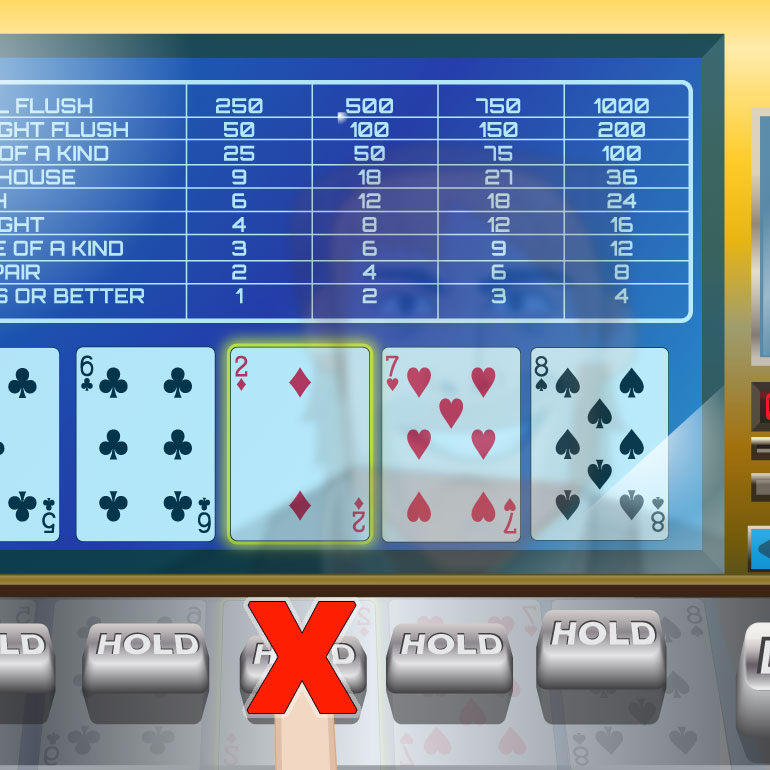
    Let us look at the following sample hand. The initially dealt hand consists of the 6 of clubs, 6 of diamonds, king of diamonds, 8 of hearts, 2 of spades.

    Low Pair Video Poker

    Note that any hand with a low pair and no shot at a flush or straight produces exactly the same results.

    The highest return of any possible hold comes from holding the two 6’s.

    Pair of 6s at video poker

    The return for this hold is 4.1184 credits based on an initial five credit bet. That is better than an 80 percent return. While the return varies with other games and pay tables, a low pair does have a fairly decent return in any non-wildcard game.

    But, what makes up the return of 4.1184 credits? How many different hands are possible and how is that return spread over those hands?

    These are all very good questions. Here is the breakdown.

    Let us take a look at all the possible hands when holding just a low pair. The table below shows the number of occurrences, the percentage of that occurrence and the return rate for each possible resulting hand.

    HandFrequencyPercentReturn
    Loser11,55971.3%0
    Two Pairs2,59216%2 for 1
    Three of a kind1,85411.4%3 for 1
    Full House1651%9 for 1
    4 of a kind450.3%125 for 1

    Notice that a player loses a bit more than 71 percent of the time. What do video poker players remember? Actually, what does any gambler remember? They remember big wins. They remember royal flushes. Unfortunately a held low pair will never become a royal flush.

    So, other than big wins, what do gambles remember?

    Video poker players also remember losses. With a low pair, this means they remember the over seven losses out of every 10 hands. What they remember is not the minor winning hands, it is the hand after hand that ends up as a loss.


    While it may seem like more than seven losses out of every 10 hands, if you keep good records of your actual results over several thousand hands, you will find the results would be fairly close to the 70 percent losing hand rate.

    So why is a low pair rated so high in the returns and strategy?

    The table shows that every winning hand returns a profit to the player, not just the return the initial bet that often happens with a high pair. Not only that, but sometimes the profit is considerable.

    Additionally, while this table represents the game of Jacks or Better; had the game been Double Double Bonus Poker, there would have been additional lines for 4 Aces with a 2, 3, or 4; 4 Aces; 4 2s, 3s, or 4s, with an Ace, 2, 3, or 4; 2 2s, 3s, 4s, and 4 5s thru Kings. The frequency and percentage of these additional hands would have been lower, but the return would have been higher – dramatically higher in some cases (4 aces with a kicker of 2, 3, or 4 returns 400 for 1). Had the game been Triple Double Bonus, the return for 4 aces with a kicker would have been 800 for one – the same return as a royal flush!


    While it is true that a low pair will most often return nothing (more than seven out of 10 times), making it seem that one never wins with it, at times the win can be very healthy (up to 800 for 1 in Triple Double Bonus Poker). This explains its fairly high position in returns and strategy. The winning hands may not be very frequent, but they can pay extremely well.

    Remember also, in the game of Jacks or Better, the actual return for an initial hand of a low pair is 82 percent. While this number includes the fairly infrequent full house and four of a kind hands, it is still a very decent return – better than most of the holds on a strategy chart.


    While a high pair will guarantee you at least the return of your initial bet, you will always improve upon a 1-for-1 return when you win after holding a low pair. Maybe this type of thinking can help you get through that miserable 71+ percent loss rate of low pair hands.

    October 18, 2017
    Jerry "Stickman" Stich
    Body

    Jerry “Stickman” has been involved in casino gambling for nearly 30 years. He is an expert in blackjack, craps, video poker and advantage slot machine play. He started playing blackjack in the late ‘80s, learned several card counting systems and used these skills to become an advantage blackjack player and overall winner of this game. He also acquired the skills necessary to become an overall winner in the game of craps, accomplishing this by a combination of throwing skill and proper betting techniques. Stich is also an overall winner playing video poker. This was accomplished by playing only the best games and using expert playing strategy. 

    Jerry used his skills to help others also become better gamblers. He has taught advantage play techniques in blackjack, craps, video poker and slot play to hundreds of students. He is a regular contributor to top gaming magazines and has authored and co-authored various books on gambling.

    factcheck
    Off
    hidemainimage
    show
    Hide sidebar
    show
    Fullwidth Page
    Off

    Timed Video Poker Tournament: The Royal Flush Strategy

    Video poker tournaments have been around almost from video poker’s beginnings. They are still popular events today. Many tournaments are free, or they require only a nominal fee to participate. While the prize amounts vary greatly, a first-place prize for a video poker tournament can be several thousand dollars. This certainly is enough to make a player want to do whatever possible to try to win a portion of that prize fund.

    There are two basic types of video poker tournament. They are either limited to a certain number of hands or limited to a specific length of time. Sometimes the tournament has both a time limit and a limit to the number of hands. Examples:

    • Video poker tournament session is limited to 15 minutes. The player attempts to play as many hands as possible in 15 minutes.
    • Video poker tournament session is limited to 200 hands per session with no limit time limit.
    • Video poker tournament session is limited to 200 hands or 15 minutes – whichever comes first.

    With no time limit, a player can take the time to play a strategy that is more complicated. However, if there is a time limit play should be as fast as possible. This will give the player the best chance to get a royal which will almost certainly lead to a prize. Most of today’s video poker tournaments have time limits making the “fast play” strategy more desirable.

    vp

    This article will cover one fast play strategy. Other articles will cover more complex strategies that are more useful when the tournament is not timed.

    So, how to play video poker tournament with the best strategy? Some prefer to play the same strategy as in non-tournament play; that is, play the optimum strategy designed to get the most return from each hand played. The reasoning is that the player will have to be lucky to win the tournament and this strategy will give you most from each hand. Hopefully that will be enough to put the player in the winner’s circle.

    Others advocate forgetting about all the lower paying hands and “go for broke” by simply saving for a royal flush on every hand. Those who favor this strategy also realize that to win a video poker tournament the player will need luck. It does not matter whether he or she is out of the money by 10 points or by 10,000 points. Either way, no money will be won. So why not give yourself the best chance you can to get some royals? If you are lucky with this strategy, you will win video poker – and win big. If you are not lucky, nothing will change – you will be out of the money either way.

    While normal video poker strategy varies based on the specific game and pay table, a “royals-only” tournament strategy remains the same regardless of the game or pay table. It really does not matter since you will only be saving for royal flushes.

    To use the “royals-only” strategy, you save only those cards that could produce a royal flush.  This is so simple that you may not even need to generate a formal strategy. Simply save for a royal flush.

    If you have a video poker strategy program that will generate playing strategies, here is how you would set up the five-credit column of the pay table for jacks or better. For other games, enter “0” for any hand other than the royal.

    HandPays
    Royal Flush4,000
    Straight Flush0
    4 of a Kind0
    Full House0
    Flush0
    Straight0
    3 of a Kind0
    2 Pairs0
    Jacks or Better0

    The only hand that means anything in this strategy is the royal flush. Using a video poker strategy program, the following strategy was generated. Since fast play is the goal, we don’t mind simplifying our play a little so the “basic” strategy option was chosen over the advanced strategy option. In some cases, more than one line was generated that had the same exact return. When that is the case it does not matter if the lines are combined. The strategy after combining the equal paying lines follows:

    1. Dealt Royal Flush
    2. 4 cards of a Royal Flush
    3. 3 Cards of a Royal Flush
    4. Suited QJ, KQ, or KJ
    5. Suited AK, AQ, or AJ
    6. Suited JT, QT, KT, or AT
    7. A, K, Q, or J

    This strategy is simple while still zeroing in on the hands that will boost the appearance of a royal flush and your total score. It can be learned quickly and played rapidly since the lines of the strategy are very intuitive. That makes this royals-only strategy a great tournament strategy.

    Now you have a strategy that can be used to help improve your chances of ending up in the money in a video poker tournament. This strategy will work for any video poker game where the highest paying hand is a royal flush.


    video poker player


    Remember, all tournaments require luck, but if luck is on your side, a very simple strategy focused upon royal flushes will allow you to play the most hands giving you the best opportunity to score a tournament win.

    October 28, 2017
    Jerry "Stickman" Stich
    Body

    Jerry “Stickman” has been involved in casino gambling for nearly 30 years. He is an expert in blackjack, craps, video poker and advantage slot machine play. He started playing blackjack in the late ‘80s, learned several card counting systems and used these skills to become an advantage blackjack player and overall winner of this game. He also acquired the skills necessary to become an overall winner in the game of craps, accomplishing this by a combination of throwing skill and proper betting techniques. Stich is also an overall winner playing video poker. This was accomplished by playing only the best games and using expert playing strategy. 

    Jerry used his skills to help others also become better gamblers. He has taught advantage play techniques in blackjack, craps, video poker and slot play to hundreds of students. He is a regular contributor to top gaming magazines and has authored and co-authored various books on gambling.

    factcheck
    Off
    hidemainimage
    show
    Hide sidebar
    show
    Fullwidth Page
    Off

    4 Craps Tips for the Short Bankrolled

    Casino players have the rare opportunity to play craps with a house edge of less than 1 percent. Unfortunately for low rollers, may require wagers too large for their comfort zone.

    What’s a player on a budget to do? We’ll do some comparison shopping right after we look at what’s needed to get the lowest house edge.

    To get that less than 1 percent deal, players either back pass and come bets with free odds or lay the odds behind don’t pass and don’t come bets.

    There is no house edge on the odds, and the house edge on pass or come combined with single odds is 0.8 percent, and that drops to 0.6 percent with double odds, 0.5 percent with triple odds and so on – the more of your bet is taken in odds, the lower the edge.

    It’s the same with don’t pass and don’t come and laying the odds. At single odds, the house edge on the combination is 0.7 percent, and that drops to 0.5 with double odds, 0.3 with triple odds and so on.

    However, most players don’t stop with one bet working at a time. One common method is to follow a pass bet with two come bets so you have three numbers working at a time.

    If the minimum bet is $5, then a pass and two comes means bets totaling $15 are at risk. If each is backed with single odds equaling the original bets, that’s a $30 total, and that grows to $45 with double odds and $60 with triple odds.

    All those bets could be wiped out at once if the shooter rolls a 7.

    It’s enough t make a $5 bettor more than a little nervous.

    What if you can’t afford that kind of money? What if your bankroll dictates table minimum bets? Should you just skip craps and move to a different game?

    You can still play and win at craps, although the house edge will be a little higher than in the method above.

    Here are some methods that keep the house edge under 2 percent while conserving your bankroll.

    TIP #1: STICK TO ONE PASS OR DON’T PASS BET, WITH ODDS

    Instead of having three numbers working, go with only one.

    You still drop the house edge to less than 1 percent, but instead of having $30 at risk with a pass and two comes backed with single odds, your wager total drops to $10. At double odds, the total rise to $15, with triple odds it’s $20 and so on.

    Where you stop is between you, your bankroll and how much odds are permitted at your casino of choice. But you can get the house edge under 1 percent while risking only twice the table miniumum.

    One drawback: Many players find this method boring. They’re drawn to the fast action and multiple wagering possibilities of craps. The remaining methods are for such players.

    Craps table

    TIP #2: SKIP THE ODDS

    This just feels wrong to some craps players because the odds are the best deal at the table, but there’s no point in low rollers worrying about bets they can’t afford.

    If they use the tried-and-true pattern of following a pass bet with two come bets to get three numbers working, then at a $5 table they would have $15 at risk at one time. 

    If they’re willing to limit themselves to one come bet after the pass, the risk is reduced to $10, and they can go with a rock-bottom $5 with just the pass bet.

    Nowhere near as much money is at risk as when you add free odds to the equation.

    Bottom line: The house edge on this method is 1.41 percent. It’s not as good a deal as those who can afford odds get, but it’s still one of the best bets offered in casinos.

    TIP #3: PLACE 6 AND / OR 8

    The most frequently rolled number in craps is 7. Six of the 36 possible two-dice combinaions total 7

    Rolled next most often are 6 and 8. There are five ways to make each of those numbers, making them numbers players love to have working.

    When you place 6, you’re betting the shooter will roll a 6 before the next 7. It works the same way when you place 8 – you want that 8 to come up before a 7.

    The house pays 6 and 8 at 7-6 odds, and that means you want to be in multiples of $6 to make that payoff possible.

    If you want to go with just one number working, you’ll have $6 at risk at a $5 minimum table. If you be both, then the total is $12, still far less than backing multiple pass and come bets with odds.

    Bottom line: The house edge on either 6 or 8 is 1.52 percent. You get a reasonably low house edge without putting too much of your bankroll at once.

    TIP #4: FOLLOW A PASS BET WITH 6 AND / OR 8

    For those who love to have multiple bets working, this assures you of having the two most frequent winners.

    Start with $5 on the pass line. If the shooter rolls a 6 or 8 on the comeout to establish that as the point, then make a $6 place bet on the other number in this pair.

    That gives you wagers totaling $11 at a $5 minimum.

    If the point is not 6 or 8, then follow your pass bet with $6 place bets on both numbers for a total risk of $17.

    Bottom line: You face a 1.41 percent house edge on pass and 1.52 percent on the place bets, giving you a nice combo with frequently rolled numbers at a reasonable house edge.

    SUMMARY

    If you can afford free odds, great. You can get the best of what craps has to offer. But if your bankroll is limited – and you should never bet more than you can afford to lose -- you still can play with house edges of less than 2 percent.

    These other methods may not be the absolute best in craps strategy, but sometimes the best deal you can afford is the way to go.

    August 21, 2017
    John Grochowski
  • ">
  • Body

    For nearly 25 years, John Grochowski has been one of the most prolific gaming writers in the United States. He’s been ranked ninth by GamblingSites among the top 11 gambling experts at Gambling Sites and his Video Poker Answer Book was ranked eighth among the best gambling books of all time.

    He started a weekly casinos column in the Chicago Sun-Times at the beginning of 1994 and He soon found himself in demand by a wide range of publications. He has written for casino industry professionals in Casino Executive and Casino Journal magazines, and for players in Casino Player, Strictly Slots and many other magazines.

    John’s twice-weekly columns appear in Casino City Times, Atlantic City Weekly and several websites. He has written six books on casino games, including the “Casino Answer Book” series. And, of course, John is a regular at 888casino Blog.

    Today John’s work includes a weekly column on baseball metrics for the Sun-Times. He lives in the Chicago area with Marcy, his wife of 30 years.

    factcheck
    Off
    hidemainimage
    show
    Hide sidebar
    show
    Fullwidth Page
    Off