The dice are tumbling and there are plenty of high fives as the shooter hits yet another point number. Players scramble to place their bets for the next roll at the bustling, high-energy table. In a few minutes those dice will be moving again.

A craps table can be one of the most entertaining places to be at a casino. Players love the action as the dealers pay out winners with stacks of multi-colored casino chips – unless that dreaded seven shows up. While most are accustomed to playing the game in a live casino, craps also has a history beyond the gaming floor.

In fact, the game goes back to the streets – known as “street craps” by many who like shooting dice with friends and acquaintances. Here’s a quick look at this popular version of the game.

Quick History of Craps

Craps a unique history. Gambling and games involving dice date back to the Roman Empire when soldiers reportedly shaved pig knuckles into cubes. Numbers were added and soldiers tossed the cubes in their shields. This might have been the earliest version of some form of street craps and is believed to have brought about the saying “roll the bones.”

By the 13th century, dice games could be found in Spain and other European countries. Early versions included games like Hazard and Marlota, in which a player had to roll a certain number before rolling another number.

Dice as an addition to gambling proved popular – whether in a gambling house or in other scenarios and locations among friends. Fourteenth century scholar Francis Petrarch was a critic of this form of gambling and described gambling with dice as “an inexplicable, gaping cesspool leading to abject desperation.”

Despite those warnings, the game would grow in popularity in the years to come. By the 1700s, the game gamblers would recognize today had taken shape and was called “crabs” in France.

The French spread the game to North America, including New Orleans, where it eventually became known as “craps” and the new name stuck. The game could typically be found where workers or others might gather on a break or with a bit of downtime. Those with a few bucks in their pockets may have been willing to gamble with dice to kill some time.

“African-Americans were among the first players, and likely the inventors of American Craps,” author David Schwartz notes in Roll the Bones: The History of Gambling. “Black roustabouts and other river workers up and down the Mississippi were for years the most eager players of ‘American dominoes,’ which was played as a social game.”

Craps in the street

Street Craps vs. Casino Craps

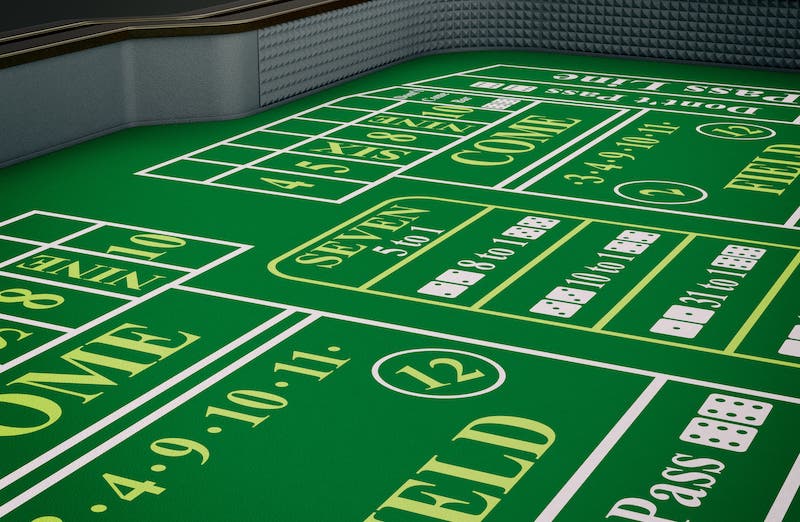
Craps can be confusing for new players entering a casino. There is seemingly an endless number of bets available. However, the best craps strategy involves bets on the Pass Line (and Don’t Pass is also available and a good bet). When betting with the shooter on the Pass Line, players win on the comeout roll when the shooter rolls 2, 3 , or 12.

If the shooter rolls a 7 or 11 during this period, the player wins on the bet. The numbers 4, 5, 6, 8, 9, and 10 are called point numbers. When the shooter rolls one of these, players are then hoping that number will be rolled again before a seven appears.

Players can also add odds to their Pass Line wagers and also put some money on other numbers via place bets and come bets. But overall this is the general idea – to roll a certain number before “sevening out.” As a casino, dealers take care of all the action – paying off wins, making certain bets on the table for players, and taking down bets when players lose.

In street craps, players take care of much of this themselves in what is a bit more of a simple game. The game is much more informal version and, as the name implies, got its name from those who rolled some bones outdoors – in the street.

With no table or felt, players place their bets on the ground usually using cash or coins. Players may act as the shooter, house, or simply bet on the shooter, depending on how those involved want the action to proceed. The game follows the same rules for the most part, but may be more simplified without all of the exotic bets and ability to back up Pass Line bets with odds.

Players are essentially playing the same type of Pass Line bets hoping to hit point numbers before sevening out to earn even money on those wagers. Some games may feature players simply betting against each other. Players can agree on a number to roll before rolling a seven or roll the dice to establish the point number. 

More sophisticated street operations may have additional rules and payouts, but this varies by game. Street craps can be just as fun as entertaining for those involved as it might be in a real casino.

As Philadelphia magazine notes: “The craps table is the best gaming experience because it’s boisterous, it’s communal, it’s the cool kids’ table.” And that can go for the street version of the game as well.

Taking It to the Street

Craps became much more popular in the 20th century after soldiers began returning home following World War II. Many had taken to playing the game to pass time between battles. Because players basically only need a set of dice, soldiers rolling for point numbers could be found in barracks, in fields, on ships, and other locations throughout the European and Asian theaters of war.

These craps lovers brought the game back home and rolling dice became the most popular casino game, only to be passed by blackjack in later years. Street craps remained popular as well, and since Nevada was the only state in the U.S. with legalized gambling at the time, street craps could be played in other parts of the country – with players always mindful of the law.

Because of this, the game may have taken on a more unsavory reputation. Wise street hustlers may have realized that the house has an edge in the game and frequently separated unsuspecting players from their money.

A similar game known as “floating craps” refers to a more serious version of the game that can be easily moved to stay ahead of law enforcement. This version of the game plays a key role in the famous Broadway musical Guys & Dolls, which was also turned into a film in 1955 starring Frank Sinatra and Marlon Brando.

One of the main characters in the film regularly runs an underground craps game and the trailer below offers a look at some of the on-screen dice action.

Numerous other films have featured street craps through the years, often using the game to set the scene around a gritty location where characters may be a bit more down and out or running afoul of the law. But as more states and countries have legalized casino gaming, craps may have a better reputation than it once had.

Those who enjoy rolling some dice with a couple dollars on the line may want to give some street craps a try. With a little luck, you may win a few bucks and some bragging rights over your friends.

November 7, 2024

By Sean Chaffin

Sean Chaffin
  • ">
  • Body

    Sean Chaffin is a full-time freelance writer based in Ruidoso, New Mexico. He covers poker, gambling, the casino industry, and numerous other topics. Follow him on Twitter at @PokerTraditions and email him at seanchaffin@sbcglobal.net.

    Sean Chaffin
    factcheck
    Off
    hidemainimage
    show
    Hide sidebar
    show
    Fullwidth Page
    Off

    Do you want to know how the casinos get their edges over the players? This short answer is sufficient to fully explain the matter. Here it is: more money goes into the casinos then comes out of the casinos. Correct. You really don’t need a more detailed explanation than that. 

    That slot machine keeps more money than it pays out; so, does the blackjack game, and the craps game, and the roulette game and on and on it goes. You don’t need an advanced degree in mathematics to get this simple picture.

    Now to make you forget precisely what is happening to you, the casinos structure their games to make them “fun.” You are always this close to winning the next decision. That fact allows the players to hang in there because the decision after the decision after the decision could be the winner!

    Anticipation is a key to why people play casino games or lotteries and such. The anticipation is a strong enough feeling that it rivets most players to the games they love to play.

    (At some point or other, the player will retire from playing. He or she could be ahead; more than likely he or she will be behind. And on it goes. Perhaps for eternity.)

    How Many Players Should Be at a Table?

    A lot of players prefer to play one-versus-one against the dealer. And that could be the fast way to epic losses. You want to play at full tables (or nearly full tables) in order to play the least number of decisions that you can.

    Here is the truth: the more decisions that you play, the worse it will ultimately be for you. And you can’t escape that fact. More decisions means the game is better for the casinos. You can’t escape that fact.

    Games that are fast (such as mini-baccarat) can hammer you even though the house edges at that game are rather small on two of the three bets. Play 150 decisions or so an hour and see where you wind up. 

    Oh, and don’t play the tie bet, one of the worst bets in the casino. Just play player and even better, just play bank which has the lowest house edge. One hundred fifty decisions – remember that number can be a mere one hour of play!

    But even so. Such speed makes that game dangerous – low house edge or not.

    Also, the number of superstitious players makes that game trying on your nerves if you find yourself surrounded by such players. At times they might (they actually might) blame you for their defeats. That has happened to me.

    The house edges on the two best bets are good. The speed of the game is bad. If you want to play the game? Reduce the number of decisions you face by 50%! (Or more!)

    Baccarat hand

    Oh, Those Magnificent Slot Machines!

    The number one casino game is the slot machines. More people play the slots than all the other casino games combined. 

    Slot machines are almost always one-versus-one, the player versus the machine. Machines come in with house edges between 8% and 16% – or thereabouts. No player is getting a break when he or she plays the slot machines. 

    They are fast if the player plays fast and most slot players speed up their play as time goes by. They take more than one coin (or credit) and they can lose a lot of money quickly and surely because some will take so many coins (or credits) that the wind in your hair will make you bald with how fast the machine obliges them. 

    Slot players do not – by and large – want to play table games because, well, because, just because. One-on-one at a machine is not scary, but having a bunch of other players playing the same game can horrify a slot player. Go figure.

    Other than slot players who hit for outrageous sums on absolutely rare occasions which are (as stated) rare, the prospects for these players are dim and even dimmer than that.

    Slot machines do have lights and sound effects and cartoons and such but these are simply there to distract you from the fact that losses are coming soon and sooner even than that. The world’s casino industry is built on slot machines.

    How should a wise slot player play the machines if he or she must play the machines? Playing slowly is the best advice when it comes to how to win at slots.

    And seriously, even slower than that. 

    In fact, so slow that in a race the slot player will not even appear to be playing. You’ll have to speed up the film to notice movement!

    The bottom line is to play one coin or credit per decision. There I said it. And do it slowly, oh, so, so slowly. 

    I do not care what kind of machine you are playing, just stick to one coin or credit per decision and take your time hitting the play button. Come on, do you really think you will be one of the rare players who will hit for millions? Play one decision at a time and enjoy your time in the casinos. It won’t be too costly.

    And What About Blackjack?

    The most popular game in the casino, other than slot machines, is blackjack. It has been the king of the casinos’ table games ever since Edward O. Thorp worked out a system called card counting in the early 1960s in his book Beat the Dealer.

    This system would allow the knowledgeable player to actually get a real edge at the game (meaning more money coming out of the game and going to the player) and that would put the casinos behind such a player who could work such magic.  

    Craps, the World War II game, had been the leader in the casinos up to that time but blackjack quickly surpassed it. Why? Because everyone thought they could beat the game – even if they never learned how to count cards or had enough money to suffer and ultimately beat the bad streaks.

    The casinos soon panicked and then started adding more decks to the game from one to two to four to six and to eight. They placed the cut card not as deep into the shoe and generally ruined the pristine game that blackjack had been. (Single deck with great rules. Farewell.)

    Next came unlimited continuous automatic shufflers. Then came games where a blackjack only paid 6 to 5 instead of 3 to 2. Then came all sorts of “different” blackjack games to sucker in the players. None really made big hits but they all won money from the players who were foolish enough to play them.

    Still the good old single-deck game of blackjack from the 1950s was for all intents and purposes dead. Stone dead.

    Some card counters are still out there but, in truth, they are rare. The casinos have seen to that. The game is just much tougher to beat. Even with an edge of 1% in favor of the players, they will see loads of bad streaks. A card counter’s bankroll has to be able to survive such losing streaks. Many blackjack players can’t survive the bad streaks.

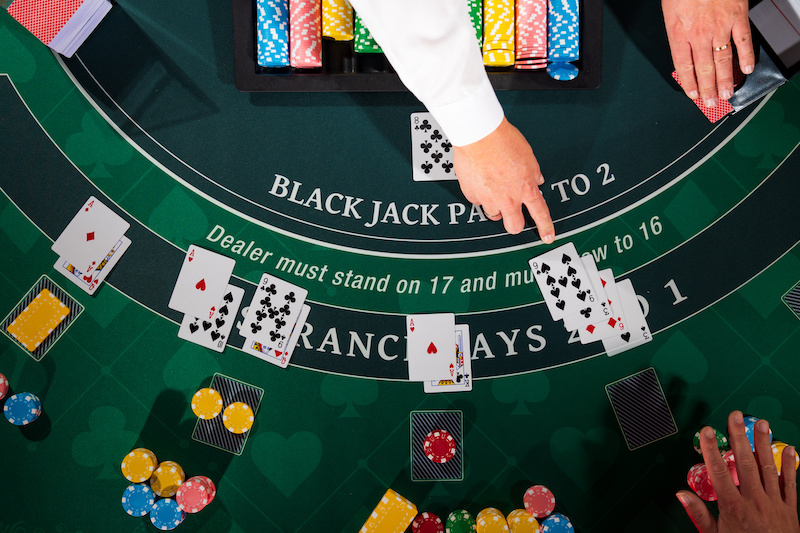
    Blackjack table

    But what else comes with blackjack? Now some decent news.

    Blackjack is a game where your decisions on what to do with your hands count. These decisions mean you make more money or lose less money. Play properly and the casinos will still only have a half-percent edge over you. And that’s good. 

    Okay, do you double down on your first two cards? Split pairs? Double down after splits? What are your hitting and standing decisions? Do you ever take insurance? Are you getting paid 3 to 2 for a blackjack?

    Anything else? Oh, indeed, yes. You see at blackjack there are some players, enough that you will definitely experience them, who want to “teach” you how to play properly as the game progresses. Are they expert players? They think they are. But, come on, are they really?

    NOPE!

    Most are total idiots. They subscribe to gaming gurus who think they have logically figured out the game but in reality their hitting, doubling, standing, and insurance decisions are by and large wrong. And they whine and moan when you make a good basic strategy decision that is right but unfortunately goes wrong.

    And what is basic strategy? It is the computerized version of how to play every hand you are dealt against the dealer’s up-card. Even players who have played blackjack for decades can have played it wrong for decades. Sad but true.

    The good news is that you can buy correct basic strategy charts from the Internet or from good gambling web sites. Yes, there are a number of different blackjack games but there are basic strategy charts for just about each and every game.

    Buy the card(s) and take your time making your decisions about your hands. Doing this will mean you are playing a strong game against the house. And never rush your play. Players who rush will inadvertently make mistakes.

    Craps: Baby Needs a New Pair of Shoes!

    I don’t know why this became a famous craps saying but it did. Craps, first known as crabs in the American South where it originated along the Mississippi River, became the “city game.” I guess it meandered into the alleyways of the North and became the number one game of soldiers during World War II. 

    The post-World War II casinos had craps galore as it was the number one game in just about every casino. That is until blackjack bumped craps out of first place. Blackjack is still in first place.

    You’ve seen the craps tables and you have certainly heard the craps players cheering wildly when things are going well and moaning awfully when things are going poorly. 

    There are actually two craps games going on at the same time; the rightside game of players who are looking for the shooter to make points and numbers, and the wrong side game, known as the darkside, where the players are betting the shooter will seven-out as quickly as possible. 

    The darksiders make up a tiny percentage of craps players but they are out there. Rightsiders generally do not like darksiders. Some rightsiders hate darksiders.

    Craps table

    Play craps on the rightside. Make no more than two bets – a pass-line bet and a come bet or a place bet of the 6 or 8. Craps is action-packed but too many players fall into the casinos’ trap of making many, many bets most of them with outrageously high house edges. Don’t fall into the trap!

    And shoot the dice. It’s fun – although often it is also sad when you seven out quickly. Still, craps is a great game but a dangerous one if you don’t bet properly.

    Do You Want Advice? 

    Many casino players do not want advice. If you are one of them then you can leave the room – but, better still, leave your wallet by the exit because, come on now, you will be losing just about every penny you bring with you to the casinos. 

    Over even a relatively short period of time that will probably happen. And that is why casinos make money; you lose, they win.

    Advice: The house has the edge at almost every game almost all of the time. Chew on that will you? You can’t escape that fact.

    What are the edges at the games? Here are a few:

    • Blackjack with proper basic strategy: about one-half percent. Systems sellers will quibble or fully disagree with the true basic strategy for the various blackjack games. They are wrong. They will cost you a lot of money. They are, for lack of a better term, idiots.
    • Craps if you make only the best bets which means pass line, come, don’t pass, don’t come and taking full odds when number is chosen by a roll of the dice.
    • Placing the 6 or 8 in $30 increments. House edge 1.52%.
    • Making other place bets? Don’t bother. The edges will go from single digits to double digits. And your bankroll will go into the drink. Just chew on that statement.

    All the best in and out of the casinos!

    November 7, 2024

    By Frank Scoblete

    Frank Scoblete
    Body

    Frank Scoblete grew up in Bay Ridge, Brooklyn. He spent the ‘60s getting an education; the ‘70s in editing, writing and publishing; the ‘80s in theatre, and the ‘90s and the 2000s in casino gambling.

    Along the way he taught English for 33 years. He has authored 35 books; his most recent publisher is Triumph Books, a division of Random House. He lives in Long Island. Frank wrote the Roulette strategy guide and he's a well known casino specialist. 

    Frank Scoblete
    factcheck
    Off
    hidemainimage
    show
    Hide sidebar
    show
    Fullwidth Page
    Off

    I am going way, way back to a time when there were candy stores just for kids. 

    Oh, not the kind of candy stores we have today with store-created candy by “candy-chefs” but the kind where maybe a fourth of the store was devoted to candy cigarettes of all types that were made by companies that made all sorts of awfully but deliciously tasting candied cigarettes for little kids who lived in a culture where so many, many adults smoked.

    All my uncles (with maybe a few exceptions) smoked. I had so many, many uncles, and all of them fought in World War II where cigarettes were given out to many of them as a part of their “rations.” 

    My father didn’t smoke – except the occasional cigar; my mother smoked but not at home. Basically, my parents’ apartment was smoke free – but me? I loaded it with seemingly millions of candy cigarettes of all types.

    We had many types of hard candy cigarettes that you had to really bite ferociously to break and chew. They must have been pure sugar. You had chocolate candy cigarettes that were wrapped in cigarette paper. Those were expensive but the best tasting of them all. How can you ever turn down a chocolate candy-cigarette?

    Now, did I know anything about sugar? No. Did I know anything about cigarettes? No.

     Only adults could smoke them and those adults looked cool although I didn’t know the word “cool” way back then. I guessed that when I became an adult I would smoke too.

    That’s what you did as an adult, right?

    I do remember that at lunch time, when I was in elementary school, the kids would rush to the candy store with their pennies (and maybe a nickel or two for the richer kids) to hoard away the candy cigarettes they’d load up on. I guess you could say that I lived the life. 

    Being ignorant of the facts of real life I had fun gobbling down loads of candy cigarettes. I had no idea of the horrors of sugar – what kid does? If it tasted good then it was good.

    Many casino players, maybe even most casino players, are like those excited kids in the candy store. The games are just like those candy cigarettes displayed for all to see. They do have a hidden danger that some players don’t really understand. It’s called the house edge

    Every game being played has such an edge. Some of the games have reasonable house edges; some have nasty house edges.  

    Look around any casino floor and there are slot machines galore and all sorts of table games jammed with players. 

    We players can, using just a wee bit of our imaginations, look just like the hordes of young kids figuring out what candy cigarettes they want to eat way back when.

    The Game of Roulette

    There are now three different roulette games in the casinos. They go from a decent game – the single-zero (0) European/French wheel with the numbers 1-36 and a single 0 with a house edge of 2.7%, to mediocre with the double-zero (0, 00) American wheel with the numbers 1-36 and a 0 and a 00 with a house edge of 5.26%, and the latest roulette game that no country takes credit for, with triple zeroes (0, 00, 000) with a house edge of 7.69%.

    That triple-zero wheel seems to have come to us from the churches that held Las Vegas nights (or some such) for their parishioners and others willing to gamble for spirituality and perhaps a chance of heaven. 

    Obviously, the triple-zero game has a ridiculously high house edge. Watch how the house edges are determined and you can then see how the casinos have offered really poor candy cigarettes to their clientele.

    There are 36 numbers on all three of the roulette wheels. They travel from 1 to 36.

    Check out the wheels and you’ll see these displayed. The numbers on the various wheels are not in numerical order, for example, the number one is nowhere near the number two. However, the layout is in numerical order. 

    Why is this so? Placing the numbers as the casinos do prevents people playing the layout from betting groups of numbers that are in bunches on the wheel. Of course, wheel-watchers are, obviously, watching the wheel and not the layout but still almost all roulette players play the layout and not the wheel. Just check out a game with a lot of players.

    [Please note: The chances of finding a truly biased wheel are now so remote in today’s casinos that it is probably a waste of time to scout for them. Yes, sorry, they probably don’t exist anymore as today’s wheels are computer and electronic marvels and they are constantly checked. My wife, the Beautiful AP, and I accidentally found a biased wheel in the early 1990s in a Las Vegas casino. Three numbers were coming up for an entire day out of all proportion to their probabilities. So, finally at night, we sat down at the table and started to hammer home those numbers. Strangely, no one else played them! The pit boss finally closed the wheel. He was very polite when he told us we could go to another table which was just being opened. Instead, my wife and I went to our room for a well-earned sleep.

    Now we come to the zero and the double and the triple zeroes. These can be found at the top of the layout and opposed to each other on the wheels.

    So far so good, right? Now, more bad news as I look at the payouts for the various roulette games. 

    All inside bets directly on the numbers or the zeroes will pay 35-to-1. At the European/French single-zero game, there are 37 pockets for the ball to fall into. The true payout for a winning bet is not really 35-to-1 but 36-to-1. The casino does not pay out the true value of the bet – otherwise it can’t make money. In short, the casino short-changes the players. By the way, it does this at many of their games, just check out some of the “place” bets at craps.

    The American game, the double-zero wheel, has 38 pockets, and a winning hit on this still pays 35-to-1. That increases the edge over the players from 2.7% to 5.26%.

    And finally, and lousily, the triple-zero wheel has 39 pockets and a winning hit still (yes, still!) pays 35-to-1. Just figure it this way, the more zeroes a wheel has the higher its edge.

    Roulette wheel

    How to Buy the Casinos’ Roulette Candy Cigarettes 

    Roulette has been a great casino game for several centuries and there does not seem to be any reason to believe it won’t stay as popular. Sure, today’s blackjack game is numero uno but roulette is number two or number three. Roulette players are a loyal tribe. 

    The game was invented by scientist, philosopher, and theologian Blaise Pascal in the 1600s. Blaise was trying to answer one of science’s greatest questions: Could there be such a thing as a perpetual motion machine? That is, a machine that would not need the input of any outside energy to run and run and run, well, and run perpetually. He received the answer everyone who tried to discover the correct answer received and that was (sad to say) a resounding “no!”

    But he did, along the way, invent roulette.

    [Please note: What else did Blaise do to give him fame? He answered the question of whether it would be smart to believe in God? His answer was pretty clever. If he doesn’t believe in God and God actually exists, well then, good old Blaise would be in for everlasting torment in hell. So, Blaise figured he’d believe in God and if there were no God, what the heck, no eternal damnation; actually no nothing. But if there were a God then Blaise probably smiled, knowing he would be saved. Sadly, there is no way to play roulette in a casino where the house does not have an edge.

    All Those Bets!

    Roulette has an amazing number of bets a player can make – all of them coming in with that particular game’s house edge. There is only one way to escape this – and I’ll get to that later (don’t you dare skip ahead!).

    Betting one number directly on that particular number opens you up to long losing streaks, much like slot players face. 

    Just contemplate this. You have a one in 37 chance of hitting your number on the single-zero wheel, a one in 38 chance of hitting it on the double-zero wheel, and a one in 39 chance of hitting it on the triple-zero wheel. Those bets are long shots for sure.

    Yes, you can make two, three or more bets on two, three or more numbers – spending two, three or more amounts of cash. That is an option is you can afford it. You’re just like the rich kid buying up all the candy cigarettes.

    Or, you can bet propositions which come in with many more numbers and only one bet needed. Here are a few of these:

    You can put a single bet on the side of some numbers such a 1, 2, 3 or 4, 5, 6 on up by threes. (You can do groupings of six numbers too.)

    You can put a single bet on propositions such as columns and dozens which will pay 2-to-1. You lose if the green zero or zeroes show up. 

    You can bet the even-money bets of red or black, high or low, or odd or even. 

    These are called even-money bets because a win is paid at even-money. You bet one chip and get paid one chip but the BIG BUT here is that on the single-zero wheel you have a one in 18 chance of hitting your proposition (you want red so you bet red) but the casino is still taking its cut from your win. How so? Those green zeroes are all losers on the even-money bets too. Ah, nuts!

    It gets worse as you go up the zero ladder. Still, these bets won’t come in with major losing streaks. I believe that is a good thing. I believe that is why I prefer to bet the even-money bets. Long losing streaks can really, really get to you.

    roulette gambling

    The Gift Given by Some Casinos!

    The casinos are not always money-grubbing entities, are they? Actually, in rare cases not exactly. Some casinos will give you a little treat on the even-money bets. 

    I am going to go a little sideways in this section. Stay with me, okay?

    The even-money bets are good on the single-zero wheel with a 2.7% house edge, and “so-so” on the double-zero wheel with a 5.26% house edge, and stinky on the triple-zero wheel with the abominable 7.69% house edge.

    Follow me. Just tour the casino and look at the games closely. In no game does the casino explain how it gets its house edge. There is no sign at the roulette table proclaiming “the house edge on this game is” … whatever the house edge is. At no game is this true. 

    Go to a craps table and no casino proclaims which are the good bets, which are the bad bets, which are anything about any of the bets. True of blackjack. True of every game in the house.

    But there is an option that some casinos will offer the player at roulette who bets the even-money bets, which is, in the scheme of things, a darn good one. On the single-zero game, it is called “en prison” and on the double-zero game it is called “surrender.” 

    When a zero hits, the casino will only take half your bet in the American game reducing the house edge of that game in half. It goes from 5.26% down to 2.63% – not too bad.

    But on the single-zero European/French game “en prison” does the same thing (but differently) by holding onto the bet and not paying it until the next decision. This reduces that game’s house edge down to 1.35%! That is one of the best bets on the casinos!

    How do you know if the casino allows this? Just ask! They won’t advertise it but if they offer it and you ask them, they will tell you.

    All the best in and out of the casinos!

    November 6, 2024

    By Frank Scoblete

    Frank Scoblete
    Body

    Frank Scoblete grew up in Bay Ridge, Brooklyn. He spent the ‘60s getting an education; the ‘70s in editing, writing and publishing; the ‘80s in theatre, and the ‘90s and the 2000s in casino gambling.

    Along the way he taught English for 33 years. He has authored 35 books; his most recent publisher is Triumph Books, a division of Random House. He lives in Long Island. Frank wrote the Roulette strategy guide and he's a well known casino specialist. 

    Frank Scoblete
    factcheck
    Off
    hidemainimage
    show
    Hide sidebar
    show
    Fullwidth Page
    Off

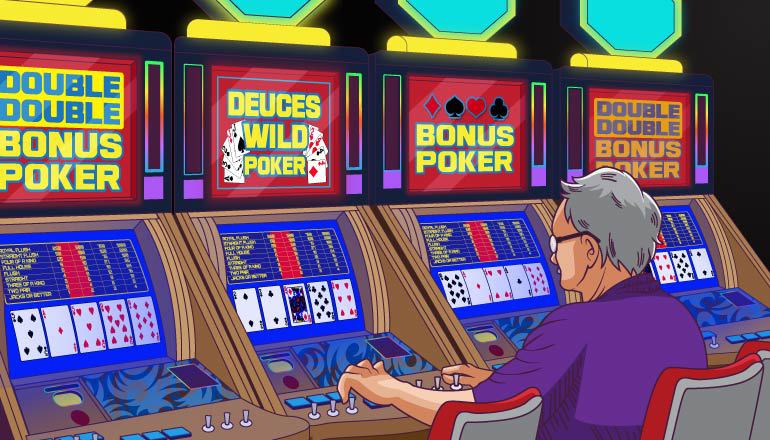
    If you are like most video poker players, you do not expect a lot when you are dealt a low pair for your initial hand. It seems like these hands never turn into winners.

    But, is that really the case? Is a low pair is such a bad initial hand? If it is, why does a low pair hold end up so high in playing strategy charts?

    Contents

    1. Strategy chart positioning
    2. Why low pairs are saved
    3. Comparing results of other holds
    4. Review and Summary
    5. Strategy chart positioning

    Just how high are low pairs in strategy charts?

    There are several video poker strategy-producing programs available. Some produce a basic as well as an advanced strategy. Others just produce a single strategy for each game and pay table combination. Still others may give three or four levels of strategy so beginners can work their way up to the maximum overall return in stages.

    For the following examples, I used the basic strategy charts created by the program I use most often. There are fewer lines in basic than advanced, but many strategy charts are summarized without impacting the results in order to make them more readable and quicker to reference. The approximate percentage of placement from the top of the chart is similar in any case.

    The table below gives the relative placement of the “low-pair” line on the strategy chart for various games and pay tables.

    Game - Pay Table Return Total Lines Low Pair Line % From Top

    Jacks or Better – 9/6

    99.54% 44 16 36

    Jacks or Better – 8/5

    97.29% 44 16 36

    Bonus Poker – 8/5

    99.16% 49 21 43

    Double Bonus Poker – 10/7/5

    100.17% 59 24 41

    Double Bonus Poker – 9/6/5

    97.81% 53 21 40

    Dbl-Dbl Bonus Poker – 9/6

    98.98% 56 26 46

    Jokers Wild Kings – 17/7/5

    98.44% 65 19 29

    You may have noticed that only one wildcard game is shown. Other wildcard games such as Deuces Wild are not included in the chart. There is a very simple reason for this. Almost all these wildcard games in a casino do not distinguish between low pairs and high pairs in the strategy. Only pairs are referenced – whether they are high or low is of no importance.

    Why low pairs are saved

    Let us take a look at what you can really expect when dealt a low pair. A full pay (9-for-1 for a full house, 6-for-1 for a flush) Jacks or Better game is used for the example, but other (non-wildcard) games have similar results. In order to be accurate with the results, we need to make sure the hands being considered have only a low pair. The information shown below is based on a hand with a low pair only and no possibility of a straight or flush.

    Let us look at the following sample hand. The initially dealt hand consists of the 6 of clubs, 6 of diamonds, king of diamonds, 8 of hearts, 2 of spades.

    This hand has a low pair and no shot at a flush or straight. Any hand that has a low pair and no shot at a straight or flush will produce exactly the same results.

    The highest return of any possible hold comes from holding the two sixes. The return for this hold is 4.1184 credits based on an initial five-credit bet. That is better than an 80% return. While the return varies with other games and pay tables, a low pair does have a fairly decent return in any non-wildcard game.

    What winning hands generate this return of 4.1184 credits? How many different hands are possible and how is that return spread over those hands?

    These are all very good questions. Here is the breakdown.

    Let us take a look at all the possible hands when holding just a low pair. The table below shows the number of occurrences, the percentage of that occurrence and the return rate for each possible resulting hand. The frequency numbers are based on a 16,215 total possible resulting hands.

    Hand Frequency Percent Return

    Loser

    11,559 71.3 % 0

    Two Pairs

    2,592 16.0 % 2 for 1

    Three of a Kind

    1,854 11.4 % 3 for 1

    Full House

    165 1.0 % 9 for 1

    4 of a Kind

    45 0.3 % 125 for 1

    On this hand players lose a bit more than 71% of the time.

    Video poker casino

    Comparing results of other holds

    Earlier I said the highest overall return from this hand is obtained by holding the low pair of sixes. Now let us see what the returns would be for other possible holds.

    Most video poker players who would not hold the low pair would instead opt to hold the lone king of diamonds in the hope of snagging another king for a high pair. That hold returns 2.3765 credits on average for the five credits bet – considerably less than the 4.1184 credits returned when holding the low pair. 

    Even more incredible, there are three holds that return MORE than the king of diamonds hold. 

    Those holds are:

    • 6 of clubs, 6 of diamonds, king of diamonds
    • 6 of clubs, 6 of diamonds, 8 of hearts
    • 6 of clubs, 6 of diamonds, 2 of spades

    Each of these holds returns 3.3765 credits for the five credits bet – significantly more than holding the lone king of diamonds.

    Review and summary

    Video poker players tend to remember big wins more than losses. But video poker players also remember losses. With a low pair, this means they remember the over seven losses out of every 10 hands. What they remember is not the minor winning hands, it is the hand after hand that ends up as a loss.

    By saving the low pair and discarding the king many players feel they are making the wrong play. They are giving up any shot at a royal flush. They are wrong.

    While it is true that a low pair will most often return nothing (more than seven out of 10 times), making it seem that one never wins with it, at times the win can be very healthy (up to 800 for 1 in Triple Double Bonus Poker). This helps explain its fairly high position in strategy. The winning hands may not be very frequent, but they can pay extremely well.

    Remember also, in the game of Jacks or Better, the actual return for an initial hand of a low pair is 82% of the bet. While this number includes the fairly infrequent full house and four of a kind hands, it is still a very decent return,

    While holding a high pair will guarantee at least the return of the initial bet, if the draw after holding a low pair produces a winning hand, it will always improve upon the 1-for-1 return from a high pair. Maybe this type of thinking can help players get through that miserable 71-plus percent loss rate of low pair hands.

    October 29, 2024

    By Jerry Stich

    Jerry "Stickman" Stich
    Body

    Jerry “Stickman” has been involved in casino gambling for nearly 30 years. He is an expert in blackjack, craps, video poker and advantage slot machine play. He started playing blackjack in the late ‘80s, learned several card counting systems and used these skills to become an advantage blackjack player and overall winner of this game. He also acquired the skills necessary to become an overall winner in the game of craps, accomplishing this by a combination of throwing skill and proper betting techniques. Stich is also an overall winner playing video poker. This was accomplished by playing only the best games and using expert playing strategy. 

    Jerry used his skills to help others also become better gamblers. He has taught advantage play techniques in blackjack, craps, video poker and slot play to hundreds of students. He is a regular contributor to top gaming magazines and has authored and co-authored various books on gambling.

    Jerry Stich
    factcheck
    Off
    hidemainimage
    show
    Hide sidebar
    show
    Fullwidth Page
    Off

    One of the more interesting hands in video poker is one that contains two pairs. This is almost always a winning hand, though in some casino games (wildcard games in particular) three-of-a-kinds are the lowest winning hands.

    This article looks at some of the peculiarities of how this hand is played in various video poker games.

    Contents

    1. The beauty of being dealt two pairs
    2. Sometimes holding two pairs is not the answer
    3. Wildcard games and two pairs
    4. A unique video poker game – no two pairs ever dealt
    5. Summary

    The beauty of being dealt two pairs

    Most video poker players smile when they see two pairs on the dealt hand. Unlike a plethora of other possible hands, a hand with two pairs is a winning hand by itself – except in some wildcard games where three of a kind is the lowest winning hand.

    Depending on the specific pay table, a hand containing two pairs pays either 1-for-1 or 2-for-1 – the player either gets the initial bet back, or doubles it. The player can never lose when dealt two pairs.

    Virtually all pay tables for the following video poker games pay 2-for-1 for two pairs:

    The wide variety of other non-wildcard games pays 1-for-1 for two pairs. These games include:

    • Bonus Poker Deluxe
    • Double Bonus Poker
    • Double-Double Bonus
    • Triple Bonus Poker
    • Triple Bonus Plus
    • Triple Double Bonus
    • And several other jacks or better-based games

    Holding two pairs eliminates any chance of a royal flush, but there is other gold to be found in the possible winning hands. When a player holds two pairs, there are 47 possible outcomes in a 52-card game. Five of the 52 cards in the deck were in the initial hand. This leaves 47 cards left in the deck. Since one card will complete the hand, there are 47 different possibilities for that card.

    Of those 47 possible hands, there are:

    • 43 hands containing two pairs
    • 4 hands containing a full house

    That means there is about a one in 11 chance of winning 8-for-1 or 9-for-1 on most pay tables. This is not a fortune by any means, but it does keep the player going for a while longer. 

    The strategy for the following games recommends holding the two pairs only:

    • Jacks or Better
    • Bonus Poker
    • Bonus Poker Deluxe
    • Double Bonus Poker
    • Royal Aces Bonus
    • USA Poker
    • Aces and Faces

    Online video poker

    Sometimes holding two pairs is not the answer

    Depending on the game being played, holding both pairs is not always the best play. This is true of most of the “bonus” games where certain four of a kind hands pay a bonus. Most often aces are the favored rank – but not always.

    When the pays for these specific quads get high enough, the video poker strategy changes. The player then must check the rank of each of the pairs. If the rank of one of the pairs has a high enough pay, just that pair is held.

    Holding one pair makes three open slots which translates to 16,215 possible resultant hands. The possible hands are:

    • 11,520 – Jacks or better
    • 2,629 – two pairs
    • 1,852 – three-of-a-kind
    • 169 – Full house
    • 45- four-of-a-kind

    There are multiple opportunities to improve the initial hand. In some cases four aces with a kicker pays as much as a royal flush and other combinations can pay up to half as much as a royal flush.

    Since most of the pay tables for the bonus games in question pay 1-for-1 for both a pair of jacks or better and for two pairs, some players may assume that there is no reason to hold both pairs and a better platy is holding just the pair of high cards due to the multiple opportunities for high-paying hands. 

    They are wrong.

    Unless the pay for the four-of-a-kind or four-of-a-kind with a kicker is high enough, holding both pairs is still the more profitable play.

    The strategy for the following games calls for holding a pair of aces before holding two pairs:

    • Double-Double Bonus
    • Super Double-Double Bonus
    • Triple Bonus Poker
    • Triple Bonus Plus
    • Triple Double Bonus
    • White Hot Aces
    • Double Aces and Faces
    • Double-Double Aces and Faces
    • Super Aces Bonus
    • Royal Aces Bonus

    All the above games call for holding a pair of aces alone when dealt two pairs. The strategy for one game (Super Double Bonus) calls for holding a high pair (jacks, queens, kings, or aces) when dealt two pairs. If both pairs are face cards (jacks, queens, kings), pick either one of the pairs. They will both return the same on average. If, however, one of the high pairs is aces, hold the aces.

    Wildcard games and two pairs

    As mentioned near the beginning, wildcard games do not follow the same patterns as non-wildcard games. This is primarily because most wildcard games require three of a kind and sometimes more in order to produce a paying hand. 

    The information given below may not hold true for all pay tables for the games, but are correct for the most common pay tables.

    Games where the strategy calls for holding two pairs if there is no wildcard:

    • Deuces Wild
    • Joker Wild

    Game where strategy calls for holding any one pair:

    • Super Bonus Deuces Wild

    Games where there is a choice of pair to hold:

    • Deuces Wild Bonus – Hold a pair of aces, otherwise hold any one pair
    • Deuces Wild Double Bonus – Hold one pair in priority order: Aces, 3s-5s, 6s-Ks

    A unique video poker game – two pairs are never dealt

    There is one unique type of game where a player never has the opportunity to hold two pairs. It is called Pick ‘em or sometimes Pick-a-Pair. Two cards are dealt face up as well as two piles of three cards with the top card of each pile displayed face up. The player must pick one of the piles of three to go with the two face up cards. 

    There is never an opportunity to hold anything other than a single pile with one face-up card. 

    Summary 

    A dealt hand containing two pairs is a guaranteed winner. That does not mean it is always best to hold the two pairs. 

    • When two pairs are held, there are only 47 possible results. They are either two pairs or a full house.
    • When one pair is held, there are 16,215 possible hands including some very high-paying winners.
    • Even though there are many possibilities if only one high pair is held, the proper strategy may still be to hold both pairs
    • The player must know when to hold both pairs or just one of the pairs. If holding one pair, the player must know which one to hold.

    A savvy player “knows when to hold ‘em” and which ones to hold.

    October 29, 2024

    By Jerry Stich

    Jerry "Stickman" Stich
    Body

    Jerry “Stickman” has been involved in casino gambling for nearly 30 years. He is an expert in blackjack, craps, video poker and advantage slot machine play. He started playing blackjack in the late ‘80s, learned several card counting systems and used these skills to become an advantage blackjack player and overall winner of this game. He also acquired the skills necessary to become an overall winner in the game of craps, accomplishing this by a combination of throwing skill and proper betting techniques. Stich is also an overall winner playing video poker. This was accomplished by playing only the best games and using expert playing strategy. 

    Jerry used his skills to help others also become better gamblers. He has taught advantage play techniques in blackjack, craps, video poker and slot play to hundreds of students. He is a regular contributor to top gaming magazines and has authored and co-authored various books on gambling.

    Jerry Stich
    factcheck
    Off
    hidemainimage
    show
    Hide sidebar
    show
    Fullwidth Page
    Off

    Players can pick new bet selections in roulette games or opt for auto repeat betting. But have you ever wondered what the best method is?  

    This article explores the pros and cons of setting auto repeat betting vs. making new bet selections in roulette games.

    If you’ve been playing roulette games for more than several weeks you’ve probably settled into a routine of how you place bets online.

    New Bet Selections in Strategy Roulette Games

    Making new bet selections in roulette games can be an advantage. For instance, if you’re targeting certain roulette numbers in different games, then making tweaks to your roulette bet selections could pay off. You might be following a roulette strategy, and the rules say you must select different roulette numbers. 

    However, gamblers shouldn’t underestimate the power of using the auto repeat betting function found in online roulette games.

    With auto repeat betting, you know your roulette numbers so bet selection mistakes are avoided. 

    Auto Repeat Betting in Roulette Games Avoids Common Mistakes 

    I’ve lost count of the times I’ve made new bet selections in roulette games only to have left out just one number that the ball ends up landing on. Such mistakes can be costly.

    If you are disorganized or distracted in a casino at the roulette table, roulette outcomes have a way of punishing you. It almost feels as if an invisible power controls the roulette ball just to remind you why the house always wins. Maybe it’s fate – I just don’t know.

    When roulette games are sped up it’s easy to make mistakes. Being able to process a new roulette betting layout, spin after spin can be challenging. Especially when trying to be exact and place chips on a roulette table before “no more bets” is announced. 

    Online Roulette vs. Land-Based Roulette

    Playing online roulette helps prevent getting distracted because the table betting layout isn’t covered with other player’s chips. 

    In a land-based casino, one of the biggest causes of confusion leading to mistakes is other players filling the betting layout with chips. Before the start of some games, there’re just so many chips you can no longer see the roulette numbers. 

    I recall one evening I was playing a roulette system on a busy table in London, England. There were heads, arms and hands everywhere. 

    With chips in my hand, I reached over to the far side of the roulette table towards green zero. As I tried to lift my head, an Amazonian Warrior looking woman’s arm was over my head as she was placing chips.     

    My head was trapped between her armpit and locked in over the 2nd dozen, the 2-to-1 payout odds option. I still managed to hold on to my chips, but I don’t think I was able to place them on the correct numbers when I was finally freed. 

    When roulette tables are busy, players frantically place chips as the ball is spinning. In fact, before the dealer has finished paying out the last winners, the betting layout is filling with chips. Dealers allow this so long as you don’t place chips on or near the last winning number. 

    As soon as the dealer removes the dolly marker from the last winning roulette number, the roulette ball is spun once again. And the race is on to place your bets on your selected roulette numbers.

    If you’re playing kind of randomly, (not following any pattern or set roulette strategy) then I guess you won’t feel as though you can make any mistakes. Ultimately, you’re trusting in luck over number connections and probabilities of forming patterns.

    Roulette wheel

    Playing Online Roulette in Your Own Space

    I favor playing live roulette online these days because I have more control. I can see the betting layout when I place my bets I’m doing so in my own environment. I’m able to focus on roulette games without being distracted or worse, hindered by other players.

    Advantage of Repeat Betting in Roulette 

    Making repeat bets in roulette games is an advantage at busy land-based tables. You don’t need to delay betting because you’re trying to work out what new numbers to place your chips on.

    Advantages of Auto Repeat Betting in Roulette 

    Auto repeat betting played on roulette games online is super convenient. You don’t need to watch the screen all the time. I can place my chips wherever I’m allowed to and select the auto repeat function. 

    Intermittently, using auto repeat:

    • I can increase or decrease my stakes. I can choose to bet more chips or fewer chips when winning and decide the same when losing on roulette games. 
    • I can control my bankroll based on how often my numbers are hitting.

    One of the biggest advantages betting on roulette using auto repeat for all new games is being able to focus on profit vs. loss.

    Setting Auto Repeat to Stop Roulette Games When in Profit 

    On some online roulette games, I can set the auto repeat betting function to end automatically once I have reached my profit target.   

    If I’m not too greedy and have my fair share of luck, I should be able to return to the screen of the device I’m playing roulette on to see a nice profit. 

    Setting Auto Repeat to Stop Roulette Games When Losing

    I can also set the roulette auto repeat betting function to stop repeating bets if the balance of my bankroll is being depleted. At the end of the day, if my roulette numbers are not hitting as often as I need them to, I can always play roulette at another time. 

    Best Points of Auto Repeat Betting in Roulette Games

    With auto repeat betting in roulette games, the placing of individual chips is all done for me. I only choose my roulette numbers once and my selections can even be saved for when I play on other days.

    If my numbers are not hitting, I can stop auto repeat and select a new set of roulette numbers. Playing online roulette is a bonus too because the roulette game can save a certain number of favorite betting layout selections.

    For example, one of my favorite roulette auto repeat betting layouts might be to select the neighbors of certain numbers. And another might be a combination of selecting straight up numbers, splits, and even chance options as well as some 2-to-1 options. 

    Auto Repeat Betting vs. New Bet Selections in Roulette Games Conclusion 

    The best part of using the auto repeat betting function is that I can control my spending budget as I keep on eye on my winning and loss ratio.

    That’s a bit trickier to do when placing new bet selections in roulette games. Which is why sometimes I prefer to sit back and hope my auto repeat betting selections are lucky.

    October 28, 2024

    By Stephen R. Tabone

    Stephen R. Tabone
    Body

    Stephen R. Tabone is an English Writer from Great Britain. He is a casino games professional pattern player and outcomes systemiser. He is the Author of Bestselling Baccarat books, ‘The Ultimate Silver Bullet Proof Baccarat Winning Strategy 2.1’ and ‘The Ultimate Golden Secret Baccarat Winning Strategy 3.0’.

    In 2011, Mr. Tabone earned a Bachelor of Arts degree with Honours in Creative Writing and Philosophy from the University of Greenwich, London. And holds qualifications in Law and in Business. 

    Mr. Tabone has been developing and testing his rule-based gaming systems since 1997 and began publishing these in 2017. As well as Baccarat, he plans to publish books on Roulette, Blackjack and other casino games. He has a fascination with number combinations, cryptanalysis, patterns and is a strong concrete and abstract thinker. He also designs stock market trading concepts.

    He is methodical in constructing powerful rule-based betting systems to combat the complex problems of finding ways to profit from randomness. Mr. Tabone’s systems help gamblers improve the way they play casino games. Back in the 90s he even bought his own Roulette Wheel to practice on.

    Stephen R. Tabone
    factcheck
    Off
    hidemainimage
    show
    Hide sidebar
    show
    Fullwidth Page
    Off

    Among the dozens of options of craps, regardless of whether you're playing online or in a live casino, a few stand out as the best bets that give you the best run for your money.

    Pass and come, don't pass and don't come, free odds and lay odds, and the place bets on 6 and 8 all carry house edges of less than 2%. All are multi-roll bets, giving the house edge fewer chances per 100 rolls to work against you.

    The best deals of all are the free odds and lay odds, which carry no house edge at all. But only pass and come bettors can take advantage of the free odds and only don't pass and don't come bettors can lay odds.

    Among the wagers that can be made independently of any others, don't pass and don't come have slightly lower house edges than pass and come, and pass and come have slightly lower house edges than placing 6 or 8.

    How does that work? What separates them? Let's take a look.

    Pass or Come vs. Don't Pass or Don't Come

    Most players view don't pass and don't come as the opposites of pass and come. That's almost true, but not quite.

    Pass and come bets win while don't pass and don't come bets lose if the comeout roll is 7 or 11. The don't bets win while pass or come lose if the comeout is 2 or 3.

    After the comeout establishes a point, pass or come bets win if the shooter repeats the point before rolling a 7. The don'ts win if the shooter rolls a 7 before repeating the point.

    So far, they're opposites. The difference come if the comeout is 12. Then pass and come lose, but don't pass and don't come don't win. They push.

    If the bets were pure opposites and the don'ts won on a comeout 12, then don't bets would have a 1.41% player edge that was opposite the 1.41% house edge on pass and come.

    The house could not let a bet with a player edge on the casino floor. Everybody would make that bet, the house would lose money and the game would fold.

    The solution was to have comeout 12s push instead of win. That gives the house the 1.36% edge on don't pass or don't come. The edge is slightly lower than that on pass or come, but it's still an edge to the house that makes the bet possible.

    Pass or Come vs. Placing 6 or 8

    Place bets give you the opportunity to choose the numbers that are winners for you. You can place 4, 5, 6, 8, 9 or 10. You win if the shooter rolls your number before a 7, but lose if the shooter rolls a 7 first.

    The best bets of these are 6 and 8 with a house edge of 1.52%. If you place 5 or 9, the edge is 4%, and it's 6.67% on 4 or 10, making any place bets other than 6 or 8 wagers to avoid.

    With two six-sided dice, 6 and 8 are the most frequently rolled numbers other than 7. Six of the 36 possible combinations total 7, with five each for 6 and 8.

    Many craps player want those frequently rolled numbers working so they place 6 and 8. If you bet on pass or come, only about 42% of point numbers will be 6 or 8, with the rest divided among the less frequently rolled 4, 5, 9 and 10.

    So why is the house edge on pass and come, at 1.41%, lower than the 1.52% on placing 6 or 8?

    The comeout roll is the key. On that first roll of the betting sequence, players have eight ways to win and only four ways to lose. Pass and come bettors win on any of the six ways to make 7 and the two ways to make 11, while losing on the two ways to make 3, one way to make 2 and one way to make 12.

    For that one roll, pass and come bettors have a big edge. The house takes its edge only if the shooter establishes a point number.

    On the place bets, there is no comeout roll and corresponding player edge. You go straight to the part where the house is in control.

    Coupled with the ability of pass and come bettors to take free odds, the comeout makes pass and come more favorable bets than placing 6 or 8.

    Craps dice

    Free Odds and Lay Odds

    Playing the odds is one of the best deals you're ever likely to see in any casino game. They're paid at true odds, so there is no house edge.

    You can only get that deal if you start with a pass, come, don't pass or don't come bet. And odds bets don't come into play unless the shooter establishes a point.

    On pass or come, you can back your initial bet with a free odds wager. If the point is 6 or 8, there are six ways to lose – the six ways a shooter can make 7 and five ways to win – the five ways to make 6 or the five ways to make 8. The odds are 6-5 against you winning, so the free odds are paid at 6-5 odds. A $5 bet wins $6.

    Similarly, the odds against making 5 or 9 are 3-2, so winning free odds bets are paid at 3-2 odds. Odds against making 4 or 10 are 2-1, so winners are paid 2-1.

    On any point number, your winning pass or come bet is paid at even money. Only the odds portion is paid at true odds, so there remains a house edge on a pass-plus-odds or come-plus-odds combination. 

    In the game's most basic configuration, your odds bet must equal your pass or come bet. That's called "single odds." Most modern casinos permit you to make an odds bet several times as large as your initial bet. Double odds, 3x odds, 5x odds, 10x odds, even 100x odds have appeared in live and online casinos.

    One common configuration is called "3x, 4x, 5x odds." Your odds bet may be up to three times as big as your pass or come bet if the point is 4 or 10, up to four times as big on 5 or 9 or five times as big on 6 or 8.

    The overall house edge on a pass or come plus odds combo drops as more of your bet goes into the no-edge odds. The house edge starts at 1.41% on pass or come with no free odds, but dips to 0.8% with single odds, 0.6% with double odds, 0.4% with 3x, 4x, 5x odds and so on, ever downward to 0.02% at 100x odds.

    Free odds are best used to minimize your pass or come bet while reserving chips for the odds. That minimizes your exposure to the house edge on pass or come and gives you a chance to collect bigger payoffs on the odds. If you bet $5 on pass and reserve the rest of your normal bet for 3x, 4x, 5x odds, you may bet as much as if you wagered $20 on pass with no odds, winning about as much but with lower risk and lower average losses.

    Lay odds work in much the same way, but in an opposite direction. You must spot the house the odds, betting $6 to win $5 on 6 or 8, $3 to win $2 on 5 or 9 or $2 to win $1 on 4 or 10.  Your don't pass or don't come but is paid at even money.

    Even so, it's to your advantage to reduce your don't pass or don't come bet to the minimum while reserving funds for the lay odds. That way, you reduce your exposure to the comeout roll, where don't bettors have only three ways to win, one way to push and eight ways to lose. Lay the odds, and you have your big bets on the table after there's a point, when don't bettors become the favorites to win the bets.

    A Final Word of Caution

    We've seen why don't pass and don't come have lower house edges than pass or come, and why pass and come have lower house edges than placing 6 or 8. We've also seen that keeping pass, come, don't pass and don't come bets to the minimum while reserving chips for free odds and lay odds can give you the best run for your money.

    However, you will have to bet at least the table minimum. Layering odds bets on top of a minimum pass, come, don't pass or don't come bet can get expensive. It can be too rich for the blood of some low rollers.

    In any casino game, let your bankroll be your guide. If you need to skip the odds and stick to the basics, then at least stay with the few bets detailed that give you the lowest house edge. Have fun, take your chance, but never overbet.

    October 23, 2024

    By John Grochowski

    John Grochowski
  • ">
  • Body

    For nearly 25 years, John Grochowski has been one of the most prolific gaming writers in the United States. He’s been ranked ninth by GamblingSites among the top 11 gambling experts at Gambling Sites and his Video Poker Answer Book was ranked eighth among the best gambling books of all time.

    He started a weekly casinos column in the Chicago Sun-Times at the beginning of 1994 and He soon found himself in demand by a wide range of publications. He has written for casino industry professionals in Casino Executive and Casino Journal magazines, and for players in Casino Player, Strictly Slots and many other magazines.

    John’s twice-weekly columns appear in Casino City Times, Atlantic City Weekly and several websites. He has written six books on casino games, including the “Casino Answer Book” series. And, of course, John is a regular at 888casino Blog.

    Today John’s work includes a weekly column on baseball metrics for the Sun-Times. He lives in the Chicago area with Marcy, his wife of 30 years.

    John Grochowski
    factcheck
    Off
    hidemainimage
    show
    Hide sidebar
    show
    Fullwidth Page
    Off

    In the United States, the outcome of the presidential election, which will be decided on Nov. 5, is expressed primarily by people voting. In Great Britain and other jurisdictions around the world, it is expressed by people betting.  

    Considering that, in line with previous years’ numbers, billions are expected to be wagered on America’s presidential campaign outcomes. In the UK alone, the money generated by the event is massive and anticipated to be in the nine figures.

    Stateside, however, betting on the upcoming election is only gray-area legal and fairly tepid: less than $1 million in wagers from American punters on two different exchanges. 

    The action is considerably more robust on at least one crypto gaming site that already has in excess of $1.2 billion staked on Donald Trump vs. Kamala Harris. And the wagering is expected to amp up significantly as Election Day approaches.

    But there is no need to go too far out of your way if you happen to be in the right place.

    Inside the Odds

    At the time of this writing, on Oct. 19, the oddsmaking wizards working for 888 have Trump at 8/13 and Harris at 11/8. This makes Trump the favorite to win right now. Bet $130 on Trump and you will take down $80 if he comes in. Wager $80 on Harris and you will win $110 if she snags the election.

    As far as the gamblers and the bookies are concerned, Trump is the favorite to win and those who bet on him to do so give up a premium for the privilege. Harris, as a longshot, will pay off more handsomely.

    While this is fun for most of us and profitable for sharp gamblers, it is also meaningful for those who have a non-monetary interest in the election. Election odds, derived from gambling, are great predictors of actual outcomes.

    The US presidential candidate who was favored by oddsmakers has lost only twice since 1866. Once was in 1948 and the second time was in 2016 when Hillary Clinton pooched it against Donald Trump.

    So, that last bit might be comforting to people who oppose Trump as the leader of the United States.

    Eeection odds

    Looking Ahead

    The 2016 outcome provides recent proof that the odds do not always pan out. Such was the case, to a wild degree, outside of politics, when the heavily favored Mike Tyson lost a fight to Buster Douglas. Douglas was a 42/1 underdog and his 10th round knockout of Tyson cost the bookies a bundle. A similar outcome could happen with the presidential election.

    It’s also worth noting that, heading toward the November showdown, election polls in America show what is pretty much a neck-and-neck race. 

    Not so in the world where people put their money where their mouths are. On the top crypto site, Trump has a 60% chance of winning and where it is legal for Americans to wager on the election, Trump trades at 56%.

    That said, when it comes to voting, it’s one ballot per person. Where wagering is concerned, a whale with strong convictions and deep pockets can swing the odds one way or the other. But anyone who dares to discount the wagering side of things does so at his peril. 

    Bloomberg News, a major disseminator of business information in the United States, displays the gambling market right alongside the polling numbers in showing who is likeliest to make it as President of the United States.

    While there are plenty of Americans who like to bet on elections, there are also those who take issue with people wagering on political outcomes. The general concern is that they’re turning something serious into the equivalent of a sporting event and possibly influencing the way that people vote. 

    Elon Musk does not count himself among the naysayers. In fact, he recently crowed on his social media site X, “Trump now leading Kamala by 3% in betting markets [a number that has expanded since his post]. More accurate than polls, as actual money is on the line.” 

    All of us who follow and participate in the betting world – whether it’s wagering on blackjack or pushing money through slot machines – would likely agree with Musk’s sentiment. But the Commodity Futures Trading Commission, which regulates the trading of commodities on Wall Street, has expressed a different view. 

    The commission has described election betting as “contrary to the public interest.” It also maintained that making bets on elections “essentially reduce key facets of the democratic process to a source of revenue for some, fascination and entertainment for others.”

    Those of us who enjoy gambling and advocate it – including me – might yawn and wonder what is wrong with betting for profit, fascination and entertainment. Isn’t that why we do it? 

    Besides, election wagering has a venerable history that should be embraced rather than scoffed at.

    History Lesson

    Between 1868 and 1940, betting on presidential elections was common and organized if not exactly legal. Half the election betting in the United States took place in New York City. It started in pool rooms and taverns, out of which bookies operated. But by the 1880s, it was pretty much run by a predecessor to the American Stock Exchange and the amount in action on the election sometimes eclipsed that in the stock market.

    Brokers shouted out betting odds as if they were on a trading floor, offering bids that others would take. The betting died down as a way of predicting elections when more official polling came into vogue during the 1940s.

    Before then, however, the New York Times, ran a story stating in 1924 that Wall Street’s betting odds are never wrong. The article also made clear that sharp bettors do not let sentiment get in the way of a strong wager. I am with the golden-age gamblers on that one. I feel that there is nothing wrong with favoring one side for money and the other for politics. 

    Personally, I’d bet on Trump to win while voting for Harris. It’s like gambling against the Dallas Cowboys even as you root them on because you are a fan. Some people are all heart, others are all wallet, some of us are both. I fall into the latter category, with a vote to cast and money to bet. On the upside, no matter what happens with the election, at least I will have one positive result.

    October 21, 2024

    By Michael Kaplan

    Michael Kaplan
  • ">
  • Body

    Michael Kaplan is a journalist based in New York City. He has written extensively on gambling for publications such as Wired, Playboy, Cigar Aficionado, New York Post and New York Times. He is the author of four books including Aces and Kings: Inside Stories and Million-Dollar Strategies from Poker’s Greatest Players.

    He’s been known to do a bit of gambling when the timing seems right.

    Michael Kaplan
    factcheck
    Off
    hidemainimage
    show
    Hide sidebar
    show
    Fullwidth Page
    Off

    Blackjack players can be a thoughtful lot, always pondering the deeper mysteries of the game they love. That's no surprise in a game that requires knowledge and strategy. 

    That quest for knowledge has led many players to their keyboards. In three decades of writing about gambling, I've received hundreds of questions from blackjack players.

    Here are a few of the most intriguing among frequently asked questions by blackjack-playing readers.

    Is Playing Online Better Than Playing in a Live Casino?

    Question: The blackjack tables are my first stop any time I go to a casino, and I've been going a long time. Lately, I've been playing online, more and more since it was legalized in New Jersey.

    I hold my own regardless of where I'm playing, but is one better than the other?  Might I get a better game online, or are the games pretty much the same?

    Answer: There are a collection of pluses and minuses here, and in the end whether it's better to play blackjack online or in live casinos depends on your needs, your level of play and personal preferences.

    One big plus for playing online is that you can have a basic strategy card next to you or an a separate tab on your browser while you play. Familiarity with basic strategy is essential, but if you're fuzzy on some details, you can use the chart to help you.

    Some jurisdictions, including Nevada, allow you to look at a basic strategy chart while you play in live casinos. Others, including Illinois, do not. 

    But even where consulting a chart is legal, you'll encounter some resistance from the dealer and from other players if you do so too often and slow down play. Once at a Las Vegas casino, I saw a player pull a strategy chart out of his shirt pocket a few times. Finally, he reached for the chart, and the dealer said in a bored tone, "The card says hit." He wanted the game to move along.

    There's no such resistance when you consult a chart on your own online.

    Some players like playing online because they don't have to interact with other players, or watch players who think they know they game verbally bully others over perceives mistakes. Others go the opposite way, preferring the social aspects of a live game.

    If you count cards, live games are your bread and butter. Many online games dealt by a random number generator electronically reshuffle for every hand, and that makes it impossible to count cards. 

    Also, online games move much faster than live games. In most online games, there's no waiting for other players to make decisions. Bets are settled automatically, with no time taken by a dealer in paying winners and collecting losing bets. Faster games favor whoever has an edge, and that's almost always the house.

    If you do play online, take care not play too fast and overbet your bankroll. Take time to make your hit or stand decisions. Take a deep breath before clicking to start the next hand. Take breaks. Speed is not the object of the game.

    Blackjack table

    Is Counting Cards Illegal?

    Question: I know casinos don't like you to count cards and they consider it cheating. I've seen players escorted out of casinos. But is it illegal to count cards? Can you be arrested?

    There are a lot of books and information on the web that teach you how to count, but I wouldn't want to risk it if they could send me to jail.

    Answer: Card counting is not cheating, nor is it illegal in the United States. That's been tested many times in court, and no American court has ever held card counting to be illegal. Such cases are almost never brought to court anymore since the principle is so well established.

    Counting cards is using information that's freely available. Counters track the balance of high cards and low cards that have been played. If more low cards have come out, that leaves a greater proportion of high cards in the remaining deck. That makes blackjacks more likely, and counters raise their bets.

    There's nothing wrong with using that information as long as it's gathered via observation and mental processes. However, if artificial means are used, that's a problem. It is illegal to use a computer to process the information and tell you when to raise your bets.

    Although the practice is not illegal, casinos can bar for counting cards. They can stop you from playing, they can evict you from the premises. 

    Not all casinos will go for a full ban on every counter. I've known players who have been told, "Hey, you're too tough for us. You can play any other game in the house, but don't come back to a blackjack table." That's what happened in a highly publicized incident in 2014 when actor Ben Affleck was told by the Hard Rock casino in Las Vegas that he was too good a player but was welcome at any game but blackjack.

    I've also known players who have been thrown out of their hotel rooms and told any further attempt to enter the building would be regarded as trespassing.

    Casinos are allowed to go that far because courts have held casinos to be private clubs that can bar any player for any reason. 

    The prime reason they would bar a player is because if the player is sharp enough, card counting works. Allowing good card counters to play can make a dent in revenue. Affleck wasn't banned because he was cheating or because his actions were illegal. He was banned because he could hit the casino where it hurts: right in the bankroll.

    So no, counting cards is neither cheating nor illegal. But casinos can evict you if they catch you counting.

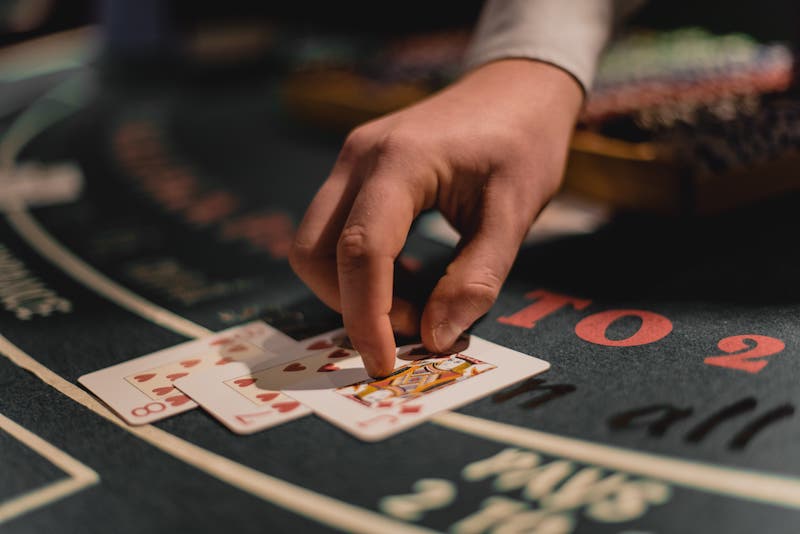
    Blackjack hand

    Is There a Flaw in Basic Strategy?

    Question: Recently, I've heard some people talking about how blackjack basic strategy is somehow flawed and that flaw has been making players lose for decades. There are even whole websites dedicated to finding the flaw. Is it true, is basic strategy wrong?

    Answer: While you might have heard it only recently, the idea of the basic strategy flaw has been around for decades. The story goes that when basic strategy was first developed in the 1960s, there was a mistake in the calculations and that that mistake has been passed down for years with most people never realizing the error.

    That's just an old gambling myth and is not at all true. Basic strategy was not calculated just once; it has been calculated thousands of times by different mathematicians and verified again and again. It has even been analyzed, and sometimes slightly changed, for every single rule variation, ensuring that players have the best chance to win.

    The reason the myth of the basic strategy flaw persists is that many people do not quite understand what it does. If you play blackjack basic strategy, you cut the house edge to under 1%, and sometimes much less depending on house rules.

    However, basic strategy does not give you an edge even if you play perfectly. You'll win more often if you play basic strategy than if you just try to play by feel, but over the time, the house will take its share. 

    Players expecting basic strategy to make them winners every time are disappointed and search for strategy flaws. But to get an edge, you need more advanced play, such as counting cards. 

    October 18, 2024

    By John Grochowski

    John Grochowski
  • ">
  • Body

    For nearly 25 years, John Grochowski has been one of the most prolific gaming writers in the United States. He’s been ranked ninth by GamblingSites among the top 11 gambling experts at Gambling Sites and his Video Poker Answer Book was ranked eighth among the best gambling books of all time.

    He started a weekly casinos column in the Chicago Sun-Times at the beginning of 1994 and He soon found himself in demand by a wide range of publications. He has written for casino industry professionals in Casino Executive and Casino Journal magazines, and for players in Casino Player, Strictly Slots and many other magazines.

    John’s twice-weekly columns appear in Casino City Times, Atlantic City Weekly and several websites. He has written six books on casino games, including the “Casino Answer Book” series. And, of course, John is a regular at 888casino Blog.

    Today John’s work includes a weekly column on baseball metrics for the Sun-Times. He lives in the Chicago area with Marcy, his wife of 30 years.

    John Grochowski
    factcheck
    Off
    hidemainimage
    show
    Hide sidebar
    show
    Fullwidth Page
    Off

    Here is a look at a few questions from readers about casino gambling.

    A question from Doris about blackjack:

    Mr. Scoblete, I am assuming you have played or read about most games. I know that blackjack is a tough game to play because you have to memorize “basic strategy” that explains why you have to hit, stand, double down or split pairs. I know there are other rules to follow when you play the game too.

    Now, all of that seems very complicated. Why have a game that requires the player to memorize so much stuff – and that player will still have to face the house edge no matter what? Does that seem fair or even make sense? I doubt it.

    I never thought that casino playing would require me to memorize a list of rules this long! Have you seen them? 

    I can’t even get through one playing card and then I discovered there were many cards depending on the type of blackjack game you are playing. You know that the rules of the game, the number of decks, what the dealer can and can’t do, yikes, changes how you play some of the hands! That’s a lot of work for not too much reward since you are doomed to lose ultimately, no matter what.

    Now, here was my first experience playing the game. Yes, I sat right down and started playing and one guy – a real bully – kept criticizing my decisions. Finally. I had enough and told him to shut up. 

    I soon left the table and went to the bathroom where I cried. I’m not a little girl but this guy got to me. He really distressed me. It was like being in junior high school.

    Now, here is what is weird. I still want to play blackjack. Yes, I do. It is the most popular table game in the casino and it seems like fun to play – if you know how to play it, that is. But do I really have to go through a college-level learning course to do so? Help required.

    Doris

    Frank responds:

    Sorry, Doris, but you ran into the biggest P.I.T.A that shows up at blackjack tables on occasion – the “expert,” the “professor,” the “Doctor” who often has little idea of how to play the game correctly but will ladle out a tremendous amount of advice, often the wrong advice too. And yell at you if you don’t follow his ideas.

    It seems he’ll always be yelling. (Sometimes the expert is a “she.”) I’m sorry you had to be badgered by this guy but once you know how to play, guess what? You’ll still get badgered on occasion! It’s the price, other than facing the house edge, that we blackjack players have to face.

    Still, when you can handle the game properly, you can just tell the “professor” you like to play the way you like to play and that’s that. “Sir, it’s my money.” That usually shuts them up. 

    Now, yes, you do have a lot of “types” of blackjack games where some of the rules aren’t like other rules other casinos might use. Take the handling of a soft 17 (A:6). Some blackjack games will have the dealer stand on the hand (that is good for the players) but many now will have the dealer hit that hand (that is good for the casinos). 

    Blackjack players – all other things being equal (which they rarely are) – should opt for the rules that are good for them if they can find those rules. 

    Okay, tonight, right now, purchase playing cards that explain how to play the different versions of “regular” blackjack that you will face. Don’t dive into Spanish 21 or the like, just get the right cards for regular blackjack. 

    Most casinos will let you refer to the cards while you play. And that’s how you’ll play until you get a handle on the game. 

    Blackjack is a great game but as you discovered there are (human) irritants involved in it. If you become a good player you will face about a 0.5% house edge, which means an expected loss of 50 cents per $100 wagered. That’s about the best bet in the casino.

    Blackjack hand

    More Lessons

    Now, I am going to give you some insider tips to help make your blackjack play as close to perfect as possible. Follow these and you will find the game of blackjack even more fun.

    • The general rule is that the more decisions you face the better it is for the casino. So, we try to keep the number of decisions low.
    • Play at a full or almost full tables.
    • Only play one hand. Do not spread to two or three hands. That simply means more money going to the casino over time.
    • When you have to go to the bathroom, go while the game is being played, not when the dealer is shuffling. The hands you miss simply reduce the number of hands you played. Fewer decisions are better for the player. Fewer decisions are good for the player.
    • Until you are comfortable with the total number of decisions you face at the game, always play with your strategy-playing cards in front of you – and take your time looking at the cards before deciding what to do. If other players try to speed you up when you aren’t ready, just ignore them or apologize for being a new player. 
    • A general rule here: Do not whine when things are going poorly for you. All blackjack players face streaks, some good, some bad. They are a part of the game.
    • Do not play continuous automatic shufflers. These are killers for a blackjack player’s bankroll.
    • When a dealer cuts cards out of the shoe look for the ones who cut a lot of cards out. That means you will play fewer hands. If you were a card counter, you would want the dealer to cut very few out of the shoe which means you’d get to see more cards to count. (If you have an edge, you want more. If the casino has the edge, you want less.)
    • Should you tip the dealers? That’s up to you. I will tip.

    A Question from Felix about Craps

    I don’t know, I really don’t. I love to play craps but I am getting killed. Does anyone ever win?  It seems like it should be easy but I am being slowly roasted. 

    I do get caught up in the game. That I will admit. I make a pass line bet and back it with full odds. I place the 6 and 8 unless one of those is my point. Then I buy the 4 and 10. 

    As the game flows I will throw out bets on some of the longshots, like the hardways, the field, snake eyes and the 12. I also like going up on the 11. These bets have big payouts. If the table has the Fire bet, yes, I will bet that because the payout is terrific.

    I do not seem to be able to catch fire in the bottle when I play. I have made some great hits but they don’t sustain me for very long. What am I doing wrong?

    I think I need some schooling.

    Felix

    Craps table

    Frank responds:

    Felix! Felix! Felix! Schooling? You need detention. Simple first: the more bets you make, the more bets you have to win. Even those longshot bets have to be hit enough times to keep you ahead of the game. 

    Yes, I know, I know those longshot bets are fun. But seriously no one – and I mean no one – can beat the game of craps for any serious length of time by making those bets. Just think of how much money you are putting on the table. And how many hits you must get to be ahead.

    The late Captain, my mentor from Atlantic City, had a rather simple philosophy when it came to betting. Have a large bankroll and make a small bet. Don’t bet those "Crazy Crapper" bets either. Those are the longshot bets you referred to. You cannot beat craps by making those bets. That’s why the Captain called those bets Crazy Crapper bets.

    A pass line bet with odds, and at best only have two bets with a come bet as your second bet, and leave it at that. Make sure the odds part is maximum if you can afford it. If not, make just one bet.

    I know, this way of betting doesn’t seem exciting but as you start to see wins occasionally entering your ledger, you will see this is the only way to wager. (Always keep a ledger. You don’t have to show it to anyone but it will keep you honest with yourself.)

    I am a big fan of craps. I know the fun of the game. But I also know that the only way to have a chance to win (short of learning dice control) is to make no more than a couple of good bets and let that be that.

    Many craps players are totally caught up in the excitement of the game. That’s great of course but it comes with a downside. You lose money if you start throwing your money around on longshot wagers. Yes, the house has an edge on every bet but a couple of low-house edge bets gives you a chance to win some money.

    Okay, enjoy your fellow players jumping up and down and screaming in joy or moaning in misery. That’s also a part of the fun of the game.

    Frank

    A Question from Sean

    This is about roulette. It does seem to me that this game has too high an edge on the double-zero wheel and seriously forget about the triple-zero wheel. How can you hope to beat a 5.26% house edge? The triple-zero is even worse.

    But I can’t seem to find any single-zero wheels that I can afford to play. How can they make the payout for a hit a measly 35 to 1?

    That’s my negative feeling. My positive feeling is that I love the game. I do. And not just because my first name is Sean (as in Sean Connery) the original and best James Bond.

    My understanding is that roulette is the oldest casino game. Do you know its origins? Any information would be helpful.

    Sean

    Roulette wheel

    Frank responds:  

    I loved Sean Connery as James Bond. Some actors have “it” and he had “it” in spades. Actresses can have “it” too. There used to be an actress long, long ago, who was called the “it” girl, her name was Clara Bow.

    Connery created the idea that James Bond would always bet the number 17 and for years now it is the number one number played at roulette.

    Blaise Pascal, a scientist, mathematician, theologian, and philosopher tried to create a perpetual motion machine. He and so far everyone who has tried to invent that machine has failed. Oh, well. But Blaise did invent roulette and that game has been in the casinos since the late 1600s. That may be his perpetual motion machine.

    It used to be the number one game, surpassed by craps in the 1940s and then blackjack in the mid-1960s. It is still one of the top three games in the casino.

    As for the payouts, those wins do pay 35 to 1 but you really have long losing streaks at times if you go straight up on a number. 

    Let me suggest this: Make one of the even-money bets of red/black, high/low, or odd/even. These are “even money” because they pay even money (1 to 1) but you won’t find really long losing streaks on these. 

    You can also take a pause between spins. Maybe sit out three spins out of 20 or something to that effect. The casino’s edge can’t take your money when you are sitting out. Give this a try.  

    All the best in and out of the casinos!

    October 3, 2024

    By Frank Scoblete

    Frank Scoblete
    Body

    Frank Scoblete grew up in Bay Ridge, Brooklyn. He spent the ‘60s getting an education; the ‘70s in editing, writing and publishing; the ‘80s in theatre, and the ‘90s and the 2000s in casino gambling.

    Along the way he taught English for 33 years. He has authored 35 books; his most recent publisher is Triumph Books, a division of Random House. He lives in Long Island. Frank wrote the Roulette strategy guide and he's a well known casino specialist. 

    Frank Scoblete
    factcheck
    Off
    hidemainimage
    show
    Hide sidebar
    show
    Fullwidth Page
    Off