The world of cruising has exploded. There are cruise ships and cruise ports over much of the world that is not currently at war (earth is almost always at war). The cost of cruising is somewhat high but then again you tend to get what you pay for.

It seems that going on cruises has become a very enjoyable, fashionable trend. I know some people who go on several cruises a year and swear by them.

Being out of sight of land can be fun. What’s out there? Water and more water and wavy water and fierce water and, again, you can visit other countries and cultures. 

When you cruise you aren’t stuck in a place or two. You can visit areas of the world you only dreamed about. Or never even knew you were interested in them. Perhaps going to different itineraries can be great fun too. 

Why not see areas of the world you have never seen before? That you’ve only read about? They are all out there in the great wide blue waters.

Areas with lush jungles, and epic forests and gleaming beaches with happy swimmers, warm weather ports where folks have only heard about winter and never experienced it. Or on the flip side, the frozen areas such as Antarctica or the North Pole. Or Alaska! 

If you enjoy cruising your choices are almost without end. You just have to stay away from countries that have not yet realized it is a waste of time to wage war when you only have one life to live.

And the food on cruises? (Maybe bring a bigger belt.) Wow! The drinks? Oh, yeah, hiccup! Your fellow passengers can be children (I’ll pass), teens (I’ll pass), 20s (I’ll probably pass), 30s on up to senior citizens (okay, that’s me).

What are the ships like? Oh, boy. They go from monstrously gigantic ships that make the Titanic look as if it were a row boat. You can book large suites all the way down to interior rooms that almost anyone can afford.

And then you have luxury cruise lines where you have your own butler (“Yes, your highness,” they’ll say, “what is your wish this morning, sire?”) and these ships rarely have more than a thousand passengers.   

You can book cruises that allow you to hobnob with the young party folks or the older folks (I prefer the older folks!) and everything in between. So, take your pick!

And just about every cruise ship will have a casino. On cross Atlantic Ocean trips that casino will be open almost 24 hours. I guess you can say that gambling and gallivanting now go hand-in-hand. If you like to gamble then why not gamble in a cruise casino?

Slot machines

Slot Machines

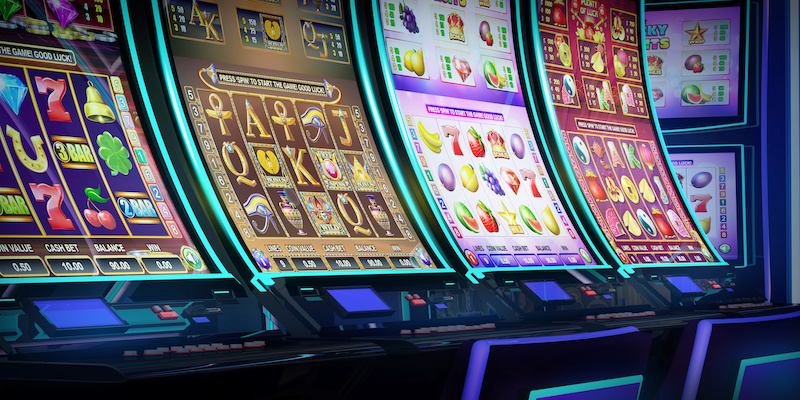
Let’s first take a look at slot machines. I do not have good news here. From what I understand, the average return of cruise slot machines is about 80%. That is much lower than the average return of machines in land-based casinos. 

You will note that this is merely a guess of mine as the cruise casinos do not have to release their returns unless they want to. And there are so many ships that keeping track would be an absolutely dull exercise in parsing playing percentages.

So, just realize you aren’t getting the best machine bets when you play the machines on a cruise ship. If you are a slot player, what should you do?

Play the lowest denomination machines. Play one decision at a time as opposed to multiple lines where you can have two, three, four or more options that you must pay to play. One decision at a time. And play as slow as you can without feeling that you are restraining yourself.

Generally, you can be on a cruise ship for 4 to 10 days and in that time you might have the desire to let it all hang out when you gamble. Restrain yourself if you happen to be that type of gambler. You want to enjoy the cruise, not lament it when it’s over.

For some reason, the slot machines attract a tremendous amount of play wherever they are found. This is true ever since they were invented over a 100 and then some years ago. 

So, you must be smart enough to play them intelligently. One decision at a time! Remember that.

Blackjack

Blackjack is still the number one table-game in the casinos – be they land-based casinos or on cruise ship casinos. It is a game that requires knowledge of how to play the various hands you get against the dealer’s face-up card.

I think cruise ship casinos will allow you to bring a blackjack strategy card with you when you play so you make the right decisions on the proper way to play your hands. If you feel shaky about your strategies then ask if you can bring a card to the table. If you can’t then you might want to go to a simpler game, such as roulette.

The cruise casinos’ game of blackjack is somewhat weak when compared to the best of the land-based casinos. Most might have the following rules:

  • Blackjacks will pay only 6-to-5 as opposed to 3-to-2. 
  • Dealers will hit a soft 17 (ace 6) instead of standing on all 17s. 
  • Games might be dealt from eight-deck or even-more-deck shoes.
  • Doubling down might be restricted; you won’t be able to double down on any first two cards.
  • You can’t double down on a split of pairs.

You will find that the table minimum bet is much lower than in land-based casinos and this is a very good thing. Be aware of the following:

  • Only play one hand. Do not spread to two or three hands. 
  • Go to the bathroom when the dealer is dealing, not when he or she is shuffling the cards. 
  • The more hands you play, the better it will be for the casino, the worse it will be for the player.
  • Play the lowest stakes you can that still make you feel as if you are gambling. No reason to play higher stakes than that.
  • Do not allow the gambling to replace other activities such as the shows, the tours, and the like.

Roulette wheel

Roulette

Blaise Pascal created the game of roulette in the 1600s. Blaise was a man of many dimensions, a scientist, theologian, philosopher, mathematician, and his greatest desire in life was to create a perpetual-motion machine.

He failed in that as has everyone who has ever tried to do this but he still has one great thing he invented, the game of roulette. That may wind up being his perpetual motion machine. 

Roulette was the number one game in the casinos until craps surpassed it in the 1940s and then blackjack took over in the mid-1960s. Still roulette has a large and loyal following. 

Generally, the game you will play on a cruise ship will be the American double-zero (0, 00) wheel. There will be 38 pockets for the ball to fall into, numbers 1-36, and those green 0 and 00.

The payment for a direct hit on a number is 35-to-1. The real payout should be 37-to-1 but the casino can’t make any money if it doesn’t shortchange the payout to the winning player.

How should you play roulette? Obviously, that is your choice but I have certain ideas that I will share with you. 

I do not like playing an inside bet on one number. There are 37 ways to lose that bet and only one way to win it. Yes, the payment is shorted at 35-to-1 and you can have very, very long losing streaks. That’s not for me. 

I prefer playing the proposition bets of red/black, odd/even, or high/low. These are called even-money bets not because they are 50/50 propositions but because they will pay even money on a win. 

The player will have 18 ways to win and 20 ways to lose. You can see that those interminable losing streaks will be rare.

The casino will still have the edge on you but you will feel as if you are in the game by playing the even-money bets.

There are some other proposition bets such as the dozens, the columns, and separate section bets on the layout. These will generally pay more than 1-to-1 but they are still better than going up on a single inside number. 

You might be like me; long losing streaks just kill the game and those you can expect when you play directly on a single number.

And, say hi to Blaise Pascal when you play his game!

[Please note: The single-zero wheel (0) has a 2.7% house edge, while the triple-zero wheel (0, 00, 000) has a 7.69% house edge.]

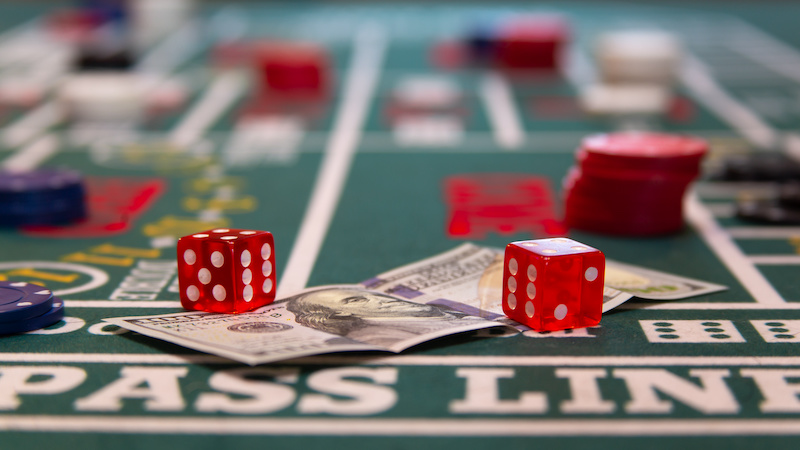
Craps table

Craps

This game started along the Mississippi River in the South of America and slowly made its way to the big and little cities (and alleys!) of the North. 

It was called crabs. (Or krabs.) And was probably based on an English game called Hazard. But Northerners couldn’t quite get the Southern pronunciation of crabs correctly and they mistakenly changed the name of the game to craps. That’s what they heard. And craps became its name.

Yes, the game was often played in alleyways in the big cities and in illegal casinos owned by cigar-smoking steely-eyed gangsters (okay, okay, I have no idea who the actual gangsters were or if they smoked cigars or had steely eyes). It was the city game despite the fact that it originated along the banks of a mighty, muddy, river.

During World War II, the game (along with poker) became the military game. Soldiers and sailors played it in whatever spare time they had unless they were actually in combat.

After the war, craps became the number one casino game, often tied with roulette, where it stood almost invincible until blackjack took over first place in the 1960s. Blackjack is still number one.

Craps was also a man’s game because until this second the men dominate its ranks. I would say that perhaps 90-95% of the players are male. Women shy away from the game.

Craps has a multitude of bets, going from excellent down (all the way down) to some of the absolutely worst bets in the casino

Make those awful bets, as many craps players seem compelled to do, and your prospects to win are remote. In fact, my mentor, the late Captain from Atlantic City, called the worst bets at craps the Crazy Crapper bets. That gives you some idea of what they are like and what happens to the players who make them.

Most cruise casinos will have one or two craps tables as each table requires at least four dealers. There are two types of craps games and they are played simultaneously; the “right” game and the “don’t” game, also called the “darkside” game. Guess which players are despised by the other craps players?

The rightside players are rooting for the shooter to make his point and the darksiders are rooting for the shooter to seven-out as quickly as possible. Maybe 90% of players are rightside players. The cheers you will hear at the craps tables are probably coming from rightsiders whose numbers and points are being hit.

(If you hear a splash, it is probably a darksider hitting the ocean waves!)

The best way to play craps is the simplest way. Bet one or two of the best bets and be done with it. The fact that there are dozens of bets should make you realize there is a reason most craps players ultimately become forlorn. 

The best bets to make are the pass line (1.41% house edge) adding odds (no house edge) when the pass line number is established and (if you can afford it) a second bet, usually a come with odds or a place bet of the 6 or 8. 

Two bets will suffice. You’ll have plenty of rolls where nothing hits and that is just fine. Enjoy the camaraderie at the table. Forget about betting the darkside as you might wind up being the player making the splash in the ocean. If you have never played craps buy a good book and study the game.

Conclusion: Enjoy your cruises and play some time in the casino, yes, but do not allow the gambling to take away from why you are on that ship. There’s a big world out there.

All the best in and out of the casinos!
 

October 2, 2024

By Frank Scoblete

Frank Scoblete
Body

Frank Scoblete grew up in Bay Ridge, Brooklyn. He spent the ‘60s getting an education; the ‘70s in editing, writing and publishing; the ‘80s in theatre, and the ‘90s and the 2000s in casino gambling.

Along the way he taught English for 33 years. He has authored 35 books; his most recent publisher is Triumph Books, a division of Random House. He lives in Long Island. Frank wrote the Roulette strategy guide and he's a well known casino specialist. 

Frank Scoblete
factcheck
Off
hidemainimage
show
Hide sidebar
show
Fullwidth Page
Off

The horses head down the stretch and the excitement builds. Fans leap to their feet and cheer on their jockeys. Within a few minutes the horses race across the finish line. Some bettors celebrate and others are disappointed with the results. Hopefully that ticket is a winner and if it’s not, maybe a few spins of the reels at the slot machines or some blackjack play might instead bring some winnings.
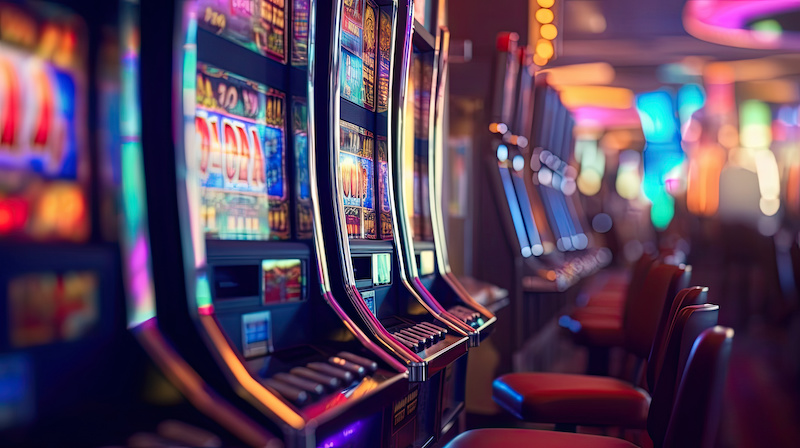
These are some of the gambling options one might find in the unique gambling properties known as “racinos” – a combination of the words a mash-up of “casino” and “racetrack.” These popular destinations have grown in popularity in recent years and some even offer modern amenities one might experience in Las Vegas.

Birth of the Racino

It may seem like a simple idea. Horse racing bettors may want to spend a few minutes playing slot machinesor at the blackjack tables when not making those daily double and trifecta selections. Or perhaps when it’s not racing season, an empty track might benefit financially from running a casino year-round, complete with a nice hotel, great restaurants, and some simulcast horse betting as well.

But the idea didn’t come to fruition until 1995, when the Prairie Meadows racetrack in Iowa added some slots in an effort to bring in more customers. At that time, the idea of a racino was a novel idea but the effort revived the racetrack. That success also inspired other states to also legalize slots and other gaming options at horse and dog tracks.

“The initial premise behind permitting casino gaming at racetracks in states with parimutuel racing and wagering was to preserve and promote horse and dog racing,” Global Gaming Business magazine notes. “The parimutuel racing industry was recognized as having been adversely affected by competition from other forms of gaming. Specifically, provisions were included that required a percentage of slot machine revenue to be allocated for payment of purses, to owners of racing animals at the racetrack, and in some cases breeders of racing stock in the state in which the racinos were located.”

Racinos were soon flourishing across the country with slot machines, video lottery terminals, and table games found at many tracks. Many of these racinos are now full-service resorts with great hotels, restaurants, showrooms, and major entertainment options.

Horse racing

Historical Horse Racing Machines

Another interesting aspect of the American racino and gaming industry is the emergence of historical horse racing (HHR) machines, which further intertwines gaming and racing.

The games were invented in 1997 and are similar to slot machines. As the name implies, the results are based on the results of past horse races. The games are officially considered a type of parimutuel wagering (just like horse racing, with money pooled and paid out based on the odds of winning), and players can officially look at handicapping information when playing.

Early versions looked like race betting terminals, but now most look more like slot machines. Most HHRs now feature symbols on spinning reels that correspond to the results of the player's wager. A video of the race can be found in a small video in the corner of the screen while others may show a computer-generated animated reenactment of a race.

HHRs have become big business. Traditional horse racing companies like Churchill Downs (also the name of the track that is the home of the famed Kentucky Derby) owns several HHR gaming facilities. The company began constructing the $100 million Owensboro Racing & Gaming HHR facility this year as an extension of Ellis Park racetrack in Henderson, Kentucky, which already has HHR games as well.

However, the machines initially sparked some controversy in the state, where casino gaming is technically illegal. But most gamblers would probably not be able to tell the difference between these games and traditional slots. Opponents argue that the machines are “horse racing” games in name only and most don’t even have a link to horse racing in any way. They believe the games are simply slot machines just with a different name.

Supporters argued that the games have played a critical role in shoring up the state’s horse race industry in recent years by adding to purses and tracks’ financial security. Kentucky legilators officially made the games legal in February.

“If it were not for historical horse racing, Ellis Park would be closed and Churchill Downs would not be rebuilding Turfway Park,” Elisabeth Jansen, executive vice president of the Kentucky Equine Education Alliance, said in 2021 of adding HHRs to tracks in the state. “Without historical horse racing, we would have a few days of racing at Churchill Downs and a few days of racing at Keeneland and that would be about it.”

Historical horse racing games remain controversial in other states, but can are or have been in operation in Minnesota, Alabama, Idaho, Kansas, Louisiana, New Hampshire, Oregon, Virginia, and Wyoming.

Casino

Growth of the Industry

As racinos have grown in popularity over the last decade, they have become even more critical to the horse racing industry. In many locations, revenues generated from casino gaming also help add to purses that horse owners can win on the track. They also help fund tracks and pay employees.

The concept of the racino can also be found in other parts of the world outside the U.S. In Canada, gamblers can find racing/casino options in Alberta, British Columbia, Manitoba, Ontario, Prince Edward Island, and Quebec.

One of the best of those, and perhaps one of the best in the world, was unveiled in 2023 when Great Canadian Casino Resort Toronto opened next to Woodbine Racetrack. The property features a modern resort casino with “transformative architecture” and 328,000 square feet of gaming space with 4,800 slot machines and 145 table games as well as VIP rooms and sports betting kiosks.

The casino is located on 33 acres adjacent to Woodbine and also boasts a 400-room hotel, 5,000-person live entertainment venue, and numerous on-site dining options. The $1 billion resort Toronto is now the largest casino property in the country and one of the largest private sector projects in Ontario. This racino really ramped up the experience. 

Another example of international racinos can be found in Buenos Aires, Argentina. The Hipodromo Argentino de Palermo features opened in 1876 and is one of the most modern tracks in South America and also houses two buildings for casino gaming with more than 1,000 slot machines.

In recent years, casino gaming has greatly cut into the horse racing market and many see adding casinos to these complexes as a way to keep racing alive. In turn, the facilities have also helped grow the casino industry in the U.S., Canada, and other locations.

“While the introduction and growth of racino gaming has been a mixed blessing to the race horse industry, it has been a boon to the casino business,” Global Gaming Business magazine reports. “It has had the intended effect of increasing purses with resulting increases in spending, employment and preservation of green space by the industry in state and local economies. Further, the presence of live and import simulcast races at racetracks has been found to increase slot machine wagering significantly.”
 

September 26, 2024

By Sean Chaffin

Sean Chaffin
  • ">
  • Body

    Sean Chaffin is a full-time freelance writer based in Ruidoso, New Mexico. He covers poker, gambling, the casino industry, and numerous other topics. Follow him on Twitter at @PokerTraditions and email him at seanchaffin@sbcglobal.net.

    Sean Chaffin
    factcheck
    Off
    hidemainimage
    show
    Hide sidebar
    show
    Fullwidth Page
    Off

    The internet if full of books, strategy cards, pamphlets, and advice that tout winning at the casino. Some authors claim that by using their systems, you will win up to 75% of your wagers. Others claim that their systems will guarantee a win if you follow the betting patterns they promote.

    Casinos are big business. They are able to build opulent structures, provide fine amenities, swimming pools, spas and a myriad of other creature comforts. These huge resorts employ tens of thousands of people to serve the casino’s guests.

    Ask yourself this question, if there was a simple betting system that would guarantee a win for the gambler, would casinos allow the betting system?

    Of course not. This article examines some common betting systems and shows why they will not work in the long run. 

    Contents

    1. Up as you lose betting systems
    2. Up as you win betting systems
    3. Hedging your bets – winning a higher percentage of the time
    4. Quit when you are ahead systems
    5. Summary

    Up As You Lose Betting Systems

    An up as you lose betting system have the player increase the bet each time the previous bet loses. Each up as you lose betting system has different specifics. 

    • Some say increase by one unit with each loss.
    • Some say double (or triple) the bet with each loss.
    • Some start with one unit and raise the bet by the sum of the previous two bets – example: 1, 1, 2, 3, 5, 8, 13, 21, …
    • Restart at one unit after every win.

    The logic is that the system user will eventually win a bet, and hopefully the amount won will put the player back in the winning column.

    The logic is sound. Eventually, the player will win a bet, if:

    • The player has a large enough bankroll.
    • The table limit is not reached.

    If the player had unlimited funds, (the casino has virtually unlimited funds) the proper up as you lose system would guarantee a win. 

    Did you ever wonder why there are upper limits on gaming tables? 

    Part of the reason is the casino must have adequate reserves to pay any winners and upper limits help manage the reserve amounts. The initial, and primary reason, however, is to foil the up as you lose betting systems. 

    Up As You Win Betting Systems

    Rather than increase bets as you lose, up as you win betting systems raise bets as they win. Similar to up as you lose betting systems, up as you win betting systems have different specifics:

    • Increase the bet after each win – by one unit, half a unit, or something else.
    • Double the bet after each win.
    • Start upping the bet immediately.
    • Start upping the bet only after winning a certain number of bets.
    • Wait until having won a certain amount (such as being ahead by two or three units).
    • Restart at one unit after each losing bet.

    The logic with up as you win betting systems is that luck comes in streaks. Jump in on the winning streaks and keep the bets low on the losing streaks.

    There are definitely streaks in gambling. Sometimes they are long – both winning and losing. The problem with up as you win betting systems is you never know when the winning streaks are going to end. 

    Up as you win betting systems can work well during long streaks. They perform miserably in choppy games.

    Betting systems

    Hedging Your Bets – Winning a Higher Percentage of the Time

    The glaring advertising for this type of betting system is something like “win 80 percent of your bets.” They work best in craps and roulette, games that have multiple ways to bet on each event.

    In craps they recommend making bets that cover multiple numbers.

    • Bet the field – which will win if a 2, 3, 4, 9, 10, 11, or 12 rolls. Separately bet the 5, 6, and 8. This system will win on any number except a 7.
    • Bet a pass line and a don’t pass bet. This system wins on any bet but the 12 (or sometimes the 2).

    There are other variations, but the all fall into the same category. The player wins on almost every roll. The downsides are:

    • In the field bet system, you win each bet individually but lose all bets on a 7.
    • On every bet on the craps table, the casino has an edge. It is a situation of bet more, lose more. Even though the player wins something, they do not win at a rate that matches the true odds of the bets.

    Quit When You Are Ahead Systems

    The main problem with these systems, is when do you say you are ahead? If you win the first bet, do you quit? Of course, not. 

    A better way to handle this would be to have a win goal and a loss limit. Quit when you hit either, knowing that you may quit earlier than you might want on the winning side.

    Summary 

    • Betting systems abound with good-sounding claims.
    • The fact of the matter, however, is no betting system can guarantee a win. Do not fall for the hype.
    September 24, 2024

    By Jerry Stich

    Jerry "Stickman" Stich
    Body

    Jerry “Stickman” has been involved in casino gambling for nearly 30 years. He is an expert in blackjack, craps, video poker and advantage slot machine play. He started playing blackjack in the late ‘80s, learned several card counting systems and used these skills to become an advantage blackjack player and overall winner of this game. He also acquired the skills necessary to become an overall winner in the game of craps, accomplishing this by a combination of throwing skill and proper betting techniques. Stich is also an overall winner playing video poker. This was accomplished by playing only the best games and using expert playing strategy. 

    Jerry used his skills to help others also become better gamblers. He has taught advantage play techniques in blackjack, craps, video poker and slot play to hundreds of students. He is a regular contributor to top gaming magazines and has authored and co-authored various books on gambling.

    Jerry Stich
    factcheck
    Off
    hidemainimage
    show
    Hide sidebar
    show
    Fullwidth Page
    Off

    House edges are important guides to your shot to win in any casino game, but they're not the only factor.

    Speed of play can make a difference. It certainly does in craps, which has a collection of bets that vary not only in house edge and in rolls per decision.

    A craps bet can have a lower house edge than another, yet lead you to larger losses per 100 rolls because decisions come faster.

    The Field vs. Place Bets

    Take the field bet, which in its better version has a house edge of 2.78%. You win even money on the field if the roll is 3, 4, 9, 10 or 11. Commonly, you win and are paid at 2-1 odds if the roll is 2, and are paid at 3-1 odds if the roll is 12.

    A small number of casinos reverse the 2-12 payoffs so you win 2-1 on 12 or 3-1 on 2. That does not affect the house edge, which remains at 2.78%. If your casino pays only 2-1 on both 2 and 12, the house edge soars to 5.56%.

    That 2.78% edge is lower than place bets on either 5 or 9, with a 4% house edge. It's much lower than the 6.67% edge on either 4 or 10, though not as favorable 

    Should you make the field bet instead of placing 4 or 10, or 5 or 9? Not necessarily.

    The field is a one-roll bet. It move much faster and puts more pressure on your bankroll than placing 5 or 9, with an average of 3.6 rolls per decision, or placing 4 or 10, with four rolls per decision.

    Imagine you're making $10 wagers and re-betting after each decision for 100 rolls. Bet on the 2.78% version of the field, and 100 rolls bring 100 decisions. You put $1,000 at risk, and your average loss is $27.80.

    When you place 5 or 9, you'd make an average of 27.8 wagers – 100 rolls divided by 3.6 rolls per decision. Your average risk would be $278, and your average loss would be $11.12 – less than half the average loss on the field.

    Divide 100 rolls by the average of four rolls per decision when placing 4 or 10, and you get 25 wagers. That's a risk per 100 rolls of $250. Even with the high 6.67% house edge, the average loss of $16.68 per 100 rolls is less than the average loss when you put your money on the field. The slower pace in deciding place bets makes a big difference.

    Craps table

    One-Roll Bets

    When bets are decided in just one roll, decisions come fast and furious. That speed does not work in your favor. 

    Most one-roll bets also have very high house edges, and the combination of big house edge and high speed is a bankroll-killer.

    Let's take a look at the house edge and the average loss per 100 rolls with $10 bets on the most common one-roll bets:

    The Field

    As we've just seen, the better version of the field where you get 2-1 on 2 and 3-1 on 12 – or occasionally the reverse – costs an average of $27.80 per 100 rolls. That's reflective of the 2.78% house edge.

    When field payoffs on 2 and 12 are both 2-1 with no 3-1 roll, the house edge doubles to 5.56%. Average losses also double, to $55.60 when you risk $10 a roll for 100 rolls.

    Any Craps

    You win a 7-1 payoff if the roll is 2, 3 or 12. True odds against winning are 8-1, leaving a house edge of 11.11%. 

    Risk a total of $1,000 in our 100-roll trial, and the average loss soars to $111.11.

    3 or 11

    If you bet on 3, you have two ways to win. Either 1 must land on the first die and 2 on the second or 2 on the first and 1 on the second. Similarly, winning combos on 11 are either 6-5 or 5-6.

    Payoffs on winners are 15-1, and the house edge is 11.11%. That matches the house edge on any craps, so the average loss for our 100-roll trial is $111.11.

    2 or 12

    There's only one winner on 2. Both dice must land on 1. To win on 12, both dice must land on 6.

    Winners pay 30-1, but that's far below the true odds of 35-1. The house edge is 13.89 percent. In our trial of 100 rolls at $10 per roll, that leaves a whopping average loss of $138.90.

    Any 7

    Seven is the most common rolls in craps. Six of 36 possible rolls total 6. True odds against winning are 5-1, but winners pay only 4-1. The house edge is huge at 16.67%, so with 100 $10 bets, losses average $166.67.

    Bottom Line

    One-roll bets are hazardous to  your bankroll. Most house edges are very high, and even with a reasonable edge as on the field, decisions come so rapidly they can be a drain on your chips.

    Craps dice roll

    Multi-Roll Bets

    When it takes multiple rolls to decide a bet, you make fewer bets per 100 rolls, and that eases pressure on your bankroll.

    Let's look at average losses per 100 rolls with bets of $10 per decision at common multi-roll wagers. We won't get into taking odds or laying odds. Those bets have no house edge, but to you can't make them without also betting pass, come, don't pass or don't come. Let's look as wagers you can make as independent bets.

    Pass or Come

    These bets work the same way. If the first roll is a comeout for the shooter's sequence, bet  on pass. If it's not a comeout for the shooter, bet on come and the next roll serves as a comeout for your bet.

    Either can be decided in one roll. If the dice land on 7 or 11, you win. If they land on 2, 3 or 12, you lose. More often, they land on one of the other six numbers. In that case, that number becomes the point. You win if the shooter repeats your number before rolling 7, but lose if a 7 comes first. 

    It takes an average of 3.38 rolls to decide a pass or come bet. Per 100 rolls, you'd average 29.6 bets. At $10 per bet, that's a risk of $296. The house edge is 1.41$, leaving an average loss of just $4.17.

    At that level, you need only one more win than average to turn that expected loss into a profit.

    Don't Pass or Don't Come 

    The near opposites of pass and come, you're betting the shooter will not make the point. 

    The reason these are near opposites and not fully opposites is that if the comeout is  12, don't pass or don't come push instead of winning. The do win on 2 or 3 and lose on 7 or 11, and once there's a point number, they win if the shooter rolls 7.

    These take an average of 3.47 rolls to decide, leaving 28.8 decisions, a $288 average risk and with a 1.36 percent house edge an average loss of $3.92.

    Place Bets

    We've already seen how place bets work in the comparison with the field earlier in this article. As noted, 5 and 9 have a 4 percent house edge, take an average of 3.6 rolls to decide, leaving average losses for 100 rolls at $10 per roll at $11.11.

    Place bets on 4 or 10 have a 6.67% house edge, take an average of four rolls to decide, with an average loss of $16.68 in our trial.

    The most favorable place bets are those on 6 or 8, with a house edge of just 1.52%. On average, a decision takes 3.27 rolls, leaving 30.6 decisions per 100 rolls, a risk of $306 at $10 per bet and an average loss of a mere $4.65. That's not as low as pass, come, don't pass or don't come, but you can swing a profit with one more win than expected in our 100 rolls.

    Hardways

    To win, the shooter must roll your number the hard way before rolling either a 7 or your number the easy way.

    What's the hard way for craps players? Both dice must land on the same number. A hard 4 is 2-2, hard 6 is 3-3, hard 8 if 4-4 and hard 10 is 5-5.

    These have much higher house edges than the other multi-roll bets listed. Hard 6 or hard 8 pays 9-1, has a 9.09% house edge and is decided in an average of 3.27 rolls. Hard 4 or 10 pays 7-1, takes an average of four rolls to decide and carries an 11.11 percent house edge.

    Average losses in our trial conditions are $27.82 on hard 6 or 8 and $27.78 on hard 4 or 10, much higher than the other multi-roll bets.

    Bottom Line

    One one-roll bet – the better version of the field – has an average loss per 100 rolls that is competitive with the hardways, all in that $27.80 area.

    But all are much worse than pass, come, don't pass, don't come and the place bets. One-roll wagers are bets to avoid. Don't feel the need for speed.

    September 23, 2024

    By John Grochowski

    John Grochowski
  • ">
  • Body

    For nearly 25 years, John Grochowski has been one of the most prolific gaming writers in the United States. He’s been ranked ninth by GamblingSites among the top 11 gambling experts at Gambling Sites and his Video Poker Answer Book was ranked eighth among the best gambling books of all time.

    He started a weekly casinos column in the Chicago Sun-Times at the beginning of 1994 and He soon found himself in demand by a wide range of publications. He has written for casino industry professionals in Casino Executive and Casino Journal magazines, and for players in Casino Player, Strictly Slots and many other magazines.

    John’s twice-weekly columns appear in Casino City Times, Atlantic City Weekly and several websites. He has written six books on casino games, including the “Casino Answer Book” series. And, of course, John is a regular at 888casino Blog.

    Today John’s work includes a weekly column on baseball metrics for the Sun-Times. He lives in the Chicago area with Marcy, his wife of 30 years.

    John Grochowski
    factcheck
    Off
    hidemainimage
    show
    Hide sidebar
    show
    Fullwidth Page
    Off


    For the average player (as well as the not so average player) hitting a royal flush at video poker is a rare and exciting event. Years can pass between them. Just what are the odds against hitting a royal flush? How about the odds against getting royal flushes back to back?

    Let's investigate those questions.

    Contents

    1. A royal flush is usually treated differently by the casino than other winning hands
    2. The playing strategy matters
    3. The odds against getting a royal flush immediately after a previous royal flush
    4. The odds against being dealt two royal flushes in a row
    5. Summary

    A royal flush is usually treated differently by the casino than other winning hands

    Although there are a few video poker casino games and pay tables that have winning hands that can be as rewarding to the player, on most games, a royal flush pays more than any other hand. 

    Depending on the denomination the game being played, the payoff meets or exceeds the IRS limit for a win ($1,200) and a W2-G form must be generated. This requires casino personnel to get involved. The machine locks up and plays a happy sounding melody while help is summoned. If it is a busy time, the music can get on your nerves during the long wait.

    Once the attendant arrives, he or she verifies everything is proper, gets your personal tax information, and heads back to get your hand pay and W2-G form.

    Usually two attendants return – one with the cash and tax form and the other as a witness. Once you are paid, the machine is unlocked and you are asked to play off that glorious royal flush. 

    It is bad for business to have a video poker machine showing the last hand as a royal flush. Nobody wants to play a game that has just scored a hand that occurs only once in about 40,000 to 45,000 hands or so. Players would much rather sit at a game where a royal has not appeared in a good long time.

    Players who have just collected for a royal flush generally do not mind playing off the royal. They have just received a very nice pile of cash and are feeling flush.

    Once curiosity got the best of me, however. After getting a royal flush, getting my W2-G, and my winnings, I was asked to play off the royal flush. My response was, what if I refuse to do so? The attendant was speechless for a few moments. The initial response was something to the effect of back-to-back royal flushes have been known to happen.

    “Have you ever seen it happen,” I asked. “No,” was the response, “but I know it has happened.” I do not remember exactly what else was said, but after a brief while, and to the apparent relief of the attendant, I played off the royal flush.

    I know other players who got royals within a few hands of each other. In fact, I am one of them. This was not one of those times that back-to-back royal flushes happened.

    The question (and topic of this article) is, if a royal flush occurs once in about 40,000 to 45,000 hands, what are the odds against getting two of them back-to-back?

    The Playing Strategy Matters

    The odds vary according the specific game and pay table as well as the strategy employed while playing the game. The normal video poker playing strategy has the player maximize the return of each hand being dealt – not maximizing the chance of getting a royal flush.

    By maximizing return, the player has the best overall chance of winning. This strategy also allows the player to play for the longest possible time on a particular bankroll.

    If the playing strategy was tilted toward getting royal flushes, they would happen more frequently, but the player would also throw away hands that would produce other, less lucrative winning hands. The net result is the player would lose more by chasing royal flushes.

    On a standard full-pay jacks or better game, a good example of holding for the maximum return of each hand rather than for a royal is a dealt hand containing a suited ace-10 with mixed junk cards. The correct hold for maximum return is to hold the lone ace. This hold guarantees the player will NOT get a royal flush, but in the long run will win more money.

    Each different game can affect the playing strategy. Each different pay table can affect the playing strategy. Finally, the playing strategy affects the frequency of royal flushes. 

    This article uses only the standard full-pay jacks or better game strategy for its calculations. 

    Odds Against Getting a Royal Flush Immediately After a Previous Royal Flush

    Keeping in mind that we are using a strategy that favors a maximum overall return, a standard full-pay (9-for-1 for a full house, 6-for-1 for a flush) jacks or better game strategy will see a royal flush occur once every 40,390 hands, on average. This a frequency of 0.0024758%. 

    While the player may very infrequently be dealt a royal flush, the frequency numbers are based on the player having the opportunity to select replacement cards before the final hand is determined. 

    If I have done my research correctly, the frequency of back-to-back royal flushes is 0.0024758% times 0.0024758% (0.000024758 x 0.000024758) which equals 0.0000000612988%. Put another way, this will happen, on average, once every approximately 1.6 billion hands. For comparison, the odds against being hit by lightning in any given year are about a million to one.

    Video poker

    Odds Against Being Dealt Two Royal Flushes in a Row

    The odds against having two royal flushes in a row are, indeed, long. How about the odds against being dealt a second royal flush immediately after being dealt the first one?

    On average, a royal flush is dealt once every 649,740 hands. This works out to a frequency of 0.0001539%. Using the same formula, the frequency percent of two dealt royal flushes in a row 0.0001539% times 0.0001539 %.

    This equals 0.0000000002369% – once every approximately 422 billion hands. Talk about long odds!

    Summary 

    • Hitting a royal flush in video poker is a rare, exciting, and lucrative video poker event.
    • Casinos want players to play off a royal flush because leaving it showing would cause other players to avoid playing that machine. 
    • It is stated that hitting two royals in a row has happened – but what are the odds?
    • While hitting a royal flush is rare, hitting two in a row happens only once every approximately 1.6 billion hands, on average.
    • Hitting two dealt royal flushes in a row is ridiculously rare – once every approximately 422 billion hands, on average.
    • The odds against getting hit by lightning in a given year is “only” about a million to one.
    September 23, 2024

    By Jerry Stich

    Jerry "Stickman" Stich
    Body

    Jerry “Stickman” has been involved in casino gambling for nearly 30 years. He is an expert in blackjack, craps, video poker and advantage slot machine play. He started playing blackjack in the late ‘80s, learned several card counting systems and used these skills to become an advantage blackjack player and overall winner of this game. He also acquired the skills necessary to become an overall winner in the game of craps, accomplishing this by a combination of throwing skill and proper betting techniques. Stich is also an overall winner playing video poker. This was accomplished by playing only the best games and using expert playing strategy. 

    Jerry used his skills to help others also become better gamblers. He has taught advantage play techniques in blackjack, craps, video poker and slot play to hundreds of students. He is a regular contributor to top gaming magazines and has authored and co-authored various books on gambling.

    Jerry Stich
    factcheck
    Off
    hidemainimage
    show
    Hide sidebar
    show
    Fullwidth Page
    Off

    Things are not always as they seem in roulette. Take the roulette table layout and wheel. New players quickly learn that the numbers on the wheel are not in the same order as the numbers on the layout.

    That represents a challenge to players who like to bet neighboring numbers. Some online games, including Roulette Advanced, distributed by NetEnt, have stepped up to that challenge by offering a single-zero roulette variation that enables combination bets on numbers that are neighbors on the wheel.

    Not every online casino has such games, and they are rare in live casinos.

    In standard roulette games, many bettors will wager on consecutive numbers on the layout in combination bets – two-number splits, three-number streets, four-number corners and six-number double streets.

    What if you want to combine numbers that are adjacent on the wheel, but not on the layout, thinking that the dealer might hit a certain sector on the wheel? In standard roulette, you must make several wagers to cover all your numbers.

    Roulette Advanced enables you to pick among combinations that are adjacent on the wheel. 

    The Roulette Advanced layout includes the standard grid, but it also has a racetrack-like oval display to choose among sector bets. On that oval, the numbers are marked off in segments in wheel order.

    Good Neighbors

    "Neighbors" bets, placed on the racetrack, enable you to bet on roulette combinations as they appear on the wheel. If you want to bet the ball will land within a three-number wheel segment of 27, 6 and 34, a three-number neighbors bet will do the trick.

    If you want to expand the segment and pick 9 as your center number, it falls in between 31 and 22, and a five-number neighbors bet can also get you 14 to the left of 31 and 18 to the right of 22.

    You could expand that once again to a seven-number bet, with the 14-31-9-22-18 sequence you've already chosen along with 20 to the left of 14 and 29 to the right of 18.

    Where neighbors bets are available, they're essentially treated as separate wagers on each number. That means neighbors bets should be made in multiples of numbers in your segment. If the table minimum bet is $1, then a three-number neighbors combination requires wagers of $3, or $6, $9 or some other multiple of $3.

    In online casinos, you sometimes can find minimum bets as low as 10 cents, so your three-number combo can be 30, 60 or 90 cents, or $1.20, $1.50 and so on.

    If any of the numbers in your combination wins, it is treated as a single-number payout. In you bet $7 on the segment of 20-14-31-8-22-18-29 and the ball lands on any of those numbers, you get a 35-1 payoff on $1 if your bet. You lose the $6 earmarked for the other six numbers, but you win $35 and keep the $1 portion of your bet that applies to the winner.

    At wizardofodds.com, Michael Shackelford offered a breakdown of the math on neighbors bets that show a 2.7% house edge, the same as on single-number bets on a single-zero wheel. You'll win 8.1% of the time on a three-number combination, 13.5% on a five-number segment and 18.9% on a seven-number neighbors bet, but in each case, the house edge remains at 2.7%.

    Roulette wheel

    Other Possibilities

    Several other bets can be made in the space at the center of the racetrack in Roulette Advanced. 

    Serie 5/8

    The long-form name of this wager is Le Tiers du Cylindre, and you'll sometimes find it just written as "Tiers." In the Roulette Advanced racetrack center, it's just labeled "Serie 5/8."

    It's a 12-number bet that's made of up of six split bets. The splits cover 5-8, 10-11, 13-16, 23-24, 27-30 and 33-36.  You could make such a combination on a standard roulette game by making those splits, but the racetrack layout enables you to be the combo all at once. It's really six separate bets, so you need to bet in multiples of six betting units – multiples of $6 if there's a $1 minimum.

    Any winning split gives you a 17-1 payoff on that portion of your bet, though you lose the other five wagers.

    As with the neighbors, the house edge is the 2.7% that's the norm at single-zero roulette.

    Voisons De Zero

    In English, that's "neighbors of zero." On the Roulette Advanced racetrack, it's labeled "Serie 0/2/3." This enables you to cover the 0, the eight numbers to its left and the eight numbers to its right as they appear on the wheel. They range from 22  to the left to 25 on the right.

    Bets should be in multiples of 9, so if the minimum bet is $1, bets should be multiples of $9.

    That bet is then broken down into one unit each on the two-number splits 4-7, 12-15, 18-21, 19-22 and 32-35; two units on the three-number trio of 0, 2 and 3, and two units on the four-number corner 22-26-28-29.

    Any winning split is paid at 17-1, a winning trio at 11-1 and a winning corner at 8-1. As you'd expect by now, the house edge is the standard 2.7% for single-zero roulette.

    Jeu Zero

    Shortened to "Zero" on the Roulette Advanced racetrack, the English translation is "game zero." It's a seven-number bet that covers the segment from 12-15 at they appear on the wheel.

    You wager represents four bets: two-number splits on 0-3, 12-15, and 32-25 along with a single-number bet on 26. The bet should be made in multiples of four, or at least $4 with a $1 minimum bet.

    Any winner on a split is paid 17-1, with 35-1 if the single-number bet on 26 hits. The house edge is 2.7%.

    Orphelins

    "Orphans" in English and shortened to "Orph." at the racetrack center, this bet covers numbers not included in the other advanced combinations.

    It is composed of five bets, so bets must be multiples of five, or $5 with a $1 minimum wager. Component bets are a single-number bet on 1 along with the two-number split 6-9, 14-17, 17-20, 31-34.

    As we've seen, winning single-number bets pay 35-1 and winning splits pay 17-1. The house edge? You guessed it: 2.7%.

    Conclusion

    When a roulette number has come up multiple times in a short period, many roulette players like to bet it and its neighbors. Problem is, the neighbors on the standard betting layout can be far removed from your number on the wheel.

    The Roulette Advanced combinations give you a way to bet nearby numbers in wheel order. If the ball bounces from you number to one next door, it's the wheel order that matters.

    Be cautious. As long as the wheel is balanced on a live game or the random number generator is in order online, betting wheel segments doesn't give you any real edge. But it doesn't increase the house edge, either, and it can be a fun way to play.

    September 20, 2024

    By John Grochowski

    John Grochowski
  • ">
  • Body

    For nearly 25 years, John Grochowski has been one of the most prolific gaming writers in the United States. He’s been ranked ninth by GamblingSites among the top 11 gambling experts at Gambling Sites and his Video Poker Answer Book was ranked eighth among the best gambling books of all time.

    He started a weekly casinos column in the Chicago Sun-Times at the beginning of 1994 and He soon found himself in demand by a wide range of publications. He has written for casino industry professionals in Casino Executive and Casino Journal magazines, and for players in Casino Player, Strictly Slots and many other magazines.

    John’s twice-weekly columns appear in Casino City Times, Atlantic City Weekly and several websites. He has written six books on casino games, including the “Casino Answer Book” series. And, of course, John is a regular at 888casino Blog.

    Today John’s work includes a weekly column on baseball metrics for the Sun-Times. He lives in the Chicago area with Marcy, his wife of 30 years.

    John Grochowski
    factcheck
    Off
    hidemainimage
    show
    Hide sidebar
    show
    Fullwidth Page
    Off

    Like many companies around the world, the casino and gaming industry has been forced to deal with a growing technological concern over the last few years – cyber attacks. Cyber security has never been a bigger concern as casinos around the world have experienced breaches in recent years.

    Harvard Business Review recently reported a 20% increase in data breaches from 2022 to 2023 and that looks to continue going up.

    “For many years, organizations have struggled to protect themselves from cyberattacks: companies, universities, and government agencies have expended enormous amounts of resources to secure themselves,” the report noted.

    Casinos have also seen a major uptick in cyber attacks in recent years, including some major cases in 2023 with a couple of cases drawing some major headlines.

    MGM Resorts

    In September 2023, MGM Resorts experienced a cybersecurity attack that left many of the company’s computer systems down. The outage affected company websites, email accounts, reservation systems, and even slot machines at casinos across the U.S.

    “MGM Resorts recently identified a cybersecurity issue affecting some of the company’s systems,” the company said in a statement at the time. “Promptly after detecting the issue, we quickly began an investigation with assistance from leading external cybersecurity experts.”

    The company notified law enforcement and also consulted with outside security experts to combat the cyber attack. However, the breech greatly affected the company with casinos reverting back to operations one might have seen years ago – with many transactions and reservations conducted by hand rather than computer. Slot payouts were even made in cash for a time.

    After several days, the company began to get things back to normal, but that came with considerable costs financially, with a drop in earnings for the third quarter of about $100 million. Hotel occupancy dropped to 5% compared to September 2022, which actually may not be too bad considering the issues the company faced.

    MGM’s Securities and Exchange Commission filing reported that MGM also saw a $10 million one-time expense for technology consulting services, legal fees, and the use of other advisors during the cyber attack. Several lawsuits were also filed against the company.

    MGM also said in the filing: “While no company can ever eliminate the risk of a cyber attack, the company has taken significant measures, working with industry-leading third-party  experts, to further enhance its system safeguards. These efforts are ongoing.”

    The FBI said the attack was the work of a group called “Scattered Spider,” which has cost companies millions of dollars since it began operating in 2021.

    Casino sign

    Caesars Entertainment

    MGM wasn’t the only company to experience an attempted cyber attack in 2023. Caesars Entertainment, the company that operates numerous major casinos including Caesars Palace, Paris Las Vegas, Flamingo, Harrahs, and numerous others, also experienced a cyber attack around the same time as MGM, with hackers demanding a ransom.

    The company took a different route to getting back control of the companies’ system, according to the Wall Street Journal, and ultimately paid a $30 million ransom. The high-tech bandits used a similar scheme as with MGM to initially gain control of the company’s systems.

    “Hackers used a social-engineering scheme, in which a person pretending to be an employee contacted the company IT help desk to have a password changed,” the Wall Street Journal reported. “Caesars said that the incident resulted from a social engineering attack on an outsourced IT support vendor, without providing further detail on ‘the unauthorized actor’ responsible for it.”

    The company quickly activated response protocols for this type of situation and enacted containment and remediation measures for Caesars computer systems. Management was able to gain back its systems completely after paying the ransom, according to reports.

    The Journal noted: “Hotels and casinos are potentially lucrative targets for hackers because of the amount of personal and financial data they collect from customers.”

    Shutting Down in Canada

    American gaming companies haven’t been the only gaming and casino operators affected by cyber crime and a major case in Canada offers a look at how these cases can hurt employees. In April 2023, Gateway Casinos and Entertainment shut down casinos all across the province of Ontario after undergoing a ransomware attack.

    The shutdowns lasted two weeks and greatly affected Gateway employees in the province, who weren’t able to work. The company operates gaming properties in British Columbia, Ontario, and Alberta and has annual revenues of more than $200 million. Management brought in outside experts to help regain access to computer systems and to protect customer data.

    Some of the recent cyber attacks against gaming firms point to what should be a growing concern, according to a report from web performance and security firm Cloudflare.

    “Over 5.41% of the total DDoS attack traffic recorded by Cloudflare in Q3 (2023) targeted gambling and gaming sites, taking over the cryptocurrency sector that was previously the most targeted,” Canadian Gaming and Business noted. “Looking at specific regions, Cloudflare reported a 10% increase in Canadian cyberattacks year-on-year. Canada ranks fifth globally for DDoS attack traffic, behind the US, Singapore, Vietnam, and China. In total, Canada is responsible for a 1.687% share of all DDoS traffic globally.

    Casino hackers

    Other Hacking Cases

    There have been more casino and gaming-related cyber security breaches in recent years as well. In February, Arizona’s Casino Del Sol in the U.S. was the victim of an attempted cyber attack and faced serious disruptions to the property’s computer systems. The attack affected the casino’s phone systems, bingo operations, rewards club, and more.

    As noted, online operators have not been immune to these types of attacks as well. In September 2023, CoinTelegraph.com reported that a major crypto gambling site lost $41 million after being hacked.  The site reported that the gaming site was drained of three different cryptocurrencies to an account that had previously seen no activity.

    “Crypto gambling site Stake experienced $41 million in withdrawals on Sept. 4 in what blockchain security analysts have called ‘suspicious outflows,’” CoinTelegraph reported. “The withdrawing account has been labeled ‘Stake.com Hacker’ by Etherscan, implying that the drained funds may be the result of a stolen private key.”

    In November 2023, Mexican online gaming operator Strendus allegedly left open access to numerous users’ personal data in what some media reports have called a “rookie mistake.” Cybernews reported that the “data was likely compromised by unauthorized actors.”

    The site reported that significant personal data was available including names, home addresses, phone numbers, government ID numbers, email addresses, IP addresses, and more.

    In 2002, one of the world’s largest online poker operators also experienced a serious setback after being cyber attacked. The attempted hack occurred during a major online poker series and left the company forced to reschedule many events.

    No doubt casinos and other gaming entities will be targets in the coming years and technology staff members must remain vigilant in the war against these high-tech criminals.

    “As the technology we use advances and progresses, the enormous potential for cyber crime also grows,” business insurance firm Embroker notes. “Not only is the number of cyber attacks growing, but incidents are becoming more sophisticated and dangerous. Cybercrime costs are on the rise, and it is expected to cost the world more than $24 trillion by 2027.”

    September 19, 2024

    By Sean Chaffin

    Sean Chaffin
  • ">
  • Body

    Sean Chaffin is a full-time freelance writer based in Ruidoso, New Mexico. He covers poker, gambling, the casino industry, and numerous other topics. Follow him on Twitter at @PokerTraditions and email him at seanchaffin@sbcglobal.net.

    Sean Chaffin
    factcheck
    Off
    hidemainimage
    show
    Hide sidebar
    show
    Fullwidth Page
    Off

    The competition (and bragging rights) for the World's Greatest Blackjack Player (aka Grosjean Cup) was significantly different than previous years at this year's Blackjack Ball.

    Instead of the usual 21-question "test," this year's blackjack competition was implemented in a sudden-death format where you had to answer each question to advance correctly. You were eliminated if you had an incorrect or no answer to a question.
     

    Max showed the first question on the big screen. If you answered it correctly, you raised your answer card. As expected, quite a few contestants raised answer cards. Those who didn't get the correct answer placed their answer card on the table, and they were eliminated from the competition. This process was repeated for questions 2, 3, and 4. Below are the four questions.

    (Note: Click here to read Part 1 of this article.)

    Grosjean Cup Questions

    1. It’s a double-deck live game in a casino, face up, first round. Who should take insurance?

    blackjack hands

    2. It’s a double-deck game, dealer stands on soft 17 (s17), and a blackjack pays 3-2.  According to Peter Griffin’s Theory of Blackjack , before you look at your hand, what is your expectation with the dealer showing a six upcard?

    Blackjack quiz

    3. Which player’s hands are NOT one of Don Schlesinger’s Illustrious 18?

    Blackjack hands

    4. Four-deck game, dealer hits soft 17 (h17), and doubling down allowed after pair splitting (das). Indicate what the basic playing strategy is for each hand. If you miss one, you are eliminated.

    Blackjack table

    (Note: The answers to the questions are at the end of the article.)

    After the fourth question, there were only seven contestants with raised answer cards. They were invited on stage for a tiebreaker question.

    Tie Breaker Question

    "Name a Las Vegas casino with over 2,000 hotel rooms." Each contestant went in turn and named a casino. If they repeated the name of a casino or named a casino with fewer than 2,000 rooms, they were eliminated.

    The three players who survived the tiebreaker were:

    • Barry Meadow
    • Michael Kaplan, and 
    • Stan

    They joined John Chang, winner of the World's Fastest Card Counter (WFCC) contest, on the final table for the skills competition. This involved:

    • Correctly playing your hand if you can see the dealer's hole card.
    • Memorizing the sequence of cards spread on a table.
    • Estimating the number of cards in a stack of cards.
    • Inserting the cut card exactly at 17 cards.

     Here are the result of the competition:

    • John Chang won the Grosjean Cup and bragging rights as "The World’s Greatest Blackjack Player." 
    • Steve won the Munchkin trophy for second place 
    • Barry Meadow came in third place.
    • Michael Kaplan finished in fourth place.

     John Chang won both competitions this year: World’s Fastest Card Counter and the Grosjean Cup.

    Winning Teams in Pari-Mutuel Competition

    Based on the above winners, players in the Pari-Mutuel contest cashed in if they wagered on the three teams listed below.

    • WIN: Hall of Fame Team #4 (included John Chang)
    • PLACE: The Field Team #1 (included Steve)
    • SHOW: Gambling Writers Team #10 (included Barry Meadow)
    • FOURTH: Gambling Writers Team #10 (included Michael Kaplan)

    Answers to the Grosjean Cup Questions

    1. Nobody
    2. $24
    3. 8-8
    4. 1-SR, 2-D, 3-D, 4-SR 

    Acknowledgments

    I want to acknowledge that assistance of Michael Dalton (blackjackreview.com) for formatting that images, photos, and slides, and Max Rubin and Don Schlesinger for reviewing the article and providing me with some additional information prior to its publication.

    Henry Tamburin is the author of the Ultimate Blackjack Strategy Guide. To read more of his articles on blackjack and video poker click here.

    September 17, 2024

    By Henry Tamburin Ph.D

    Henry Tamburin
    Body

    Henry Tamburin is one of world’s most respected blackjack experts and a world-class player. He is the author of the Ultimate Blackjack Strategy Guide, and Blackjack: Take The Money and Run. He edited the monthly Blackjack Insider Newsletter, and was a featured blackjack columnist for Casino Player magazine, Midwest Gaming and Travel magazine, Gaming South magazine, Southern Gaming magazine, New England Gaming News, Jackpot, Bingo Bugle, and Casino City Times.

    He has appeared on numerous gaming shows on the Travel Channel and A&E network, and has been a guest on hundreds of radio shows. Tamburin is also a skilled blackjack tournament player, and an invited guest at the prestigious Blackjack Ball, an annual gathering of blackjack professionals.  He has taught thousands of players how to get the edge at blackjack in his seminars, card-counting classes, newspaper and magazine articles, and on his websites (smartgaming.com and bjinsider.com).

    Besides is prowess at blackjack, Tamburin is also a skilled video poker and craps player. His column on video poker playing strategies appeared monthly in Strictly Slots magazine, and he also authored these books: Ten Best Casino Bets; Craps: Take the Money and Run; Henry Tamburin on Casino Gambling; and Winning Baccarat Strategies.    

    Henry Tamburin earned a Bachelor of Science and Ph.D. degrees in chemistry and worked as a production and technical manager for an International Chemical company for 27 years while pursuing his avocation as a part-time professional blackjack player. 
     

    Henry Tamburin Ph.D
    factcheck
    Off
    hidemainimage
    show
    Hide sidebar
    show
    Fullwidth Page
    Off

    Another year, another Blackjack Ball. But wait … this year's 27th Ball was slightly different from previous years. Co-hosts Max Rubin and Richard Munchkin implemented some exciting changes and additions that included:

    • The first-ever "World's Fastest Card Counter" competition
    • Revamped Calcutta team betting
    • Speech by Dr. Edward Thorp
    • Different procedures to determine the winner of the Grosjean Cup, and a 
    • Bingo game. 

    This is the third consecutive year the Blackjack Ball has been held at the unique and spectacular Lou Ruvo Center in Downtown Las Vegas. Its large ballroom easily accommodated the 150 invitees, who included some of the most dangerous advantage blackjack players from here and abroad and others who have contributed to the craft. Guests paid $350 to attend, or they could purchase a table for $5,000 or $10,000, with premium reserved seating. 

     The Blackjack Hall of Fame (BJHOF) became a non-profit corporation in 2022, which allowed it to have a charitable objective. In 2022, $25,000 was donated to the University of Nevada Las Vegas Gambling Policy and Health, which is dedicated to studying problem gambling and developing policy recommendations for regulators and the industry to help minimize the harms of problem gambling.

    In 2023, the BJHOF donated $37,500 to the National Council on Problem Gambling. As of this writing, the BJHOF committee had not decided how much and to whom would be donated based on this year's Ball. However, according to Max Rubin, "it will be substantial."

    Additionally, Keith Whyte, executive director of the National Council on Problem Gambling, gave a brief talk at the Ball. His message was clear ... casinos target losers. Last year, there were 300,000 callers to the group's helpline, a substantial increase due, in part, to more players falling under the spell of online gambling.  If someone you know has a gambling problem, speak to the person directly or a family member for help or treatment. There are plenty of resources at www.npcgambling.org.

    A Look at This Year's Blackjack Ball

    Last year, the Blackjack Ball was held in the fall, and guests wore formal attire. This year's Ball was held in the summer, and the dress was "business casual." Upon arrival, guests were escorted to an outside garden with an open bar to obtain a libation of their choice and hors d'oeuvres. Here, we all chatted with each other and met old friends we hadn't seen in a while.  Jason England, an unparalleled master of the dark arts of taking down casinos from the outside, inside, and through cyber hacking, demonstrated some sleight-of-hand cheating moves that baffled even the best card counters. 

    At one point during his demonstration, I asked England to shuffle the cards, cut them, and deal three hands, with one being a blackjack on my spot. His sleight-of-hand casino cheating moves were accomplished flawlessly as I gazed at the blackjack hand he had dealt me.

    Blackjack Ball
    Cleveland Clinic Lou Ruvo Center for Brain Health – Las Vegas

    Card Counting Competition

    The first "World's Fastest Card Counting" (WFCC) competition began as soon as guests arrived. The WFCC was a single-elimination, "March-Madness" style competition where one player competed against another to determine the fastest and most accurate card counter

    "Anyone with skill, luck, or guts necessary to stand up to the hired guns of the game is welcome to play," Richard Munchkin said.

    Guests placed their names on a board  and when their name was called, they stepped up to the blackjack table to compete against other players. Each contestant was given a single deck of cards, and one card was randomly removed.

    Cowboy Buzz was the dealer, and Max Rubin's daughter, Megan, kept time with a stopwatch. Contestants were allowed to hold the deck face down. When Buzz said, "Start," each competitor rapidly counted the 51 cards using a method of their choice. The first player who finished had to say whether his missing card was either a low, neutral, or high card. If correct, he advanced to the second round to compete against another round-one winner.  However, if he misidentified the card, his opponent would automatically advance to the second round.

    When the first round was completed, the second round began with the same rules, except two cards were removed from the single deck. The first player to call "Stop" had to say what the two cards were (low, neutral, or high).

    Winners of the second round advanced to the third round, where three cards were removed from the deck. The semifinal round had four contestants: John Chang, Stan, Nick "the Greek", and Justin.  After the WFCC, the following winners received their medals. Here are the winners:

    • Gold Medal – John Chang (legendary former manager of the MIT Blackjack Team)
    • Silver Medal – Stan (Blackjack Apprentice Pro)
    • Bronze – Justin (co-manager of the Greek Team)
    Card counting winners
    Top finishers in the card-counting competition

    Since Chang won the WFCC contest, he was automatically awarded a seat for the subsequent Grosjean Cup competition (World's Greatest Blackjack Player).

    (Note: The gold medal award for the winner of next year's WFCC will be renamed the "John Chang Medal" in honor of beating a very skillful group of competitors in this year's competition.)

    Most players used the High-Low count during the WFCC competition. Therefore, they had to identify whether a low card was in the range of either 2-6, a neutral card (7-9), or a high card (10-Ace).  Players were not allowed to use the Ace-5 count. Most competitors counted down their deck in 10-20 seconds.

    In my first round, I feverishly counted the cards in my deck, but with only a few cards left my opponent Cody finished before I did. However, he misidentified the removed card. I advanced to the second round to face off against my friend Rick "Night Train" Blaine. Again, I was down to a few cards when Rick yelled "stop" ahead of me. He correctly identified the two missing cards this time, so he advanced to the next round, and I was eliminated.

    Blackjack Bingo

    During dinner, a fun bingo game was conducted by Dr. Ed Thorp. We were given a bingo card , and Dr. Thorp called random numbers, which we marked out on our card. When the 11th number was called (G-54), I filled a row and yelled, "Bingo." However, so did a surprising number of other attendees. The joke was on us, however, Dr. Thorp made a good point when he said, "You are all winners."

    According to Mark Billings, author of The Ultimate Edge and one of the Blackjack Hall of Fame nominees, "All of the bingo cards did not have the same numbers, nor did they all win in the same way. Some won vertically, diagonally, or horizontally, with different columns or rows filling in.

    Four or five numbers were required to win (some winners go through the middle "free" square). Nine numbers had to be pulled, with G-54 the last number. We pulled 11 numbers. The extras were specifically chosen, so they did NOT cause anyone to win. There was a total of 10 unique cards.

    Not accidentally, no table at the Ball had more than 10 people. That way, no two people at the same table would win similarly. I know this because I set up the bingo game. I've done this only twice in 20 years, but involving the inimitable Ed Thorp was a coup I'll never forget.

    Hall of Fame Tribute

    Max paid tribute to Blackjack Hall of Fame member Frank Schipani (aka Al Francesco), who recently passed away at 90.  Al was a frequent participant at the Blackjack Ball, a true gentleman, and highly respected by everyone in the room for creating the "Big Player" concept of team play.

    Just about every one of the members of the successful blackjack teams present in the room (Hyland, MIT, Czechs, Greeks, Washington State, Florida, and others) owe their careers to Al. Bill Erb also eulogized Francesco with stories of how he and Al attacked Panama casinos. Al Francesco will always be remembered as "one of the greatest blackjack players there ever was."

    Joanna (Queen of Spades) then spoke highly of Maria "The Greek," a Blackjack Hall of Fame member and co-founder and one-time manager of the successful "Greek Blackjack Team."

    Maria recruited only the top talent who had to pass a notoriously difficult set of tests to get on the team. She was also the first woman to have ever won the title of "World's Greatest Blackjack Player" at a previous Blackjack Ball.  She was inducted into the Blackjack Hall of Fame at last year's Blackjack Ball. Since she couldn’t attend last year, she gave her acceptance speech at this year's Ball. 

    Dr. Ed Thorp also gave a short speech. He credited Max Rubin for the idea to create the Blackjack Ball (the first Ball was held in 1997) and for keeping alive the memories of all those who have beaten, and are still beating, the casinos with legal advantage play blackjack.  Thorp wrote his best-selling book Beat the Dealer in 1961 while teaching at MIT.

    "The press thought I was a fool for writing the book," he said at the time. "I was a math professor, not a gambler. And I wrote the book to create ‘a team of card counters.'"

    Mission accomplished as over 100 card counters in the room gave him a standing ovation. 

    Modified Calcutta Blackjack Ball calcutta

    This year's Calcutta, where you can bet on which team you believe will win the Grosjean Cup contest, was modified to pari-mutuel wagering.

    Each player was slotted into an appropriate grouping (team seed), and you could place a wager on one or more seeds (see photo at right). For the first time, everyone received a free $5 wager on the team of his choice.

    A betting window was set up with the odds posted for each seed. A total of $18,240 in bets was made. I usually wager on the "Gambling Writers" team (of which I'm a member), but for some reason I passed and placed a wager on another team. (Keep reading for the results.)

    2024 Nominees for the Blackjack Hall of Fame

    One of the highlights at the Ball was the voting for the newest inductee into the Blackjack Hall of Fame. Every guest who was either a member of the hall, a skilled blackjack player, or a contributor to the craft voted for one of the following seven nominees.  (Note: Every person cast one vote, and the vote of Hall of Fame members present or absent counted as three votes.)

    After you read each nominee's accomplishments, whom would you have voted for?

    Bill Erb

    Mentioned in Ken Uston's books, Bill was trained by Al Francesco as a card counter and became the first Big Player (BP) on Al's blackjack teams — essentially, the first BP in history. In 1974, over 10 days in the casino at Dieppe, France, Al and Bill literally put the casino out of business.

    Bill also became an expert hole card player and may have been the first blackjack player to get a significant edge on the house by milking loss rebates. Bill was creative, courageous, and ahead of his time. According to Al, Bill and Blair Hull were the two best BPs he had ever worked with in terms of total money won.  

    Bryce Carlson

    Bryce Carlson is widely recognized today as one of the world's top authorities on advantage casino blackjack. The subject of a 1999 feature article in the Los Angeles Times by Pulitzer Prize-winning reporter Michael Hiltzik, Carlson burst on the scene in 1992 with his book Blackjack for Blood, which not only showcased an extremely strong, practical, and readily-playable system (the Advanced Omega II ) but also included a detailed presentation of camouflage and betting techniques designed to make it very difficult for pit bosses, the "eye-in-the-sky", and other "counter catchers" to detect winning play.

    Blackjack for Blood has now sold over 100,000 copies and has gone through many printings and editions. With each new edition, Carlson carefully updates the book with new material that reflects current changes in the casino game.  

    Carlson's playing career spans several decades now, and he's still active as a professional player, with a solo career win estimated by those in the know of more than $750,000 (and growing). But for Carlson, it's not just about the money; it's also about thoroughly investigating and understanding the game from a practical and mathematical perspective.

    As a noted player and author, he's also a researcher who has published several important papers on the mathematics of casino blackjack and advantage play in general.

    In addition to extensive contributions to Blackjack Review, BJ21.com, and Blackjack Forum, Carlson has also published several important papers documenting his discoveries regarding incomplete multiple-deck shuffles (The Card Clumping Myth), multiple-hand play (Risk, Ruin, and Trip-Stake Wipe-Out), modified Kelly betting (Kelly Betting vs. Real-World Betting), and the potential (or not) of beating casino craps (Why Casino Craps Can't be Beaten).

    Colin Jones 

    Colin founded and co-managed "The Church Team," one of the most prominent and prolific card-counting teams in the 21st Century. In 2008, Colin began building BlackjackApprenticeship.com, which has grown into the premiere blackjack training and community worldwide. It regularly graduates professional blackjack players to winning careers and costs casinos millions of dollars each year.

    BJA's secretive and infamous boot camps have sold out for the last seven years and counting. Colin authored The 21st Century Card Counter: The Pros’ Approach to Beating Today's Blackjack and continues to be the voice and leader for the next generation of card counters.

    Mark Billings 

    Starting in 1981, Billings enjoyed a blackjack career that included many usual suspects (counting, shuffle-tracking, steering, etc.). In addition, he traveled the world as one of the very early computer players. He was instrumental in pioneering advanced non-counting methods of getting an edge.

    Many of these exploits are recounted in his book, The Ultimate Edge. Roulette was next, taking over where Doyne Farmer and the Eudaemons had left off and succeeding in a way that had to be seen to be believed. That adventure can be found in his latest book, Follow the Bouncing Ball. Throughout a 26-year career, Billings has played in over 500 casinos on six continents and has been thrown out of some of the best of them.

    Blackjack table

    Norm Wattenberger 

    Norm is the foremost blackjack software developer in the world today, and his line of Casino Vérité products has come to be known as the quintessential tool for analyzing virtually any problem associated with the game of blackjack.  The incredible graphics and the realism of the practice modes of CV have received the highest praise from the thousands of satisfied customers who have honed their skills on this magnificent product. 

    Norm has made many of his computer studies and applications available free of charge on the Internet, and you will be amazed at the sophistication of his analyses when you visit his website at www.qfit.com.  A consummate programmer, Norm is an industry legend who continues to provide computer simulations and studies to answer problems on his blackjacktheforum.com site while continuing his blackjack research.

    His two-volume Modern Blackjack is perhaps one of the most original and comprehensive treatments of the game in print and represents hundreds, if not thousands of hours of computer-generated insights into the game not to be found anywhere else.

    Rick Blaine 

    Rick Blaine, known throughout the elite blackjack circles as "Night Train," is a skilled, disciplined, and winning blackjack player. Rick has taken professional play as a part-timer to new levels while staying under the radar.

    During his career as a high-powered executive in the financial world, Rick was introduced to winning methods in the 1980s. While traveling worldwide, Rick mastered the art of expense-free play by combining business trips on corporate America's dime with profitable casino visits.

    After being recruited on an existing high-stakes blackjack team, Rick learned the ins and outs of team play. That experience and managerial expertise prompted him to organize teams in the late 1990s.

    Sharing his unique insights, Rick authored Blackjack Blueprint: How to Play Like a Pro … Part-Time, which many consider the most comprehensive book on the game. At the Blackjack Ball in 2015, he won the intense competition to claim that year's title of World's Greatest Blackjack Player. He's appeared as a guest on the Gambling With an Edge podcast hosted by Richard Munchkin and Bob Dancer.

    Night Train is still active and is often sought out as a player by high-stakes teams due to his low profile. 

    Robert Loeb 

    "Bob" Loeb is a criminal defense lawyer, law professor, successful card counter, and lawyer for the AP community for over 25 years. He is the co-author, with I. Nelson Rose, of Blackjack and the Law. This original book covered the legal issues of card counting, countermeasures, barrings, arrests, searches, chip and cash seizures, civil forfeitures, taxes, Indian gaming, and Internet gaming.

    Bob first became an advocate for APs in a case involving a bogus airport seizure by federal authorities of over $100,000 from a Tommy Hyland team member. Since then, Bob has represented dozens of players in cases, resulting in the recovery and return of over $1 million illegally seized or which casinos have initially refused to redeem.

    He has defended APs against numerous serious criminal charges. One case involved five defendants who won $1.2 million in machine play and were charged with 84 counts of cheating, computer fraud, computer tampering, theft, and structuring.

    At trial, Bob obtained findings of not guilty on all 84 counts. He has also defended criminal charges for hole-carding. Except for one misdemeanor conviction in a tribal court, he has won every hole-card case he has tried in state courts.

    Bob has also been a consultant with attorneys on several civil and criminal gambling cases in several states and has been an expert witness for attorney Bob Nersesian in a case regarding the right to play anonymously. He has regularly fielded hundreds of calls from the blackjack community over the years, counseling them at no charge on their legal rights in casinos.

    After the votes were counted in the Blackjack Hall of Fame voting, Max announced that Rick Blaine had garnered the most votes, and he was thus inducted into the Blackjack Hall of Fame. The updated Hall of Fame members list and the year each person was inducted are listed below.

    • Al Francisco (2002)
    • Peter Griffin (2002)
    • Tommy Hyland (2002)
    • Arnold Snyder (2002)
    • Edward O. Thorp (2002)
    • Ken Uston (2002)
    • Stanford Wong (2002)
    • Max Rubin (2004)
    • Keith Taft (2004)
    • Julian Bruan (2005)
    • Lawrence Revere (2005)
    • John Chang (2006)
    • James Grosjean (2006)
    • Roger Baldwin, Wilbert Cantey, Herbert Maisel, and James McDermott, collectively known as the "Four Horsemen of Aberdeen" (2008)
    • Richard Munchkin (2009)
    • Darryl Purpose (2010)
    • Zeljko Ranogajec (2011)
    • Ian Andersen (2012)
    • Robert Nersesian (2014)
    • Don Schlesinger (2015)
    • Bill Benter (2016) 
    • Don Johnson (2017)
    • Wally Simmons (2018)
    • Rob Reitzen (2019)
    • Anthony Curtis (2020)
    • Blair Hull (2022)
    • Cat Hulbert (2022)   
    • Maria "The Greek" (2023)
    • Rick Blaine (2024)

    Rick Blaine had only two more votes than Colin Jones. You can view the Blackjack Hall of Fame at the Barona Resort and Casino in San Diego, California.

    Part 2 of this article will contain the World's Greatest Blackjack Player competition –  who won it and received the Grosjean Cup.

    Acknowledgments

    I want to acknowledge that assistance of Michael Dalton (blackjackreview.com) for formatting images, photos, and slides, and Max Rubin and Don Schlesinger for reviewing the article and providing me with some additional information prior to publication.

    (Note: To avoid the awkward use of "his or her," I referred to attendees at the Ball in the masculine gender.  Rest assured, there were some brilliant and very successful female blackjack players present. Additionally, a pseudonym was used to protect the playing careers of some of the players mentioned in the article.)

    For Part 2 of this article, click here.

    Henry Tamburin is the author of the Ultimate Blackjack Strategy Guide. To read more of his articles on blackjack and video poker click here.

    September 16, 2024

    By Henry Tamburin Ph.D

    Henry Tamburin
    Body

    Henry Tamburin is one of world’s most respected blackjack experts and a world-class player. He is the author of the Ultimate Blackjack Strategy Guide, and Blackjack: Take The Money and Run. He edited the monthly Blackjack Insider Newsletter, and was a featured blackjack columnist for Casino Player magazine, Midwest Gaming and Travel magazine, Gaming South magazine, Southern Gaming magazine, New England Gaming News, Jackpot, Bingo Bugle, and Casino City Times.

    He has appeared on numerous gaming shows on the Travel Channel and A&E network, and has been a guest on hundreds of radio shows. Tamburin is also a skilled blackjack tournament player, and an invited guest at the prestigious Blackjack Ball, an annual gathering of blackjack professionals.  He has taught thousands of players how to get the edge at blackjack in his seminars, card-counting classes, newspaper and magazine articles, and on his websites (smartgaming.com and bjinsider.com).

    Besides is prowess at blackjack, Tamburin is also a skilled video poker and craps player. His column on video poker playing strategies appeared monthly in Strictly Slots magazine, and he also authored these books: Ten Best Casino Bets; Craps: Take the Money and Run; Henry Tamburin on Casino Gambling; and Winning Baccarat Strategies.    

    Henry Tamburin earned a Bachelor of Science and Ph.D. degrees in chemistry and worked as a production and technical manager for an International Chemical company for 27 years while pursuing his avocation as a part-time professional blackjack player. 
     

    Henry Tamburin Ph.D
    factcheck
    Off
    hidemainimage
    show
    Hide sidebar
    show
    Fullwidth Page
    Off

    Will it be prime rib or crab legs? Or maybe some Italian dishes are in order tonight? And don’t forget dessert, the key lime pie looks great but a bit of chocolate cake is pretty enticing as well. These are just a few of the thoughts that gamblers may be considering when heading to a casino buffet.

    These expansive smorgasbords literally offer something for everyone and have become staples in today’s mega-resort gambling houses. Worked up an appetite? Today’s modern buffets can fit the bill – and possibly help pack on some pounds.

    But why have buffets become synonymous with casinos and Las Vegas? Keep reading to learn a bit of the history of these food fiestas.

    After-Midnight Sandwiches

    For years, Las Vegas boasted plenty of budget meal options – from cheap steaks to shrimp cocktail to free drinks. Visitors enjoyed a great but low-cost meal with their gambling. The city’s first all-you-can-eat option debuted at the El Rancho casino in 1945.

    A visitor to the property, which was the first to open on the Vegas Strip in 1941, named Herb McDonald was looking for a late-night bite to eat, so a helpful employee brought out some cold cuts, cheese, and bread to make a sandwich at the bar. Other hungry casino guests began stopping by and asking for a sandwich as well.

    The casino’s owner, Beldon Katleman, apparently realized this could be a good idea that could keep gamblers at the casino. The property’s Buckaroo Buffet soon became a regular option at the casino and came with a price of just one dollar.

    “When the fixed-price all-you-can-eat midnight feast proved to be a roaring success, it was quickly adopted by operators all over town, keen to keep hungry patrons gambling on the graveyard shift without having to cover the expense of a full-service restaurant,” the Las Vegas Advisor noted.

    Food and Wine magazine also added: “The casino lost money on its buffet (for the most part, they still do), but profits weren't the point. The whole objective was to keep patrons inside and gambling as long as possible.”

    Casino buffet plate

    More People & More Meals

    With more casinos adding buffets of their own, casino management realized how popular these dining options could be. In the 1950s, other properties also began offering buffets during more normal hours. The Frontier and the Dunes began offering breakfast buffets for those looking for eggs, sausage, and other options to help kickstart a day at the slots or blackjack tables.

    By the 1960s and ‘70s, as more visitors came to gamble, the buffets also expanded across Sin City to offer dining for all three meals. The quality greatly improved from that original El Rancho offering with many more options and trained chefs looking to whet any possible appetite.

    For hotel guests, the buffets offered an easy and speedy way to grab some grub to suit any taste and not have to worry about actually placing an order. A buffet also still offered plenty of bang for the buck. Even into the 1970s, a plate at one of these colossal cornucopias could be had for just a few dollars. The buffets were “loss leaders,” meaning the casinos would take a loss but keep visitors happy – and keep them gambling as well.

    However, that began to change in the 1980s as properties ramped up the food offerings even more. Diners could now find carving stations, steak dinners, lobster, omelets made to order, delectable desserts, champagne brunches, and almost any possible food combination one could think of.

    More buffets also began offering Asian, Mexican, and other cuisines from other parts of the world. All these expanded eating options began to include higher prices as the quantity and quality of food began to go up.

    A Look at Today’s Buffets

    Decades later, the buffet remains a key amenity for hundreds of casinos around the world. While COVID saw many buffets shut down, a large number haveCasino buffet desserts returned offering just about anything a hungry gambler might desire.

    As legalized casino states also expanded across the U.S. and around the world, the buffet also became more popular in other states as well. From Oklahoma to Atlantic City and everywhere in between, gamblers continued lining up to grab a plate and pile on the meats, vegetables, desserts, and more.

    Despite Las Vegas seeing an elevated culinary reputation over the last couple decades, the buffet remains at many casinos – but now often with higher-quality options than those early feeding frenzies.

    “Eighty years later, the buffet remains a popular commodity — often located just off the casino floor,” Eater.com notes. “While the house is poised to always ‘win,’ the buffet offers a tantalizing opportunity for travelers to succeed in getting their money’s worth by eating their weight in low-margin proteins. That’s only part of the appeal, though. While Las Vegas is home to some of the most esteemed restaurants in the country, the sheer volume of choice can easily overwhelm, especially when contrasted with the seemingly infinite possibilities of a buffet line.”

    Today’s buffets don’t come with those bargain-basement prices from the ‘50s, ‘60s, and ‘70s, but they also usually come with better-quality options are can be more higher-end experiences. Eater recently rated some of Vegas’s best buffets with some insight on what diners can expect when dishing out some food on their plates.

    The 12,000-square-foot Market Place Buffet at Rampart Casino rated well and offers some insight on how some buffets now feature themed nights to serve guests with some unique options. For $31.99, hungry guests can enjoy a prime rib dinner on Thursday, Friday, and Sunday. Champagne brunch is served on Saturday and Sunday and is priced at $32.99. An Hawaiian-themed dinner also is scheduled on Saturdays for $31.99.

    The Wynn remains one of the most luxurious casinos in Las Vegas and the property’s buffet ranks high among diners. The eatery features 16 cooking stations with rotisserie grilled steakhouse cuts, a wide variety of seafood, an eggs Benedict station, and a “Latin Street Food” station.

    Those hitting the Wynn buffet have plenty to choose from – withmore than 90 dishes available. The establishment also follows a newer buffet trend with many choices made to order. Brunch is also a popular option, starting at $54.99 with extras like unlimited mimosas, wine, and beer starting at $32.99.

    Conclusion

    Casino buffets have been popular through the years for many reasons, including the low cost, numerous food options, usually short wait times to get a table, no ordering involved, and the ability to serve yourself.

    Today’s buffets still attract plenty of people looking for a few minutes away from the casino floor. At Wynn, this food option is so popular that waits can get up to an hour and a half. But like other aspects of buffets, this element has also changed. Guests can reserve and prepay for a meal online to steer clear of the rush.

    Diners getting in line for a meal at many casinos will find some excellent culinary options. The casino buffet looks like it’s here to stay. These eating options have come a long way from that first sandwich bar at the El Rancho and will continue to change and adapt. Working up an appetite? Grab a plate and get in line.

    September 6, 2024

    By Sean Chaffin

    Sean Chaffin
  • ">
  • Body

    Sean Chaffin is a full-time freelance writer based in Ruidoso, New Mexico. He covers poker, gambling, the casino industry, and numerous other topics. Follow him on Twitter at @PokerTraditions and email him at seanchaffin@sbcglobal.net.

    Sean Chaffin
    factcheck
    Off
    hidemainimage
    show
    Hide sidebar
    show
    Fullwidth Page
    Off